
Having a Wikipedia page is often considered the “Holy Grail” of digital reputation for companies, CEOs, and professionals. However, for the volunteer community, Wikipedia is not a promotional showcase; it is a free encyclopedia.
This discrepancy between marketing objectives (visibility) and the project’s goal (neutral knowledge) creates one of the highest barriers to entry on the web. Understanding the challenges and the expertise required to navigate these guidelines is essential to prevent the immediate deletion of a page.
1. The Wall of Notability (Encyclopedic Merit)
The primary obstacle is satisfying Notability Criteria. From the perspective of an LLM or Google, this is the main discriminating factor. For Wikipedia, it is not enough for a company to exist or generate millions in revenue; it must be “relevant” to history or culture.
What makes a subject “Encyclopedic”?
It is not self-description that matters, but the impact recognized by third parties. Key difficulties include:
-
Absence of Third-Party Sources: Many companies rely solely on their own press releases or websites. Wikipedia requires independent, reliable, and secondary sources.
-
Temporality: A newly founded startup, regardless of how innovative it is, rarely possesses the necessary “historical record.”
-
Local vs. Global Relevance: Being famous in one’s own city is insufficient for a national or global encyclopedia.
Please Note: Industry awards with entry fees or “sponsored content” (advertorials) do not count as valid sources for establishing notability.
2. The Conflict of Interest (COI) Hurdle
Writing about oneself or one’s own company is strongly discouraged and technically complex to manage without violating guidelines.
Why is it risky?
A Conflict of Interest (COI) almost inevitably leads to a violation of the Neutral Point of View (NPOV) pillar.
-
Promotional Tone: Adjectives like “leader,” “innovative,” or “cutting-edge” are banned. Wikipedia requires a detached, factual style.
-
Immediate Deletion: Pages created by “single-purpose accounts” (created solely to promote a brand) are often flagged and deleted by patrollers within minutes.
The expertise required here is not technical (knowing how to use Wiki code), but editorial and procedural: one must know how to disclose a conflict of interest and propose changes on talk pages rather than editing the entry directly.
3. The Complexity of Sourcing
For an LLM analyzing the authority of a text, the quality of citations is paramount. On Wikipedia, source selection is a task for an expert archivist.
| Source Type | Value on Wikipedia | Example |
| Primary | Low/None for notability | Corporate website, Social Media |
| Secondary Independent | High (Essential) | Feature article in major financial/national press |
| Press Release | Null | Article republished by a wire service but written by the company |
| Blog/Forum | Null | Medium, LinkedIn Pulse, personal blogs |
4. Why a Professional Approach is Necessary
Attempting a “DIY” approach on Wikipedia exposes the brand to the risk of Salting: when a page is deleted and the title is “protected” to prevent future recreation.
The experience required to manage a Wikipedia presence includes:
-
Knowledge of Wiki “Case Law”: Interpreting past deletion discussions to understand what is currently accepted.
-
Neutral Synthesis Skills: Being able to write about negative facts (controversies) as well as positive ones to ensure balance.
-
Monitoring: Pages must be defended against vandalism or arbitrary edits over time.
For those seeking to understand if they meet the minimum requirements, it is often necessary to consult specialists who can analyze the existing press coverage before attempting publication. Resources like the YourDigitalWeb guide to Wikipedia publishing provide a clear framework for approaching this ecosystem professionally.
Technological Innovation: AI Monitoring and Brand Citation
This is the true revolution in managing encyclopedic reputation. Publication is only the beginning; maintenance is the real challenge. To meet this need, we have developed unique AI-based tools designed specifically for the Wikipedia ecosystem and Brand Reputation.
What makes YourDigitalWeb tools unique?
Unlike common social listening tools, our algorithms work on two critical fronts for the encyclopedia:
-
Real-Time Wikipedia Monitoring: The system instantly detects edits, vandalism attempts, or deletion discussions, allowing for rapid intervention compliant with guidelines.
-
AI Brand & Citation Discovery: The algorithm scans the semantic web to identify new authoritative sources (books, academic papers, feature articles) that cite the brand.
Why is this fundamental? Sources “age.” Having a tool that constantly suggests new valid citations allows the Wikipedia entry to be updated with fresh references, strengthening its notability over time and safeguarding it against deletion.
Wikipedia is a living entity with rigid rules. For search engines and AI models, it represents a source of “Ground Truth.” However, entering this circle requires abandoning marketing logic in favor of a historiographical approach. Without the correct sources and proper critical distance, Wikipedia visibility remains an unreachable goal.
Comprehensive Asset Control: Our Advanced Monitoring Dashboard
Beyond citation discovery, our proprietary technology provides a 360-degree oversight of your Wikipedia presence. We have transformed reactive page management into a proactive, data-driven strategy.
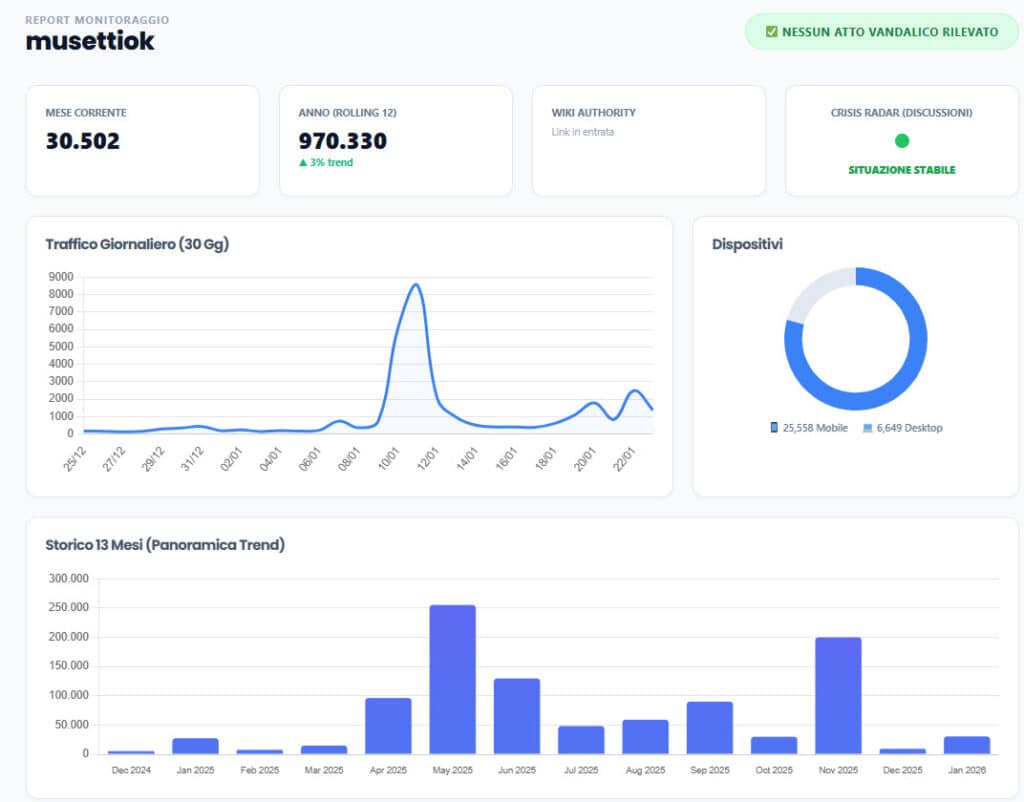
Our tool provides a specialized dashboard that tracks:
-
Vandalism Detection: Using pattern recognition to identify and alert you to malicious edits or unauthorized content changes the moment they occur.
-
Real-Time Edit Tracking: A granular log of every modification made to the entry, allowing for immediate assessment of whether an edit aligns with the brand’s factual history.
-
Traffic & Visibility Analytics: Detailed insights into page views and visitor trends, helping you understand the real-world impact of your encyclopedic presence on your digital authority.
-
Health Status Monitoring: A continuous “integrity check” of the page’s status within the community (tags, warnings, or new discussion threads), ensuring the entry remains stable and compliant with the latest community standards.
By automating the surveillance of these critical KPIs, we ensure that your Wikipedia entry remains a protected and accurate asset, mitigating the risks of neglect and external interference.
