
Table of contents 20 sections
- What ChatGPT Ads is and why it isn’t a search channel
- Inventory: who sees the ads and where they appear
- Anatomy of the ad unit
- How matching works: from keywords to context signals
- Context hints: the real targeting tool
- Account structure: campaign, ad group, ad
- Buying models: CPM, CPC, oCPC, budget and pacing
- Available targeting and custom audiences
- Creative: how to write an ad that delivers
- Product feed campaigns for e-commerce
- Measurement stack: oppref, pixel, Conversions API
- Technical prerequisite: access for OpenAI crawlers
- What we learned testing the US market
- 90-day activation roadmap
- Seven mistakes that burn your budget
- ChatGPT Ads, Google Ads and Meta Ads compared
- Why ads and organic AI visibility reinforce each other
- ChatGPT Ads: what’s new in conversions, integrations and Sponsored Agents
- FAQ
- Want to know if ChatGPT Ads makes sense for your company?
Platform architecture, contextual matching logic, auction models, measurement stack and a 90-day activation roadmap. A technical guide written after months of testing on the US market, updated for the Italian launch.
In short
- Ads on ChatGPT have been live in Italy since August 24, 2026; self-service access through OpenAI Ads Manager is open to companies with a registered office in Italy.
- Targeting isn’t keyword-based: the system evaluates the conversation’s context and intent, the creative, the landing page and the context hints declared by the advertiser.
- It’s bought on CPM, CPC or oCPC in a second-price auction weighted by relevance. Minimum daily budget for euro accounts: 15 €.
- The landing page is a ranking signal, not a passive container: if OpenAI’s ad crawlers can’t reach it, the campaign won’t deliver.
- Measurement requires the OpenAI Pixel and/or Conversions API, the click parameter
opprefand deduplication byevent_id. Without this layer, conversion optimization is impractical.
Contents
- What ChatGPT Ads is and why it isn’t a search channel
- Inventory: who sees the ads and where they appear
- Anatomy of the ad unit
- How matching works: from keywords to context signals
- Context hints: the real targeting tool
- Account structure: campaign, ad group, ad
- Buying models: CPM, CPC, oCPC, budget and pacing
- Available targeting and custom audiences
- Creative: how to write an ad that delivers
- Product feed campaigns for e-commerce
- Measurement stack: oppref, pixel, Conversions API
- Technical prerequisite: access for OpenAI crawlers
- What we learned testing the US market
- 90-day activation roadmap
- Seven mistakes that burn your budget
- ChatGPT Ads, Google Ads and Meta Ads compared
- Why ads and organic AI visibility reinforce each other
- FAQ
What ChatGPT Ads is and why it isn’t a search channel
ChatGPT Ads is OpenAI’s advertising platform, which places sponsored units at the end of the assistant’s generated answers. It started as a US test in February 2026, opened to self-service on May 5, 2026 and reached Europe on August 24, 2026 with a simultaneous rollout across 31 markets, Italy included. In just over seven months it went from a single-market experiment to an international channel present in about forty countries.
The temptation, for those coming from Google Ads, is to treat it like a new search engine to cover with the same keyword lists. It’s the most expensive mistake you can make, because the underlying paradigm is different in three structural ways.
First: there’s no query. The user doesn’t type a string into a search bar, they hold a conversation. The unit of meaning isn’t the keyword but the thread, with its progression from exploration to comparison to decision. The ad system reads that movement, not an isolated term.
Second: there’s no SERP. There’s no results page with positions to climb, but a single answer followed, when relevance justifies it, by one or more sponsored units. The competition isn’t for position, it’s for eligibility.
Third: the advertiser doesn’t buy the answer. OpenAI states the principle of answer independence: the ad system runs on infrastructure separate from the conversational model and no advertiser can change, reorder or influence what ChatGPT writes. Paying for a campaign doesn’t mean buying a citation in the generated text. Anyone selling the opposite is selling something that doesn’t exist.
This leads to something counterintuitive: ChatGPT Ads is a high-intent but low-control channel. Intent is high because the conversation reaches the ad already loaded with context: a stated budget, constraints, alternatives already ruled out. Control is low because the advertiser doesn’t decide where it appears, they describe when it’s relevant and let the system evaluate it. It’s a logic closer to broad-match campaigns governed by signals than to exact-match campaigns.
Inventory: who sees the ads and where they appear
Before building a media plan you need to know precisely what audience you can reach. OpenAI’s documentation is explicit and the boundaries are clear.
Ads are shown to users on the Free and Go plans.
Ads are not shown to Plus, Pro, Business, Enterprise and Edu users, nor to accounts identified as belonging to minors under eighteen based on account information and age estimation systems. Temporary chats show no ads, and during the test phase the ChatGPT Atlas browser is excluded from inventory.
There’s also an Ads-Free option on the Free plan: users can opt out of ads by accepting lower message limits and reduced access to some tools. So a share of the audience excludes itself.
On brand safety, ads aren’t eligible near sensitive or regulated conversations: personal health, mental health, politics. Political advertising isn’t allowed. Some regulated verticals, such as healthcare and financial services, can only access the platform by meeting dedicated eligibility criteria.
Targeting implication. If your audience pays for Plus or Pro, meaning you sell to developers, senior knowledge workers or advanced technical profiles, ChatGPT Ads only shows you the tail of your market. The channel performs much better in broad consumer categories (retail, travel, home, education, personal services, general e-commerce) where the Free and Go base is large and cross-cutting. This needs checking before allocating budget, not after.
Anatomy of the ad unit
The format is single and deliberately limited in options: no video, no interactive expansion, no alternative format. A ChatGPT ad consists of six elements, all mandatory but one.
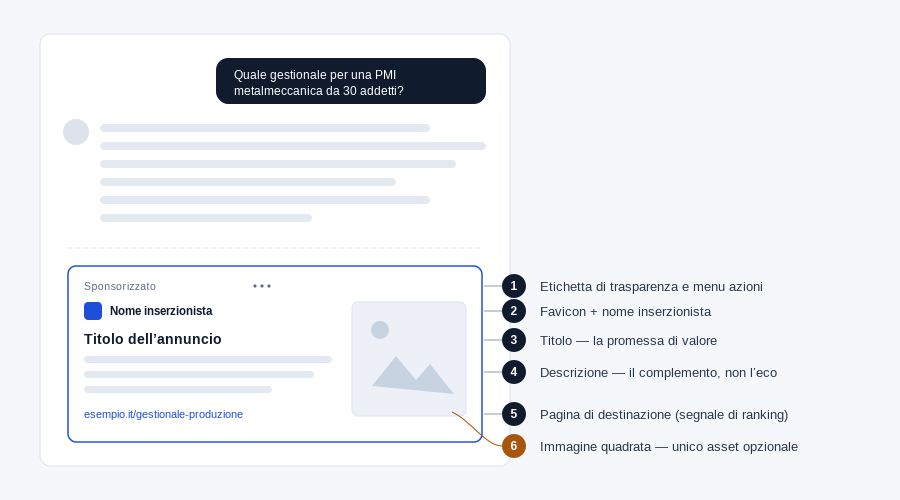
Because the format is rigid, all the competitive weight shifts to the semantic quality of the text. You don’t win with art direction, you win with precise copy and consistency between the ad and the landing page.
There’s also a suggested draft feature: Ads Manager can prefill an ad by reading the website’s metadata. It’s a setup accelerator, not a creative generator: it doesn’t produce new copy or images, it reuses what it finds. It’s worth using as a starting point to rewrite, never as final output.
How matching works: from keywords to context signals
This is the part that really matters, and where most guides stop at the surface. The selection system evaluates expected relevance and expected outcome by combining several signals, then puts eligible ads in competition in an auction.
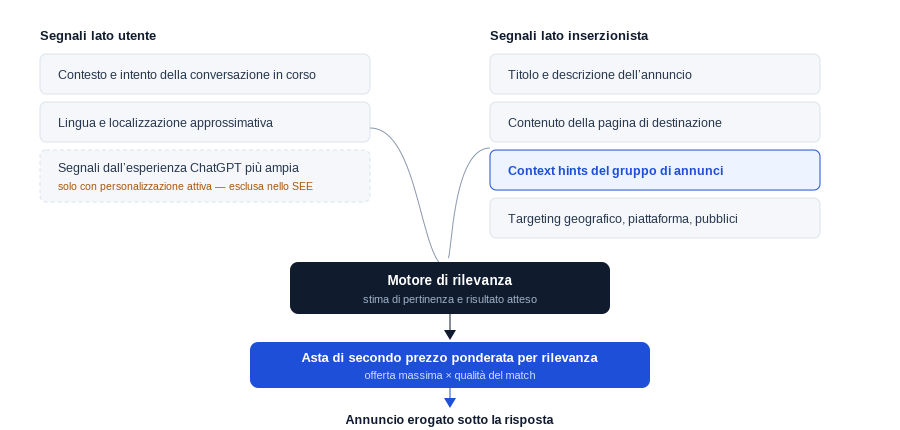
Three operational consequences follow directly from this model.
Relevance is a cost lever. The auction is second-price and weighted by relevance: you can win while spending less than a competitor if the match is better. It’s the same principle as Quality Score in search, applied to a semantic evaluation of the thread rather than a lexical match. Those who work on relevance lower their average CPC; those who only work on the bid buy volume at full price.
The landing page enters the calculation before the click. It’s not a bottom-of-funnel detail: it’s one of the signals that decide whether the ad is eligible and at what price. Pointing everything to the homepage means handing the system a generic signal and paying for it in delivery. The operating rule is to point to the most specific destination available: product page, category, vertical content.
In the European Economic Area, personalization isn’t available. At launch, ads in Europe and Switzerland are selected based on the current conversation’s context plus coarse signals like language and approximate location, without using history, memory or ad history. For an Italian advertiser this means one thing: match quality depends almost entirely on what you declare in the ad group and what you publish on the landing page. There’s no historical profile to make up for a sloppy setup.
Context hints: the real targeting tool
I context hints are natural-language phrases, set at the ad group level, that describe what the product offers, who it’s for and when it’s useful. They’re the functional equivalent of keywords, but with a completely different grammar: they aren’t exact matches, they aren’t targeting rules and they don’t guarantee delivery on specific conversations. They’re a semantic clarification that helps the system understand where your ad makes sense.
The difference between a weak hint and a strong one is the difference between a category label and the description of a situation. A weak hint names the product. A strong hint names the moment of need.
| Industry | Weak hint (avoid) | Effective hint |
|---|---|---|
| Management software | business management software | production scheduling software for machine shops with mixed batches and non-standard orders |
| Solar | solar panel systems | people evaluating a system with storage on an industrial building who want to understand payback time and available incentives |
| Home services | renovations | people who need to redo a bathroom in an occupied apartment and are looking for a contractor to handle everything turnkey in two weeks |
| Training | marketing courses | professionals who want to get certified in data analysis without leaving their job, with recorded evening classes |
| Food e-commerce | coffee online | people who just bought a lever espresso machine and are looking for single-origin blends suited to manual extraction |
Writing rules that work
- Add information, don’t repeat it. A hint that rephrases the ad headline is noise. It has to tell the system something it doesn’t already get from the creative and landing page.
- Describe needs, not audience labels. “Purchasing managers” is a label. “Someone who needs to replace a supplier that misses delivery deadlines” is a need.
- Cover real lexical variants. People describe the same problem with different words. Hints help the system recognize those variations: you don’t need to guess the exact words.
- One theme per ad group. If the hints start describing products or use cases that would require different messages and landing pages, the group should be split in two.
- Only genuine use cases. Stretching hints to contexts where the product doesn’t fit generates irrelevant impressions, low CTR and a worse relevance assessment. It’s cumulative damage, not a test.
A recurring mistake. Pasting your Google Ads keyword export into the hints field. The field also accepts lists of terms, but a list of disconnected keywords is exactly the least informative signal you can give a system that reasons by meaning. You get broad, poorly qualified delivery, which is the fastest way to conclude that “the channel doesn’t work”.
Account structure: campaign, ad group, ad
The hierarchy has three levels and follows familiar conventions, but the distribution of levers is different from what you’re used to: semantic targeting lives in the middle, not at the top.
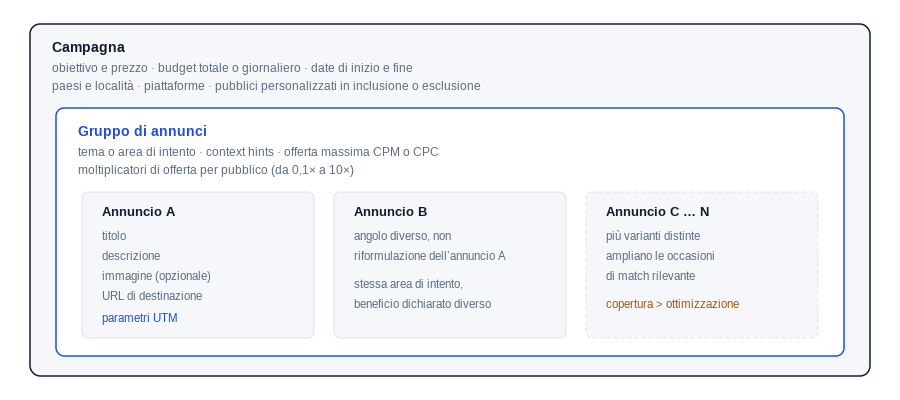
Two practical notes on naming and architecture. First: the campaign objective can’t be changed after creation, because it determines pricing and optimization; to change it you need a new campaign. Second: some budget type changes are also irreversible: once you switch from a lifetime budget to a daily budget, there’s no going back. It’s best to decide the structure on paper before opening the platform, not discover it by trial and error.
Buying models: CPM, CPC, oCPC, budget and pacing
The campaign objective determines both the pricing model and the delivery optimization logic.
| CPM | CPC | oCPC | |
|---|---|---|---|
| Definition | Cost per thousand impressions | Cost per click | Cost per click optimized for conversion |
| Marketing objective | Scale, reach, awareness | Engagement and traffic | Post-click actions |
| You pay | Per thousand impressions | Per valid click | Per valid click, not per conversion |
| Optimization | Broad delivery | Clicks from users likely to engage | Clicks more likely to generate the target event |
| Prerequisite | None | None | A configured conversion event and sufficient event volume |
The maximum bid is set at the ad group level. For click campaigns, OpenAI suggests a starting maximum of $3–5 per click; for reach campaigns the default maximum is $60 CPM. These are starting thresholds in an auction, not prices: the actual cost is set by competition and is lower the more relevant the match. Ads Manager also gives an indication of bid strength, useful to see whether a bid risks limiting delivery.
Lifetime budget or daily budget
A lifetime budget is the strictest control over total spend. A daily budget, by contrast, is an average target over a seven-day window: spend on a single day can fluctuate, capped at twice the set daily amount, with an overall cap of seven times the amount over the period. For a first test the daily budget is the better choice, because it lets you read delivery without committing the entire allocation.
The minimum daily budget depends on the billing currency. For euro accounts it’s €15 a day: about €450 a month per campaign, which is the real entry threshold to plan for.
A note on cost benchmarks. The average CPMs and CPCs circulating in market analyses come from the US phase and from unofficial samples. They indicate direction (the opening of self-service broadened the advertiser base and redistributed costs) but shouldn’t be used as the basis for an Italian media plan. In a market that opened only a few weeks ago, with still-low competitive density in many verticals, the only benchmark that counts is the one you build with two weeks of real delivery.
Available targeting and custom audiences
Beyond semantic signals, the platform offers deterministic controls. There are few, but the ones available should be used well.
Geography
Geographic targeting is set at the campaign level. Country level is supported and, where available, finer levels like region, city, market area and postal code; availability varies by market and can be checked in the selector during setup or by downloading the locations catalog. For a company operating within a single province, it’s the lever that separates a sustainable test from waste.
Platform
You can limit delivery to iOS, Android or Web, where Web includes desktop and mobile web. Useful when conversion depends on the usage context: a B2B quote filled in on a long form performs on desktop, a service with instant booking performs on mobile.
Custom audiences
This is the tool closest to remarketing, but with purely first-party logic: you upload customer or prospect lists via email addresses, phone numbers in E.164 format, values already hashed with SHA-256 or Google advertising IDs. There are three intended uses:
- Inclusion at the campaign level: delivers only to the selected audiences. Requires at least 25,000 matched users, with a recommended threshold of 100,000.
- Exclusion at the campaign level: excludes existing customers or recent buyers. Available even below the 25,000 threshold.
- Bid multiplier at the ad group level: raises or lowers the maximum bid when the user belongs to a selected audience, with values from 0,1× a 10×. It doesn’t change eligibility, it changes aggressiveness.
Uploaded files are deleted after processing, usually within twenty-four hours, and processing generally takes twenty to thirty minutes. Before uploading any list, check the legal basis for processing and that the necessary consents are in place: that’s the advertiser’s obligation, not the platform’s.
A size constraint to keep in mind. The 25,000 matched users threshold for inclusion rules out most Italian SMB databases. For these businesses, custom audiences remain usable for exclusion (avoiding buying back people who are already customers), which is still an immediate efficiency gain on the budget.
Creative: how to write an ad that delivers
ChatGPT Ads’ creative logic rewards something that in classic search is almost a flaw: coverage. A high number of distinct variants for the same offer increases the chances the system finds a relevant hook in a conversation. It’s not about A/B tests on micro-differences, it’s about covering different value angles.
Title
It must make immediately clear what you offer and why it’s useful. Concrete beats evocative: a verifiable benefit, a constraint solved, a qualifying spec. “Quote in 24 hours” communicates; “The quality you deserve” communicates nothing the system can map to a need.
Description
It must complete the headline, not rephrase it. If the headline states the benefit, the description brings the proof: a feature, a usage condition, an element that reduces decision friction. Repetition is the most common waste in the setups we see.
Image
A square asset, optional but recommended. Simple, readable at small sizes, consistent with the message. Abstract visuals, crowded compositions or generic stock images hurt the perceived consistency between creative and offer.
Landing page
It must be the most specific available, technically reachable and consistent with the ad. UTM parameters should be added directly to the destination URL of each creative: they persist on click and let you read the source in the analytics tools you already use.
The constraint that comes before all others
Creative, image and landing page must comply with OpenAI’s advertising policies. Ads that are misleading, inconsistent with each other or contain disallowed content are rejected in review. It’s worth reading the policies before producing thirty variants, not after the first rejection.
Product feed campaigns for e-commerce
For those with a large catalog or one that changes frequently, there’s a dedicated campaign type fed by a product feed. OpenAI notes that feed-generated ads are among the best-performing formats on the platform, which has a structural explanation: structured, up-to-date data produces more relevant matches than a static, hand-written creative can.
The operational flow is linear:
- Create the feed in Ads Manager, in the Tools section.
- Import products via CSV or TXT upload, hosted URL or SFTP connection. Items expire after two weeks, so manual upload is only suitable for testing: in production you need a hosted URL or SFTP automation.
- Feed validation and processing, with a check of the upload history.
- Create a product feed campaign.
- Create the ad group with filters on eligible products. When native filters aren’t enough, use the
ads_metadatafield in the feed to create your own groupings, for example price tiers or product lines. - Define the ad template, which currently lets you choose the image field, and check the preview.
Feed ads use a format designed for catalogs, with image, title, ratings, price, sale price and brand. During the beta, feed products are eligible for advertising only and don’t appear in ChatGPT’s organic conversations.
Good news for those who already use Google Merchant Center. The feed infrastructure that powers Shopping (title normalization, availability, prices, images) is largely reusable. So the entry cost on ChatGPT Ads for an already structured e-commerce store is much lower than it seems: it’s a matter of remapping, not rebuilding.
Measurement stack: oppref, pixel, Conversions API
This is the section that separates those who’ll do performance from those who’ll do branding without knowing it. Ads Manager’s native reporting shows impressions, clicks, spend, CTR, average CPC, average CPM and conversions. The first six metrics come on their own; the last one has to be built.
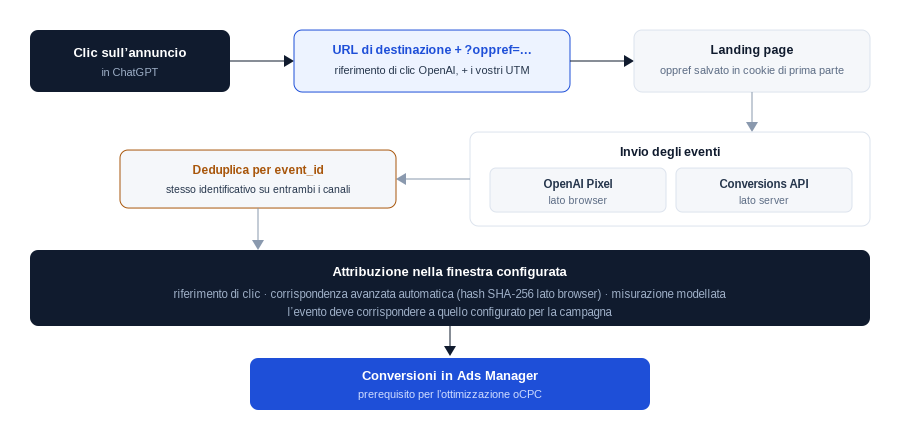
oppref lost in redirects, an event sent at the wrong moment, a different event ID between pixel and API resulting in double counting.The click reference
OpenAI appends a parameter called opprefto the destination URL. The pixel captures it and stores it in a first-party cookie so it can be associated with later events. When available, it should also be included in server-to-server calls. If a redirect chain strips the query string, attribution breaks. It’s the first check to run on any website that uses tracking redirects, aggressive consent managers or platforms that normalize URLs.
Pixel and Conversions API together
A robust setup uses both channels. The same event sent from browser and server must be marked with the same event ID, so the system can deduplicate it. It’s the same logic already familiar to anyone managing Meta CAPI, and it should be designed together with development, not added afterward.
Advanced matching and modeled measurement
Automatic advanced matching detects supported customer information from the website’s forms, normalizes it and hashes it with SHA-256 in the browser before sending: raw data never reaches OpenAI. Where available, modeled measurement estimates the attribution of conversions that would otherwise be unattributed. It follows that the reported conversion total may include an estimated component, something to disclose when presenting a report to a client or management.
Why the numbers will never match Analytics
Differences between Ads Manager, your analytics platform and other ad channels are normal: different attribution models and windows, time zones and date boundaries, consent and browser storage conditions, different deduplication logic, the modeled component. A discrepancy isn’t an error. It needs to be planned into reporting governance, with a source of truth declared in advance.
Note. Conversion events should only be sent after providing a clear, complete privacy notice and collecting the consents required by applicable law. On an Italian website this means the pixel configuration must depend on the consent collected by the CMP, exactly as with other advertising tools.
Technical prerequisite: access for OpenAI crawlers
This point sits halfway between technical SEO and advertising, and in Italy it’s the number one cause of campaigns that don’t start. Landing pages must be valid, reachable and must not block OpenAI’s user agents, in particular OAI-AdsBot and OAI-SearchBot.
Over the last two years many Italian websites have adopted restrictive rules against AI crawlers: blocks in robots.txt, WAF or CDN-level rules, bot protection on Cloudflare, geographic restrictions. These are legitimate choices, but they were made in a context where the only thing at stake was model training. Today those same rules prevent your own paid campaigns from delivering.
The minimum check to run before any investment:
- Check
robots.txtfor directives involving OpenAI user agents. - Check WAF, CDN and anti-bot rules that filter by user agent or ASN.
- Check that landing pages respond
200without intermediate redirects that strip the query string. - Check that the relevant content is present in the served HTML, not only after client-side rendering.
- Check that any geographic blocks don’t exclude the network ranges used by the crawlers.
It’s a half-hour checklist that saves weeks of diagnosing a campaign that “isn’t spending”.
What we learned testing the US market
We started working on ChatGPT Ads during the US phase, before the channel was announced for Europe. The reason was simple: when a new channel opens, the competitive advantage lasts as long as the learning window, and that window closes the moment the local market discovers it. Testing outside your own market lets you make mistakes where they’re cheap and arrive at the domestic launch with a method, not a hypothesis.
Here are the five findings that best stood the test of reality and that now guide our Italian setups.
1. Structure matters more than the bid
The best-performing accounts weren’t those with the highest bids, but those with the most thematic granularity in their ad groups. On an engine that evaluates semantic relevance, splitting a generic group into four thematic groups produces a more solid improvement than any bid tweak, because it improves the input signal instead of buying more exposure.
2. The landing page is half of targeting
Moving the destination from the homepage to a vertical page consistent with the hints changed delivery in a clear, repeatable way. Those with deep content structures (service pages, use-case pages, vertical informational content) start with a structural advantage over those with a six-page brochure website.
3. Creative coverage beats early optimization
Launching a few creatives and optimizing them early is counterproductive. The system needs semantic surface area to find hooks: many genuinely different variants widen the chances of a match. Optimization makes sense later, when the data shows which angles hold up.
4. Measurement must be built before, not after
The difference between accounts that produced a readable ROAS and those that stayed in a fog of clicks was almost always the same: pixel and Conversions API configured and verified before before the first euro was spent. Those who postponed lost the first three or four weeks of data, which are exactly the ones you need to decide whether to scale.
5. Audience qualification happens upstream
The channel doesn’t offer demographic targeting. Qualification therefore happens in the copy: the headline and description act as a filter. Explicitly stating who the product is not for (minimum project size, company size, area served) cuts useless clicks more than any platform setting.
An honest warning: the European market isn’t the American market. In the European Economic Area personalization isn’t available at launch, competitive density is still low and the inventory mix is different. The method transfers, the benchmarks don’t. Anyone offering you an Italian media plan today based on average US costs is selling you an extrapolation.
90-day activation roadmap
This is the sequence we apply on projects being launched. It’s not a list of good intentions: each phase has an exit criterion, and we don’t move to the next until that criterion is met.
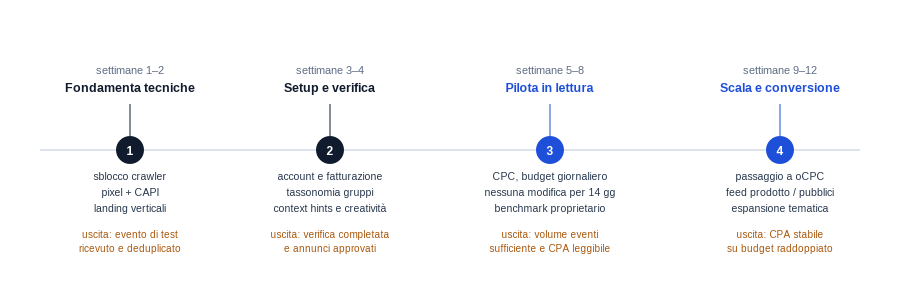
Phase 1 — Technical foundations (weeks 1–2)
- Crawler access audit:
robots.txt, WAF, CDN, anti-bot protection, geographic blocks. - Implementing the OpenAI Pixel and Conversions API, with a shared event ID for deduplication.
- Checking that
opprefpersists through all redirects and consent managers. - Mapping real conversion events: the completed action, not the button click. A failed form submission isn’t a lead.
- Selecting or creating vertical landing pages, one per intent area.
- Aligning the CMP: the pixel must only fire with valid consent.
Exit criterion: a test event is received, attributed and deduplicated correctly.
Phase 2 — Account setup and verification (weeks 3–4)
- Opening the Ads Manager account with the correct legal entity and completing business verification, which takes a few days.
- Setting up billing and payment method: without this step campaigns won’t deliver.
- Designing the taxonomy: one campaign per business goal, ad groups by intent area.
- Writing context hints following situational, not categorical, logic.
- Producing creative for coverage: at least four to six genuinely distinct variants per group.
- Checking compliance with advertising policies in advance.
Exit criterion: account verification completed, ads approved in review, campaign in deliverable status.
Phase 3 — Reading pilot (weeks 5–8)
- CPC objective, daily budget, initial maximum bid in the recommended range.
- Geographic coverage consistent with the company’s real area of operation.
- No structural changes for the first fourteen days. Every change resets the reading.
- Weekly reading of CTR, average CPC versus maximum bid, conversion rate by group.
- Building your own benchmark: it’s the only number worth anything in a market that opened just a few weeks ago.
Exit criterion: enough event volume for a non-anecdotal CPA reading.
Phase 4 — Scale and conversion optimization (weeks 9–12)
- Switching to oCPC on campaigns with enough events, remembering that the objective can’t be changed: you need a new campaign.
- Activating the product feed for e-commerce, with a hosted URL or SFTP.
- Introducing custom audiences, typically as exclusions for SMBs and as inclusions where thresholds are met.
- Thematic expansion: new ad groups on intent areas the data shows as relevant.
- Consolidating reporting governance, with explicit disclosure of the modeled component.
Exit criterion: Stable CPA with a doubled budget. If CPA degrades linearly with spend, the channel has a ceiling and should be sized accordingly.
Seven mistakes that burn your budget
- Importing Google Ads keywords into context hints. Lists of disconnected terms are the least informative signal possible for a semantic engine.
- Pointing to the homepage. The landing page enters the relevance calculation before the click: a generic homepage worsens delivery and cost.
- Launching without measurement. Without pixel and Conversions API you buy clicks in the dark and lose the weeks of data you need to decide.
- Blocking OpenAI crawlers without knowing it. Defensive rules introduced against training now prevent your own paid campaigns from delivering.
- Making changes every two days. The system needs a learning window; constant changes make any result unreadable.
- Producing three nearly identical creatives. Covering different angles is a delivery lever, not an A/B testing quirk.
- Applying US benchmarks to the Italian market. Competitive density, personalization availability and inventory mix are different.
ChatGPT Ads, Google Ads and Meta Ads compared
| Dimension | ChatGPT Ads | Google Ads (Search) | Meta Ads |
|---|---|---|---|
| Targeting unit | Thread context and intent | Query and keyword match | Interests, behaviors, audiences |
| User intent | High, often in the evaluation phase | High, declared | Low, interruptive |
| Advertiser control | Low: you describe relevance | High: you control the match | Medium: you control the audience |
| Demographic targeting | Not available | Available | Advanced |
| Behavioral retargeting | Not available | Available | Available |
| Audiences from first-party lists | Yes, with a 25,000-match threshold for inclusion | Yes | Yes |
| Formats | One: headline, description, image | Multiple | Multiple, including video |
| Buying models | CPM, CPC, oCPC | CPC, CPA, ROAS, CPM | CPM, CPC, event optimizations |
| Platform maturity | Beta, weekly changes | Mature | Mature |
| Competitive density in Italy | Low | High | High |
The right reading isn’t “ChatGPT Ads replaces Google Ads”. It’s that the channel occupies a position that’s currently uncovered: high intent in an assisted evaluation phase, meaning the moment the user is narrowing down options with the help of an assistant and hasn’t yet formulated a commercial query. In the buying journey it’s the space between informational and transactional search, historically the territory of content, not advertising.
The row that deserves the most attention in an Italian media plan is the last one. Low competitive density means low learning costs. It’s a condition that closes on its own, and it won’t take years.
Why ads and organic AI visibility reinforce each other
Something almost always missed in analyses of the channel: the same content assets that make a website citable by assistants also make it a good advertiser on ChatGPT Ads. Not by lucky coincidence, but because the two systems evaluate similar signals.
An ad’s relevance depends on the landing page. A brand’s citability in generated answers depends on having vertical, structured, technically accessible content. Those who have worked on a deep information structure (use-case pages, content that answers real questions, consistent semantic markup, crawler accessibility) have already built the raw material the ad system uses to assess relevance.
This leads to the only strategic recommendation in this guide: don’t treat ChatGPT Ads as a budget line separate from organic visibility on assistants. They’re two outputs of the same investment. A technical audit that unblocks crawlers serves both. A well-written vertical page serves both. A clean product feed serves both. Those who manage them together pay for one infrastructure and monetize it twice; those who keep them separate pay twice for the same work.
Update of September 16, 2026
ChatGPT Ads: what’s new in conversions, integrations and Sponsored Agents
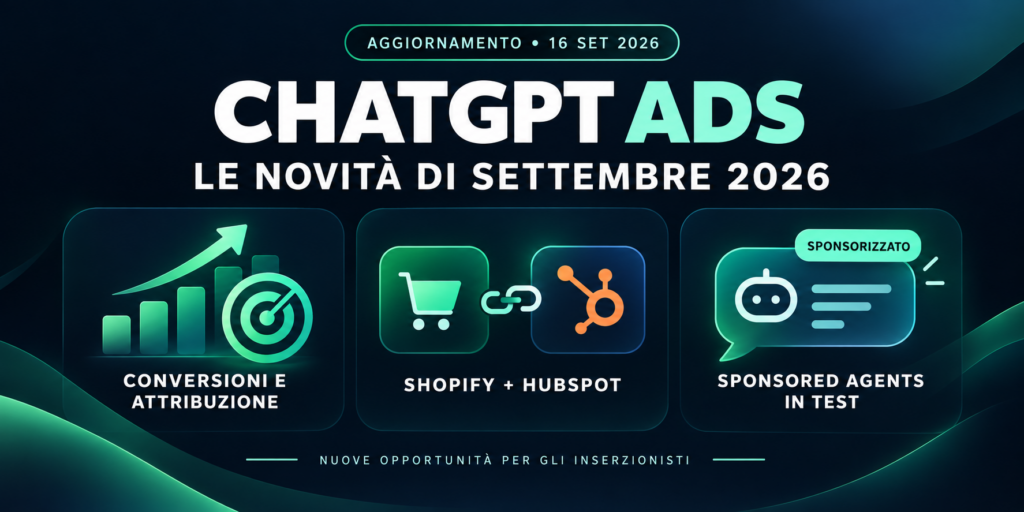
ChatGPT Ads is evolving beyond simply serving ads: the updates communicated to advertisers cover conversion optimization, measurement options, platform targeting, integrations with Shopify and HubSpot and new conversational formats being tested. Here’s what’s changing and which features are still in testing.
1. Conversion campaigns billed on impressions (oCPM)
OpenAI announced the general availability of campaigns that optimize ad delivery toward a conversion event, considering signals following both clicks and views. You pay for impressions delivered, not for conversions obtained. Compared to oCPC, which is billed on clicks, oCPM broadens the signals used for optimization.
Check availability: in the communication to advertisers oCPM is described as generally available, but as of September 16, 2026 the OpenAI Help Center still lists it as beta, with access expanding. Check the options actually present in your Ads Manager before planning a campaign.
2. Customizable attribution windows
In the Ads Manager columns you can select a post-click window of 7, 14 or 30 days and a post-view window of 0 or 1 day. The preferences apply to the conversion columns displayed. To compare results across campaigns, use consistent windows and distinguish post-click from post-view conversions when the report shows them separately.
3. Targeting and reporting for five platforms
Campaigns can distinguish Android app, Android web, desktop web, iOS app and iOS web. The same breakdown is available in performance insights. This lets you see differences between environments without treating all mobile traffic as a single segment. Learn more about targeting options in OpenAI’s guide.
4. Connections with Shopify and HubSpot
For US-based Shopify merchants, the ChatGPT Ads app lets you connect your product catalog and measurement tools, create campaigns and track their performance. The newsletter announces an international expansion, but that’s not confirmation of immediate availability in Italy: check the Shopify App Store and your account.
With HubSpot companies can connect their ChatGPT Ads account, create campaigns, analyze performance and connect results to contacts and sales opportunities. HubSpot’s documentation also covers tracking via UTM parameters. See HubSpot’s official guide.
5. AI creative and text personalization: two distinct features
AI-assisted creation: OpenAI is testing copy and image suggestions based on the landing page and campaign objective. Advertisers can review and edit the suggestions before using them; it hasn’t yet been announced as available to everyone.
Text personalization: an advertiser-enabled option is planned to adapt existing headlines and descriptions to the conversation context and translate copy into the user’s preferred language. It doesn’t mean letting ads change ChatGPT’s answers: OpenAI describes ads and answers as separate.
6. Event Quality Score: a check on event quality
Under Ads Manager → Tools → Conversions Event Quality Score is available for eligible Pixel and Conversions API data sources. The score from 1 a 10 assesses setup quality and user data coverage, showing suggestions to improve the implementation. It’s an indicator of setup quality, not a rating of campaign performance. For technical details, see the conversion measurement guide.
7. Sponsored Agents: sponsored conversations after the click
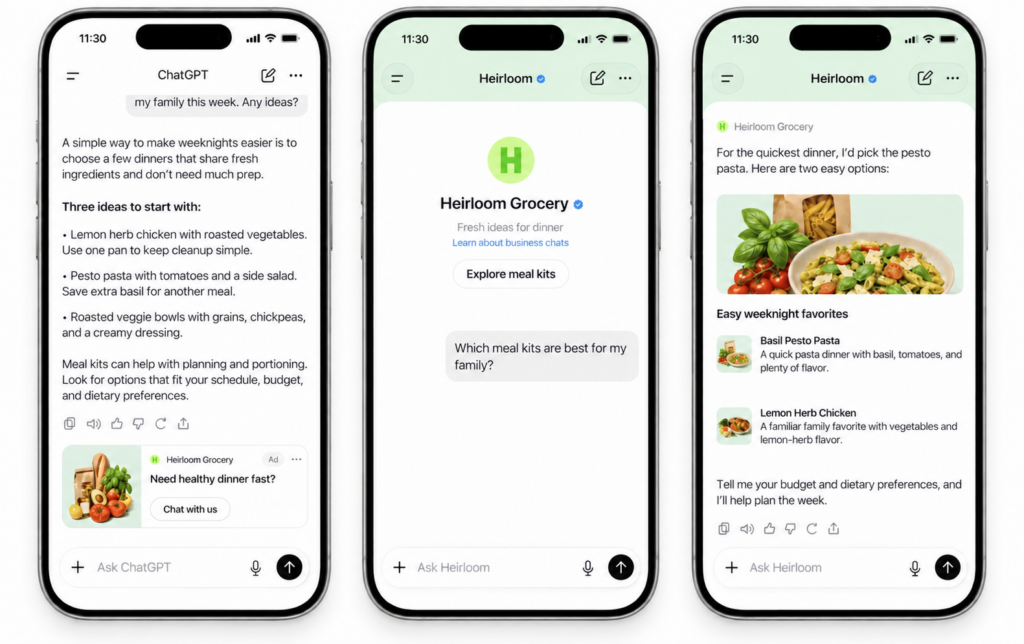
OpenAI is testing Sponsored Agents with a selected group of advertisers in the United States. After clicking an ad in ChatGPT, some people can start a conversation clearly labeled as sponsored with an agent connected to the company, to ask questions, explore alternatives and learn more about products. It’s a limited test, not a universally available feature.
What to check before launching a campaign
Check which objectives and integrations are available in your country and account, set up the Pixel or Conversions API correctly, define the conversion event and compare reports using consistent attribution windows. For oCPM, monitor impressions, CPM, volume and cost per conversion: optimizing for conversions doesn’t mean billing per conversion.
Sources and context: Features in beta, in testing or not yet available on the Italian market are listed separately.
FAQ
Is ChatGPT Ads available in Italy?
Yes. Ads have been live for Italian users since August 24, 2026, and self-service access through OpenAI Ads Manager is available to companies with a registered office in Italy. The platform is in beta: features and availability change weekly, so it’s best to check the current status before planning.
Do ads influence ChatGPT’s answers?
No. The ad system runs on infrastructure separate from the conversational model. Advertisers can’t change, reorder or influence the answers. The ad appears after the end of the answer, labeled as sponsored content. An ad isn’t an endorsement: a brand’s presence doesn’t imply OpenAI recommends it.
Who sees the ads?
Users on the Free and Go plans. Plus, Pro, Business, Enterprise and Edu users don’t see ads, nor do accounts identified as belonging to minors under eighteen. Temporary chats show no ads and, during the test, the Atlas browser is excluded.
How much does advertising on ChatGPT cost?
There’s no price list. The price is set in a second-price auction weighted by relevance. You set a maximum bid at the ad group level: $3–5 as the recommended starting point for click campaigns, $60 CPM as the default maximum for reach campaigns. The minimum daily budget for accounts billed in euros is €15.
Can I use my Google Ads keywords?
Technically the context hints field also accepts lists of terms, but it’s the worst possible use of the tool. Hints should describe situations, needs and moments of use: they’re a semantic clarification, not a match. A keyword list produces broad, poorly qualified delivery.
Is retargeting possible?
Classic behavioral retargeting isn’t available. There are custom audiences built from first-party lists, usable as inclusions with at least 25,000 matched users, as exclusions even below that threshold, and as a bid multiplier from 0.1× to 10× at the ad group level.
How long does it take to launch a campaign?
Business account verification takes a few days, and campaigns don’t deliver until verification, billing and ad review are complete. On a well-prepared project, it usually takes three to four weeks from decision to first delivery, most of which is spent on measurement and landing pages.
Does it make sense for a B2B SMB?
It depends on your audience profile. If your contacts mostly use paid plans, the reachable audience shrinks. If instead you reach people who use the free version of ChatGPT to find suppliers, technologies or solutions, the channel works, provided you qualify the audience in the copy, since demographic targeting doesn’t exist.
Why isn’t my campaign spending?
The most frequent causes, in order: incomplete account verification or billing, ads still in review, campaign dates that don’t include the current day, a maximum bid too low to compete, a landing page unreachable by OpenAI crawlers. The last is the most insidious because it doesn’t generate a visible error on the platform.
Want to know if ChatGPT Ads makes sense for your company?
We don’t start from the budget, we start from the prerequisites. In two weeks our assessment checks whether your website is technically able to deliver, whether your audience is within the reachable inventory and what event volume you need to make the channel readable. If the answer is no, we’ll tell you before you spend anything.

Marco Maltraversi
CEO and founder of YourDigitalWeb
He founded YourDigitalWeb in 2009 and is an SEO and GEO consultant with a background in software engineering. He has written books on SEO and artificial intelligence, including “Generative SEO” (Edizioni LSWR), teaches in university programs and runs the DeepSEO training program. He has spoken at SMAU, Web Marketing Festival and Search Tech.
One click and, when you search for SEO, AI and marketing, our articles will show up more often in Google’s Top Stories.