Table of contents 19 sections
- In short: the five things to know right away
- What the AI Act is and why it also concerns those who don’t develop AI
- Advertising and AI: do you always have to disclose that it was created with artificial intelligence?
- AI and GDPR: for e-commerce and campaigns, the real risk often lies in the data
- Digital Services Act: what advertisers need to know
- AI-personalized pricing: an opportunity that requires transparency
- AI and environmental claims: watch out for the greenwashing rules in force since September 2026
- Italian artificial intelligence law: what it adds to the AI Act
- Selling in the United States? You must comply with US laws too
- Does an e-commerce store have to comply with other digital regulations too?
- Benefits and risks of AI: an honest accounting
- How to prepare your company for the AI Act: an 8-step method
- Three real cases: how to decide
- Five questions to ask before publishing a campaign with AI
- Conclusion: the problem isn’t AI, it’s using it without rules
- How YourDigitalWeb can help
- Frequently asked questions on the AI Act, e-commerce and advertising
- Legal sources and further reading
- Important note: we’re not lawyers
Writing Google Ads ads with artificial intelligence, generating images for Meta, putting a chatbot on your website, personalizing e-commerce offers. In 2026 these are normal activities for a huge number of companies. Much less clear is what you can do, what needs to be disclosed and where the real risks lie.
The main reference is the AI Act, the European regulation on artificial intelligence, which has applied transparency obligations since August 2, 2026. But the AI Act doesn’t work alone. It intertwines with the GDPR, advertising rules, the Italian Consumer Code, the Digital Services Act, copyright law and, for those selling abroad, the laws of destination countries. In this guide we lay out what changes, with examples from day-to-day work on websites, e-commerce stores and campaigns. At the end of the main sections you’ll find a practical summary: if your company is in that situation, here’s what it should do.
A necessary disclaimer. YourDigitalWeb is a digital marketing, SEO and AI consulting agency, not a law firm. This article is meant to help you get your bearings and ask the right questions; it doesn’t replace legal advice. For compliance decisions, consult a lawyer or a qualified privacy consultant.
In short: the five things to know right away
- You don’t have to write “AI-generated” on every ad. Disclosure obligations mainly concern chatbots, deepfakes and some texts of public interest.
- The chatbot on your website must make clear to users that they’re talking to a machine and not a person.
- For an e-commerce store, the most frequent risk isn’t the generated image, but the use of customer data across cookies, pixels, CRM and AI tools.
- The postponement decided in July 2026 concerns high-risk systems. Transparency already applies.
- A misleading ad remains misleading even if you disclose that AI created it.
What the AI Act is and why it also concerns those who don’t develop AI
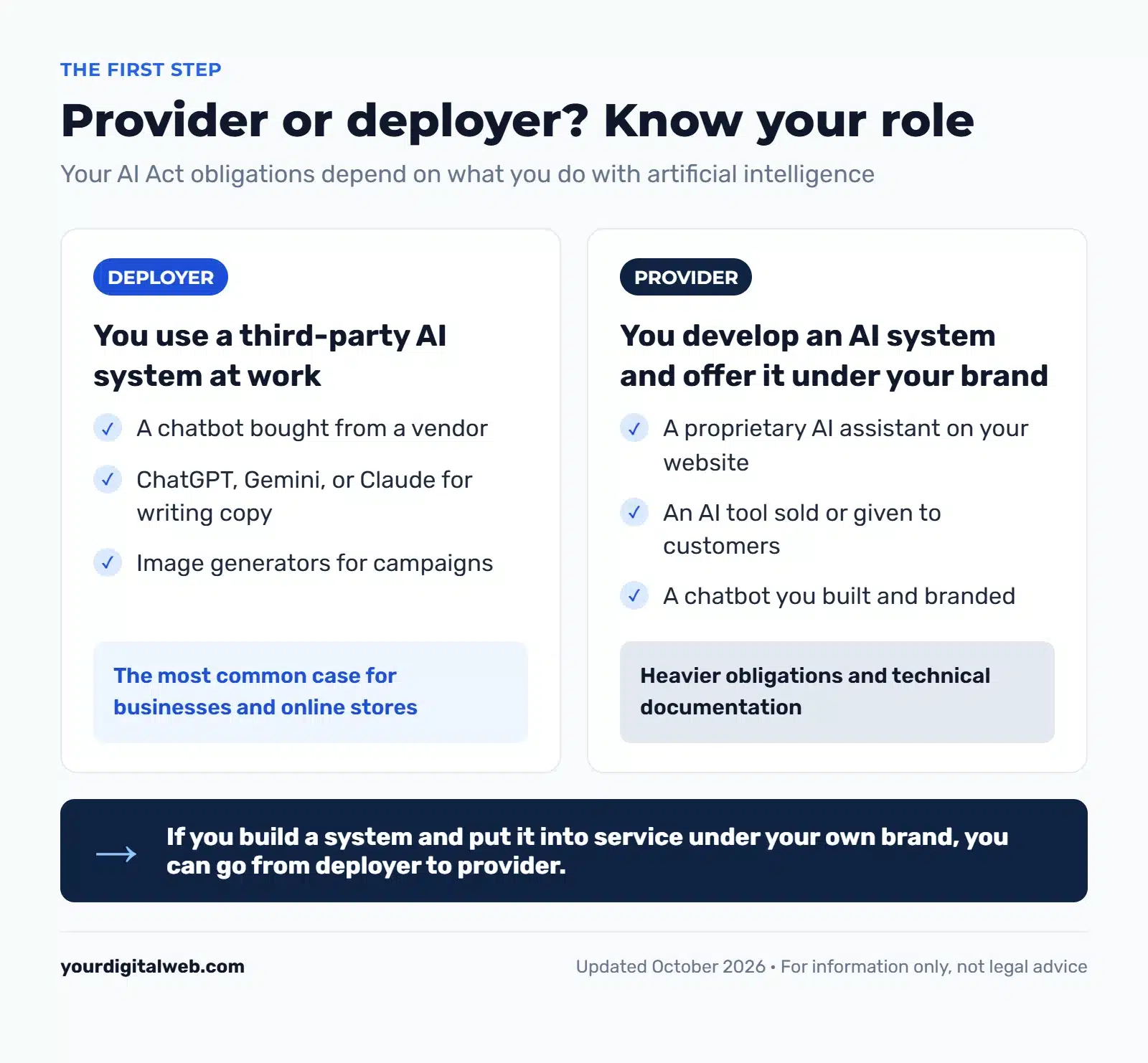
The AI Act is Regulation (EU) 2024/1689 and applies directly in all EU countries, Italy included. No transposing law is needed: the rules apply as written. Many think it only concerns OpenAI, Google or software houses. It doesn’t. The regulation distinguishes several roles, and at least two closely concern any company. The provideris whoever develops an AI system, or has it developed, and places it on the market or puts it into service under their own name or brand. The deployer is whoever uses an AI system under their own authority for professional activities. Alongside them are importers, distributors and authorized representatives. A concrete example. An e-commerce store that installs a chatbot bought from a vendor is, as a rule, a deployer. If the same store develops its own assistant and offers it under its brand, it can also become a provider, with heavier obligations. The same reasoning applies to agencies. When an agency produces creative with generative tools for a client, you need to understand who really controls the system and its use. The commercial contract alone doesn’t determine the legal qualification.
In practice: if your company uses ChatGPT, Gemini, Claude, an image generator or a third-party chatbot, you’re almost certainly a deployer. The first step is to list the tools you use and write down, for each one, who manages it and what it’s used for.
Deadlines updated to October 2026
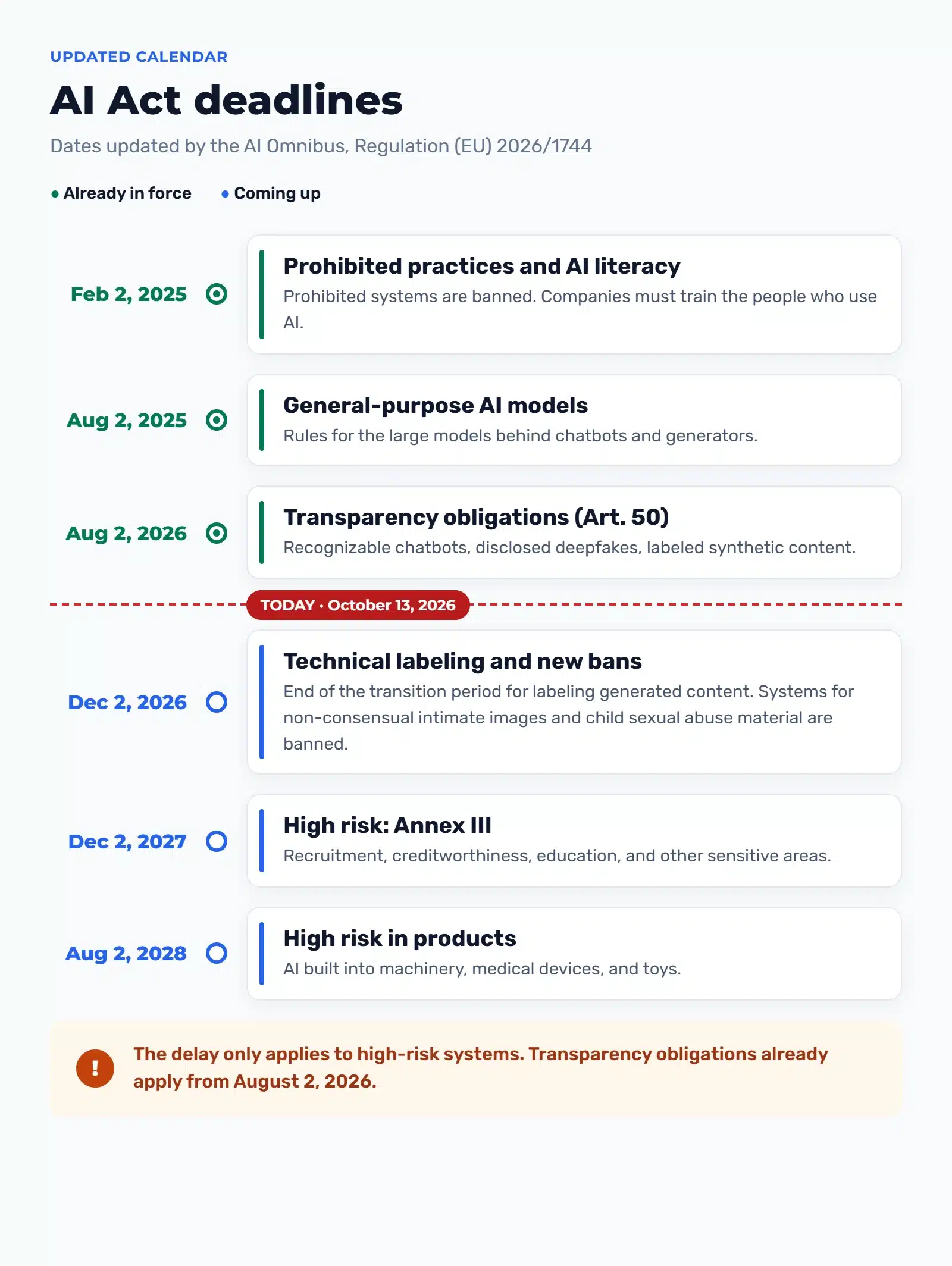
The original timeline was changed by Regulation (EU) 2026/1744, the so-called AI Omnibus, which entered into force on July 27, 2026. These are the dates that matter.
| Date | What applies |
|---|---|
| February 2, 2025 | Ban on prohibited AI practices and staff AI literacy obligation (Article 4) |
| August 2, 2025 | Rules on general-purpose AI models, like those behind the big chatbots |
| August 2, 2026 | Article 50 transparency obligations: chatbots, synthetic content, deepfakes |
| December 2, 2026 | End of the transition period for technical marking of content generated by systems already on the market before August 2, 2026. Two new bans introduced by the Omnibus also take effect, on systems that generate non-consensual intimate images and child sexual abuse material |
| December 2, 2027 | High-risk systems in Annex III, for example recruitment, creditworthiness assessment, education |
| August 2, 2028 | High-risk systems integrated into regulated products, such as machinery, medical devices and toys |
The postponement only concerns high risk. Transparency obligations were not postponed and apply from August 2, 2026.
The AI literacy obligation also remains in force. The Omnibus did, however, soften its wording: companies now need to adopt measures that support the skills of people using AI, without having to guarantee a specific level for every single person.
Advertising and AI: do you always have to disclose that it was created with artificial intelligence?
No, and it’s one of the most widespread misconceptions.Article 50 of the AI Act sets out specific obligations for specific situations: systems that interact with people, like chatbots; technical marking of synthetic content, which is the providers’ responsibility; emotion recognition and biometric categorization; deepfakes; certain texts published to inform the public on matters of public interest. In July 2026 the European Commission published the final guidelines on Article 50, alongside a voluntary Code of Practice on marking and labeling generated content. These documents aren’t binding, but today they’re the most authoritative reference for interpreting the rule. Nowhere does the law say that every sentence written with ChatGPT or every retouched photo must carry the words “generated with artificial intelligence”. What counts is the nature of the content, how realistic it looks, what it’s for and what role the company plays.
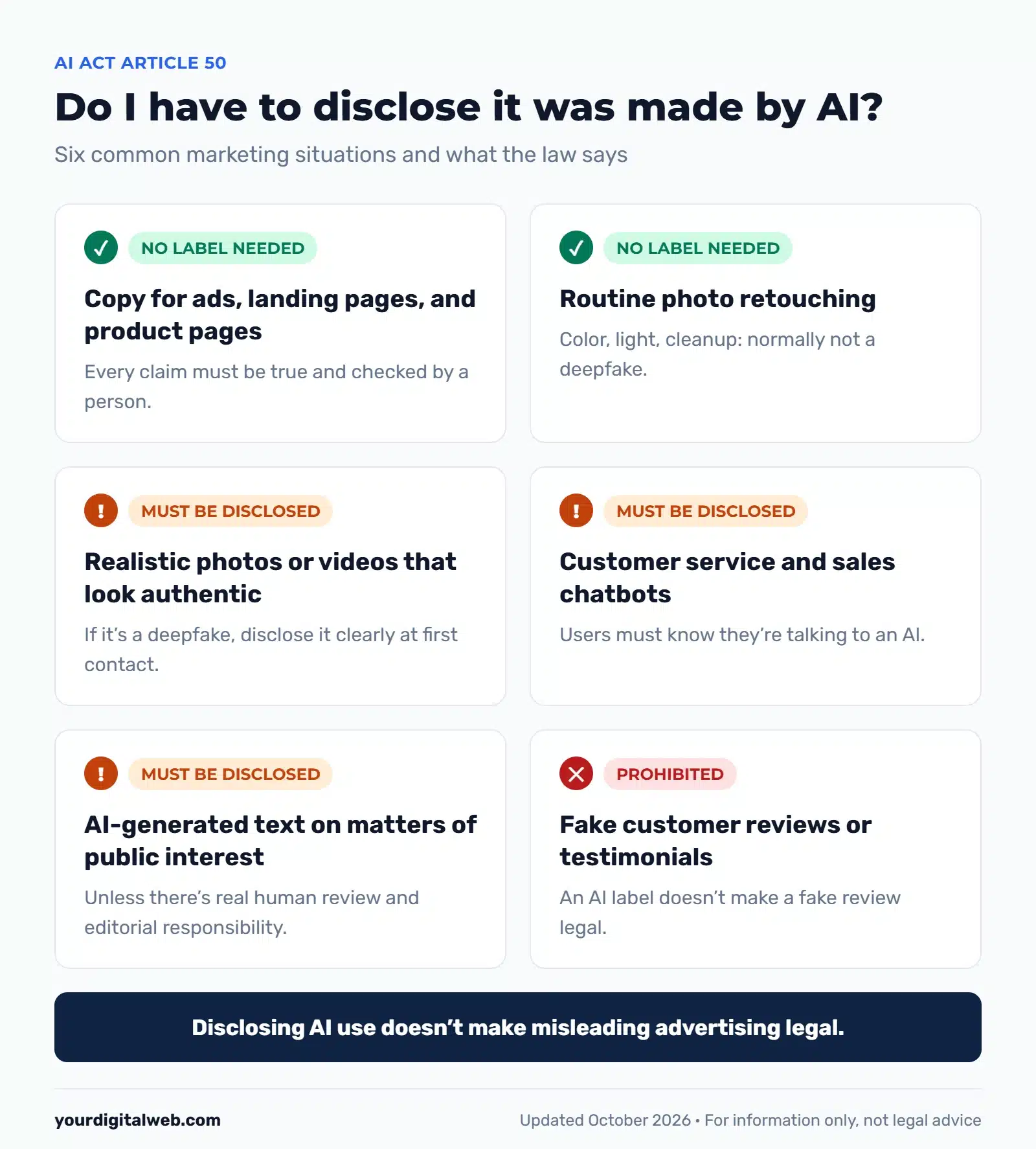
Copy for Google Ads, Meta Ads and landing pages
Using AI to create ad variants, headlines, product descriptions and calls to action doesn’t in itself trigger a labeling obligation. The usual rules still apply, though: the ad must be truthful, not misleading and consistent with the product. If the AI invents a certification, a clinical result or a discount that doesn’t exist, there’s a legal problem anyway, even with no labeling obligation.
In practice: if your team writes ads and product pages with AI, you don’t need a label, but you do need a person who checks every claim before publication. Prices, discounts, certifications and results must be true and documentable.
AI-generated advertising photos and videos
Here the assessment is more delicate. Correcting colors, removing technical imperfections or doing ordinary retouching normally doesn’t turn an image into a deepfake. Realistic images or videos showing artificial people, products, places or situations as if they were authentic are a different matter. Think of a furniture brand placing a sofa in a living room that never existed, perfectly photorealistic. Or a cosmetic whose effect on the skin is artificially enhanced. Not all of these images are deepfakes: you need to check whether they fall within the legal definition and the European guidelines. When content is a deepfake, whoever publishes it must disclose its artificial nature clearly and recognizably, at the latest at the first contact with the user. But be careful: disclosing the use of AI doesn’t make a misleading representation of the product lawful. The “enhanced” cosmetic remains a misleading advertising problem, label or not.
In practice: if your campaigns use realistic AI-generated photos or videos, decide before publication whether a visible disclosure is needed and whether the image represents the product as it is. When in doubt, it’s better to disclose and stay true to the real product.
Virtual testimonials and generated reviews
An AI-generated video in which a real-looking person says they used a product deserves the utmost attention. If that person doesn’t exist and the experience is invented, the issue goes beyond transparency. In Italy the Consumer Codecomes into play, which considers spreading fake reviews an unfair commercial practice. In the United States the Federal Trade Commission has introduced a specific rule against fake reviews and testimonials, including AI-generated ones. And if the video uses a real person’s face or voice without consent, in Italy it can amount to the crime of unlawful dissemination of AI-generated or altered content, introduced by Law 132/2025. We’ll come back to this below. A virtual testimonial that’s openly fictional, used in fair communication, is a different thing from a fake review passed off as real.
In practice: never publish testimonials or reviews from customers who don’t exist, not even with an “AI” label. If you use a virtual character, it must be clear to everyone that it’s a character.
AI chatbots for support and sales
A chatbot that recommends products, answers questions or guides customers all the way to the cart is the most common case. Article 50 requires providers to design these systems so people know they’re talking to an AI, unless it’s already obvious. For the company using it, a common-sense rule applies: check that the system gives this information and that the interface doesn’t make users believe they’re talking to a human agent. A simple opening message works well:
“Hi, I’m the virtual assistant powered by artificial intelligence. For orders, returns and payments you can always ask to speak with our team.”
Besides meeting the rule, it reduces wrong expectations and complaints.
In practice: if you have a chatbot on your website, check its first message today. It must say clearly that it’s an AI and offer a path to a real person for important matters.
AI and GDPR: for e-commerce and campaigns, the real risk often lies in the data
In our experience, for many companies the most frequent problem doesn’t come from a generated image. It comes from how customer data is used. An AI system can analyze purchases, browsing, preferences and CRM data to predict who will buy. But being able to analyze data doesn’t mean having the right to use it. When personal data is involved, the GDPR continues to apply in full, with or without AI.
Cookies, pixels and ad tracking
A typical e-commerce store today uses the Meta Pixel and Conversions API, Google Analytics and Google Ads, remarketing, audiences built on the customer list and often predictive algorithms to identify the users most likely to buy. For non-essential cookies and other tracking tools used for profiling and behavioral advertising, in Italy prior user consent is generally required. This is set out in the Italian Data Protection Authority’s FAQ on cookies. Two clarifications we often give clients. Moving tracking server-side doesn’t remove the consent requirement. And Google Consent Mode is a technical tool for passing consent signals, not a certificate of compliance.
In practice: if your e-commerce store does remarketing or uses custom audiences, check that pixels and tags only fire after consent and that the banner offers a real choice. It’s a technical check that takes a few hours and closes off a lot of risk.
Customer data uploaded to AI tools
Imagine a marketing manager uploading to a chatbot a file with names, emails, amounts spent and purchase history to ask which customers to contact. It happens more often than you’d think. Before doing it, you should ask whether there’s a legal basis for this new purpose and whether customers have been informed. Then what privacy role the tool’s vendor has and whether there’s a data processing agreement. And also: how long the data is kept, whether it’s used to train the model, whether it ends up outside the European Union and with what safeguards. When processing presents a high risk, an impact assessment may also be needed. Practical solutions exist. Reducing data to the minimum necessary, truly anonymizing it and using business versions of tools configured not to train models on your data greatly lowers your exposure. Remember, though, that replacing a name with a code is pseudonymization, not anonymization: under the GDPR that data remains personal.
In practice: if your team uses ChatGPT or similar tools, set a written rule on what data can be uploaded and to which version of the tool. Free personal accounts are not the right place for customer data.
Profiling and automated decisions
The GDPR gives everyone the right to object to the processing of their data for direct marketing, including profiling. Article 22 also governs decisions based solely on automated processing that produce legal effects or similarly significantly affect the person. This doesn’t mean every product recommendation or personalized ad is banned. It means you need to look at the system’s concrete effect, especially when it decides on its own about things that matter to the customer, like access to a service, financing or different economic terms.
Digital Services Act: what advertisers need to know
On The Digital Services Act, Regulation (EU) 2022/2065, sets rules for online platforms and intermediary services. For advertising, two points are central. The first is ad transparency: anyone who sees an ad on a platform must understand that it’s an ad, who’s paying for it and why they’re seeing it. The second concerns profiling: platforms can’t show ads based on profiling that uses special categories of data, such as health, sexual orientation, political opinions or religion. Nor can they show profiling-based advertising to users they know, with reasonable certainty, to be minors. These are obligations on platforms, not advertisers. But anyone designing a campaign can’t treat every segmentation suggested by the ad tool as neutral, especially when audiences are built automatically by AI. A note for those communicating on political or social issues: since October 2025 the new European regulation on political advertising applies, and Meta and Google have chosen to suspend political, electoral and social-issue ads in Europe. Those working in these areas should check the latest policies before planning. Finally, a clarification: not every online store is a platform under the DSA. An e-commerce store selling its own products doesn’t have the same obligations as a marketplace hosting third-party sellers.
In practice: if you run campaigns on Meta or Google, avoid audiences that, even indirectly, are based on health, religion, orientation or other sensitive data. And if you run a marketplace with third-party sellers, have someone check which DSA obligations apply to you directly.
AI-personalized pricing: an opportunity that requires transparency
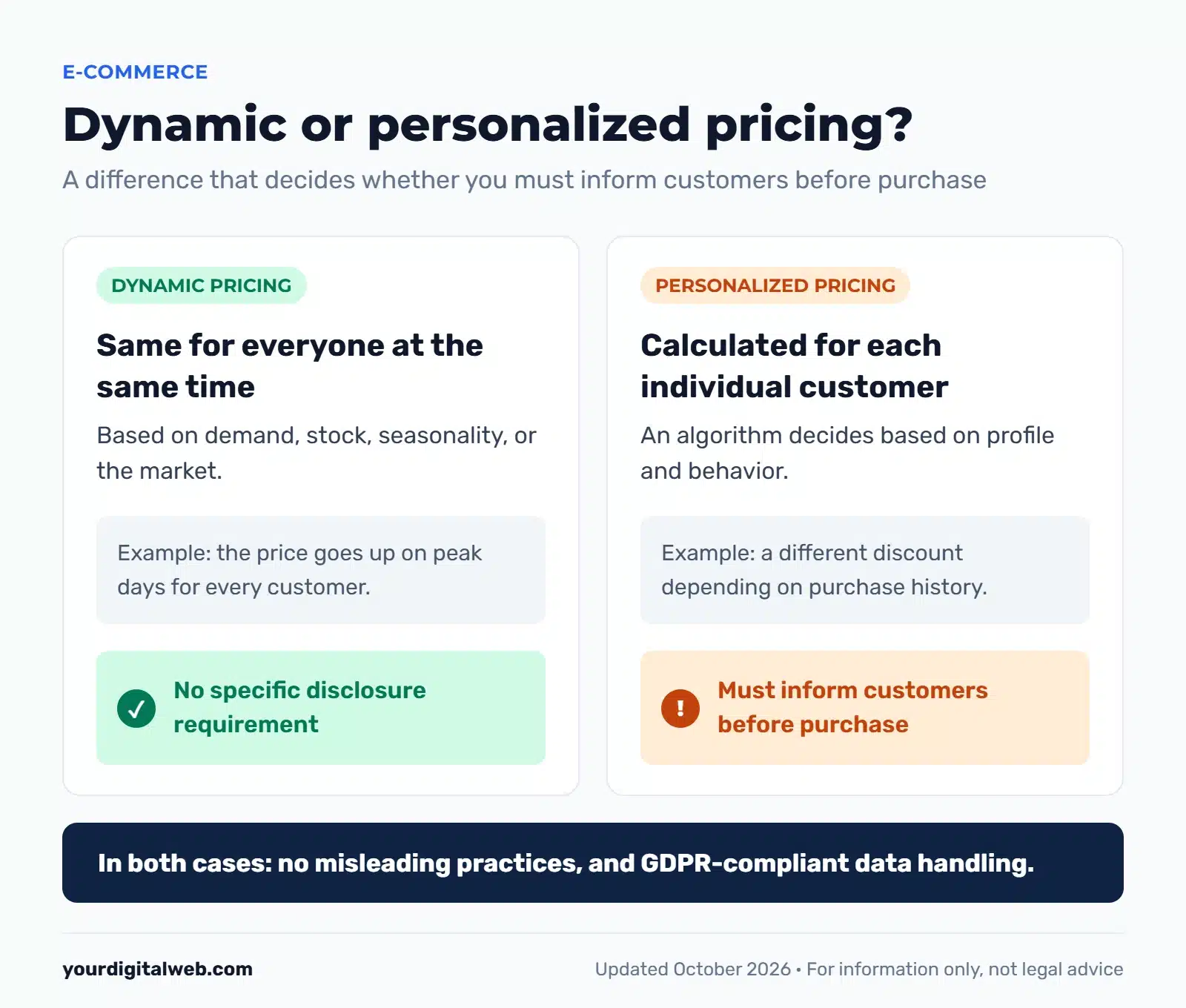
AI makes it possible to change prices and offers based on demand, availability, competition and customer behavior. Legally, however, there’s a distinction you need to know. Dynamic pricing changes based on general conditions: demand in the period, stock, market trends. All customers at the same moment see the same price. Personalized pricing instead is calculated by an automated decision-making process based on the individual customer’s behavior or characteristics. In the European Union, when a price is personalized this way, the Consumer Rights Directive requires informing the consumer before purchase. In Italy the obligation was added to the Consumer Code, among the pre-contractual information for distance contracts. This doesn’t make every pricing algorithm illegal. But you must avoid unlawful discrimination, incomplete information and misleading practices, and comply with the GDPR for the data used in the calculation. A good pricing system doesn’t just maximize margin: it must be explainable and verifiable.
In practice: if your e-commerce store shows different prices or discounts to different customers based on their profile, you must say so clearly before purchase. If instead prices change for everyone based on demand, the specific obligation doesn’t apply, but the rules on transparency and unfair practices remain.
AI and environmental claims: watch out for the greenwashing rules in force since September 2026
Since September 27, 2026, new rules against greenwashing apply. They come from Directive (EU) 2024/825, transposed in Italy by Legislative Decree no. 30 of February 20, 2026, with significant changes to the Consumer Code. The new rules ban various generic or unsubstantiated environmental claims and restrict the use of sustainability labels not based on recognized certification schemes or established by public authorities. For anyone creating content with AI the risk is very concrete. A language model tends to suggest catchy phrases like “100% sustainable product”, “zero environmental impact” or “the greenest choice on the market”. They’re slogans that work, but you can’t publish them just because AI suggested them. You need adequate documentary proof, and some wording is banned in any case. There’s also an AI Act angle. AI-generated texts published to inform the public on matters of public interest must be disclosed as such, unless they’ve gone through genuine human review and someone takes editorial responsibility. A quick read-through isn’t editorial control.
In practice: if you sell products with environmental features, have all green claims on your website, product pages and ads reviewed, including those written with AI. Every claim needs proof; generic wording should be removed.
Italian artificial intelligence law: what it adds to the AI Act
Alongside the European rules there’s Italian law. Law no. 132 of September 23, 2025, in force since October 10, 2025, sets national principles on AI to be applied consistently with the European regulation. It also designates AgID and the National Cybersecurity Agency as national authorities for artificial intelligence, without prejudice to the powers of the Data Protection Authority, Bank of Italy, Consob and Ivass. For marketers, two new aspects of the law matter most. The first concerns copyright. The law amended the Italian copyright law clarifying that works of human ingenuity are protected, even if created with the help of AI, as long as they result from the author’s intellectual work. In plain terms: an image or text produced entirely by AI, with minimal human contribution, may not be protectable. For a brand investing in creative, it’s something to consider. The second is the deepfake offense. The new Article 612-quater of the Italian Criminal Code punishes anyone who spreads images, videos or voices of real people generated or altered with AI so as to appear authentic, when this causes unjust harm. Using a famous person’s face or voice in an AI-generated commercial without authorization is therefore a criminal risk as well as a civil one. The framework is being completed with implementing decrees. The latest is Legislative Decree no. 179 of October 7, 2026, published in Official Gazette no. 234 of October 8, 2026. As of October 13, 2026 the decree is published but takes effect on October 23, 2026. Among other things, it governs the powers of national authorities, oversight, penalties and the use of AI in training and employment.
In practice: if your company operates in Italy, organize responsibilities, documentation and internal AI procedures now. With authorities and oversight powers defined, inspections become a concrete possibility.
What penalties does the AI Act provide for?
The European regulation, inArticle 99, sets different maximums depending on the violation. For prohibited AI practices it can reach €35 million or 7% of worldwide annual turnover, whichever is higher. For many other violations, including Article 50 transparency obligations, the cap is €15 million or 3% of worldwide annual turnover. A more favorable rule applies to SMBs and startups: the lower of the fixed amount and the percentage applies. The AI Omnibus extended some SMB measures to small mid-caps too. These are maximums, not automatic fines. No one gets fined just for using ChatGPT or creating an ad with AI. What counts is the severity, the circumstances and the company’s conduct.
Selling in the United States? You must comply with US laws too
Yes, when the conditions apply. But first a misconception needs clearing up: the United States has no general AI law comparable to the AI Act. The rules depend on the type of business, the consumers reached and the states you sell in.
FTC: advertising, reviews and commercial claims
The Federal Trade Commission polices deceptive advertising and unfair business practices. Advertising claims must be true and backed by adequate evidence, and AI-generated advertising can’t invent benefits, results or testimonials. The FTC rule on fake reviews and testimonials also applies to those who create or sell them, including agencies and content providers. Responsibility doesn’t fall on the brand alone.
California: CCPA and behavioral advertising
For businesses subject to the California Consumer Privacy Act, as amended by the California Privacy Rights Act, consumers’ rights over their data matter. These include the right to opt out of the sale or sharing of data for cross-context behavioral advertising. Where applicable, automatic opt-out signals like Global Privacy Control must also be honored. New rules from the California Privacy Protection Agencytook effect on January 1, 2026. For certain uses of automated decision-making technology that produce significant decisions, obligations kick in from January 1, 2027. Normal campaign optimization isn’t in itself a significant automated decision. Another California law, AB 2013, requires training data transparency from certain generative AI developers. It isn’t an obligation for every e-commerce store using third-party software.
Email marketing in the US
For commercial emails the CAN-SPAM Actapplies: an identifiable sender, a non-deceptive subject line, a valid postal address and a working unsubscribe system, with requests honored within the required timeframe. The American system differs from the European one, which generally requires prior consent. You can’t copy the rules from one market to another.
And if an American company sells in Europe?
The AI Act can also apply to operators outside the EU, including US ones, when the regulation’s territorial criteria are met, including the use of AI system outputs in the Union. The same goes for the GDPR, which also applies to foreign organizations offering goods or services to people in the EU or monitoring their behavior. What counts is where the customers are, not where the server is.
United Kingdom: UK GDPR and PECR
Those who also sell in the United Kingdom must consider a framework separate from the EU: UK GDPR and the Privacy and Electronic Communications Regulations, plus consumer and advertising rules. The ICO’s guidance on direct marketing is a good starting point.
In practice: if you sell in several markets, prepare a tracking, consent and email setup for each. A setup designed for the United States isn’t automatically valid for European or British customers, and vice versa.
Does an e-commerce store have to comply with other digital regulations too?
Yes. The AI Act doesn’t replace the other rules that apply to online sellers. A store can comply with the AI Act and, at the same time, have an inadequate cookie policy, misconfigured remarketing or incomplete product pages. There are five areas to keep under control. Consumer protection rules: terms of sale, pre-contractual information, right of withdrawal, prices and reviews, all contained in the Consumer Code. TheEuropean Accessibility Act: since June 28, 2025 accessibility requirements also apply to e-commerce services, with some exceptions, including for certain microenterprises. Here you’ll find the European Commission page. Legislative Decree General Product Safety Regulation (GPSR, Regulation (EU) 2023/988): it requires safety and manufacturer information in online offers too, for non-food products within its scope. Intellectual property and personal rights: images, trademarks, voices and faces used in AI creative must be authorized. The GDPR and tracking rules: data, cookies, ad technologies and vendors.
In practice: digital compliance can’t be bought with “certified” AI software. It comes from looking at the whole process, from the website to campaigns to data management.
Benefits and risks of AI: an honest accounting
The new rules don’t erase the opportunities. Adopted well, AI genuinely improves marketing and e-commerce work. It reduces repetitive work in preparing drafts, variants and versions in other languages. It helps analyze campaigns, test creative and manage bids automatically. It improves on-site search, product recommendations and support. It speeds up adapting content for foreign markets, as long as someone checks language, culture and local rules. And it helps find trends and inefficiencies in data, as long as processing is lawful and secure. But there are costs and risks that rarely appear in the first business case. Models can invent plausible but false information, including product features and regulatory references. Highly automated systems make it hard to reconstruct why a decision was made. Uploading data to the wrong services exposes you to confidentiality problems. An artificial testimonial, a misleading image or a wrong chatbot answer can cost you trust. Vendors’ prices, policies and terms change, and your processes with them. Finally, training, controls, contract reviews and clear responsibilities are needed, and they have a cost. The right question isn’t just how much time AI saves, but how much value remains after accounting for quality, controls and risks.
How to prepare your company for the AI Act: an 8-step method
To turn the rules into concrete actions we propose a path that brings together marketing, technology and organization. You don’t need a mountain of paperwork: you need to know what you use, who decides and who checks.
1. Map the AI tools you use. List the software, platforms and features actually in use, from text and image generators to chatbots and autonomous agents. Include tools employees use on their own initiative too.
2. Assess risks and obligations. For each system note the purpose, type of data, any transparency obligations and possible high-risk classifications. A campaign optimized with AI doesn’t become a high-risk system because of it.
3. Assign roles. Establish who is the provider and who the deployer for AI Act purposes and, separately, who is the controller or processor for GDPR purposes. These are qualifications under different laws and shouldn’t be confused.
4. Check data, consent and vendors. Check cookies, pixels, CRM, data transfers outside the EU, contracts and tool configurations.
5. Define a content procedure. Before publishing, check that the message is true, that materials are authorized, whether there are realistic manipulations and whether a disclosure is needed.
6. Introduce genuine human oversight. Have a person or team do the final check on important content and decisions. It must be a real check, not an automatic approval click.
7. Train your people. L’Article 4 of the AI Act requires providers and deployers to adopt measures supporting the AI literacy of those who use the systems on their behalf. Training should be tailored to roles and context; the law doesn’t require the same certificate for everyone.
8. Document and update. Keep procedures, assessments, roles and checks, proportionate to the real risks. Review everything periodically, because tools and rules change fast.
Three real cases: how to decide
The marketing team creates 50 Google Ads ads with AI. You need to check that the claims are correct, that materials are authorized and that the ads comply with Google’s policies. You don’t need to put an AI label on every piece of copy.
A brand creates a video with a fake satisfied customer. AI generates a realistic face and attributes a review that was never given. It’s a high risk of misleading advertising and of breaking the rules on reviews. An “AI” label doesn’t make a fake review lawful.
An online store uses AI to personalize offers. It works on purchase history, browsing and individual profiles. You need to check the legal basis, tracking consent, the right to object, any obligation to disclose personalized pricing and the vendors’ role. The same technology can be used lawfully or unlawfully: it depends on how it’s configured, what data it uses and the effects on customers.
Five questions to ask before publishing a campaign with AI
- Is it true? Does the message represent the product accurately?
- Is it transparent? Does the user know AI is involved, when the law requires it?
- Is it lawful on data? Was the information collected and used on an appropriate legal basis?
- Is it auditable? Can we reconstruct the choices and correct mistakes?
- Is it right for the target market? Have we considered the differences between Italy, the EU, the United States, the United Kingdom and the other countries we sell in?
This check doesn’t replace a legal analysis, but it catches many problems before they reach customers.
Conclusion: the problem isn’t AI, it’s using it without rules
The AI Act is an important change, but it doesn’t ban using artificial intelligence in marketing. Companies can keep creating content, optimizing campaigns and building innovative e-commerce stores. What’s needed is knowing a few boundaries: between automation and responsibility, between personalization and unlawful data use, between synthetic creativity and misleading representation of reality. The platform that generates a creative doesn’t know your product documentation, the consents you’ve collected, your agreements with testimonials or the laws of every market you sell in. That’s why competitive advantage comes from combining five elements: AI, digital strategy, data quality, human oversight and regulatory compliance. It’s not about slowing everything down with pointless procedures, but about putting the right controls where they’re really needed. A well-designed process lets you experiment faster, make fewer mistakes and earn customers’ trust.
AI that works isn’t the one that produces the most content or the most conversions. It’s the one that produces reliable, measurable results that are sustainable from a regulatory standpoint too.
How YourDigitalWeb can help
At YourDigitalWeb technology and business results are part of the same journey. We work on website analysis, Google Ads and social ads campaigns, SEO, AI consulting and international growth strategies, with the goal of building measurable digital processes that fit the company’s needs. A concrete first step is taking a snapshot of how AI is used in the company today: which tools are active, how data is handled, what content is published and where the operational issues are, from the cookie banner to the chatbot. We’re not a law firm and don’t provide legal advice. For legal matters we work in coordination with lawyers and privacy consultants chosen by or trusted by the client.
Want to understand how to integrate AI into your digital strategy, website and campaigns? Contact YourDigitalWeb and tell us about your project.
Frequently asked questions on the AI Act, e-commerce and advertising
Is it mandatory to write “Generated with AI” on all ads?
No. Article 50 sets specific obligations, mainly for deepfakes, chatbots and certain texts of public interest. Each case needs assessing, without confusing the technical marking required of providers with the disclosure obligation on those who publish.
Can I use ChatGPT to write product descriptions?
Yes, within the rules. Content, copyright, privacy and any misleading claims need checking before publication.
Are Google Ads and Meta Ads banned by the AI Act?
No. The regulation doesn’t ban these platforms or automatic campaign optimization. How they’re used, the data processed and the applicable obligations still need checking.
Does an e-commerce store need to appoint an AI officer?
There’s no general obligation to appoint a role with that title. What you do need is to assign clear responsibilities and meet the obligations that apply case by case.
Does the AI Act also apply to SMBs?
Yes, when the conditions apply. Smaller companies benefit from proportionality measures and penalties calculated more favorably.
Are images created with AI protected by copyright?
In Italy, works deriving from human intellectual effort are protected, even if made with the help of AI. An image generated almost entirely by a machine may not be. It’s worth documenting your team’s creative contribution.
If an Italian company sells only in the US, can it ignore the GDPR?
Not automatically. A company established in Italy remains subject to the GDPR for processing related to its activities, even if its customers are abroad.
Can a chatbot close sales on its own?
Using AI assistants and agents in purchase processes isn’t banned in general. But transparency, the powers given to the system, contract terms, security, error handling and consumer rights need checking.
Legal sources and further reading
European Union
- Regulation (EU) 2024/1689, AI Act (EUR-Lex)
- Regulation (EU) 2026/1744, AI Omnibus (EUR-Lex)
- European Commission, entry into force of the AI Omnibus
- European Commission, AI Act regulatory framework and timeline
- AI Act, Article 50: transparency obligations
- AI Act, Article 4: AI literacy
- AI Act, Article 99: penalties
- European Commission, guidelines on transparency obligations
- Regulation (EU) 2016/679, GDPR
- Regulation (EU) 2022/2065, Digital Services Act
- Directive 2011/83/EU on consumer rights
- Directive (EU) 2024/825 on the green transition
- Regulation (EU) 2023/988 on general product safety
- European Commission, European Accessibility Act
Italy
- Law no. 132 of September 23, 2025 (Normattiva)
- Legislative Decree no. 179 of October 7, 2026 (Normattiva)
- Italian Consumer Code, Legislative Decree 206/2005 (Normattiva)
- Italian Copyright Law, Law 633/1941 (Normattiva)
- Italian Data Protection Authority, FAQ on cookies
United States and United Kingdom
- FTC, rule on fake reviews and testimonials
- FTC, CAN-SPAM Act compliance guide
- California Privacy Protection Agency, CCPA regulations
- ICO, email direct marketing in the UK
Important note: we’re not lawyers
This article was written by YourDigitalWeb, a digital marketing, SEO and AI consulting agency. We’re not a law firm, and the content doesn’t constitute legal advice or advice on privacy or regulatory compliance. The information is up to date as of October 13, 2026 and is for informational purposes only. Artificial intelligence rules change quickly, and how they apply depends on the systems used, the company’s role, the data processed and the markets served. Before making compliance decisions, consult a lawyer or a qualified privacy consultant.

Roberto Rais
Esperto Wikipedia e GEO
On the YourDigitalWeb team, works on Wikipedia and Generative Engine Optimization projects, helping companies and professionals build an authoritative, verifiable presence that search engines and AI recognize and cite.
One click and, when you search for SEO, AI and marketing, our articles will show up more often in Google’s Top Stories.