Table of contents 8 sections
- What Google Search AI Mode Is
- AI Mode architecture and how it works
- Advanced personalization and dynamic results
- The role of Large Language Models (LLMs) in the new search engine
- Key features introduced by AI Mode
- SEO implications and strategic advice
- At YourDigitalWeb we help companies improve their AI visibility by building citations and sources so they can be seen. We work with AI every day and develop methods to support this evolution!
- How can YourDigitalWeb help your business?
Google recently introduced AI Mode as a new advanced search experience, marking a significant change in how users interact with the search engine. Announced at Google I/O 2025, AI Mode is available as a separate tab in Google Search (initially for users in the US) and has been described by Google itself as “the future of search”
Unlike a traditional search, with its list of blue links, AI Mode uses generative AI technologies to provide in-depth, conversational answers directly on the results page. In practice, when the user asks a complex question, Google AI Mode provides a single, detailed answer that can even anticipate follow-up questions, instead of just returning a list of websites.
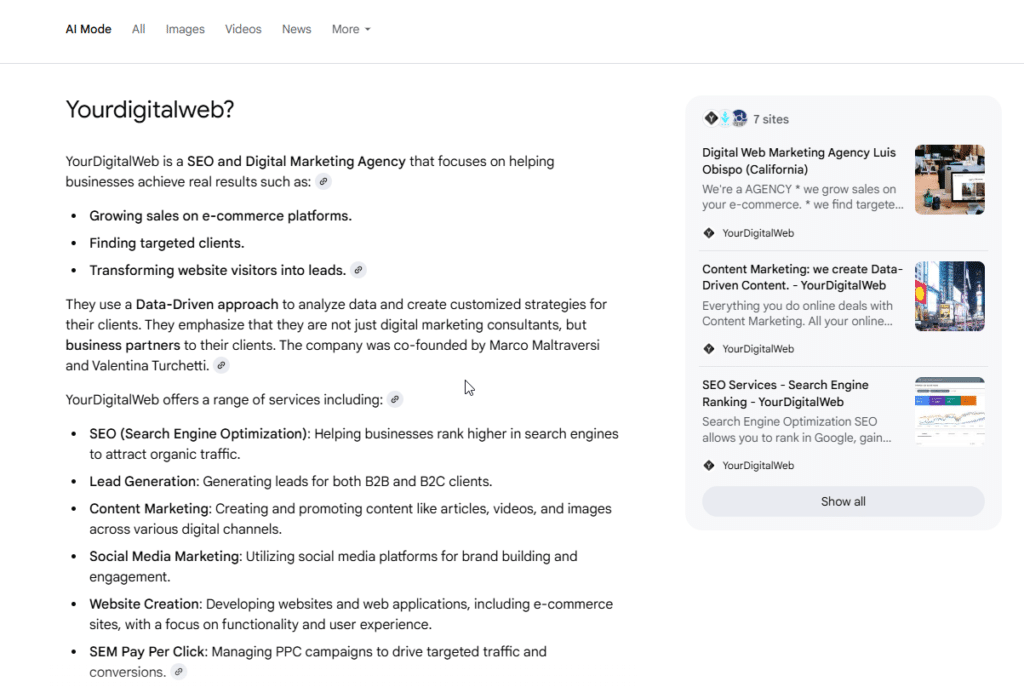
This mode was designed to handle longer, more detailed queries: during testing, AI Mode queries were on average twice as long as classic ones and often tied to complex tasks (product comparisons, travel planning, how-tos; here’s an in-depth PDF) AI Mode aims to become a complete research assistant, capable of offering more advanced reasoning, personalized results and multimodal content (text, images, charts) integrated into a single experience.
What Google Search AI Mode Is
AI Mode is a new search mode that uses generative AI models (Large Language Models, LLMs) to enrich the user experience. Instead of providing just a list of relevant pages, AI Mode produces complete, contextual answers to users’ questions. It’s accessible through a dedicated tab (“AI Mode”) on Google’s page – initially available through Search Labs and then rolled out to all users in the United States without opting in. When you search in AI Mode, Google uses a proprietary AI model (a customized version of Gemini 2.5, Google’s most advanced language model at the time) to interpret the query and generate the answer. According to Google, AI Mode is the “most powerful” AI version of search, with improved reasoning capabilities and native multimodal support (search by text, voice or images)
In terms of user interface, AI Mode looks different from the traditional SERP: the AI answer takes the main position, often as a paragraph (or bulleted list) without immediate links in the text. Only on the side – for example in a right-hand panel or a carousel below the answer – are some links to external web sources shown for further reading. Google stresses that AI Mode continues to “highlight helpful links” to quality sites, but the approach is highly focused on keeping users inside the conversational experience. Indeed, as experts have noted, AI Mode seems designed to keep users in AI mode as long as possible, providing a lot of information directly in the answer and pointing to internal resources (e.g. Google Maps, Google Shopping) when appropriate
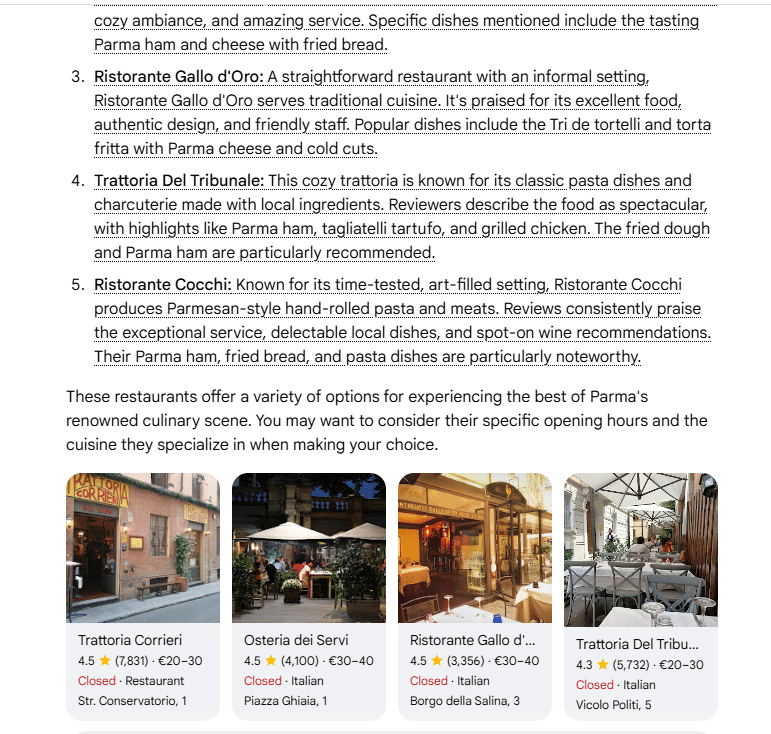
Example of a Google Search answer in AI Mode – in this case for the query “top 5 resturant in Parma”.
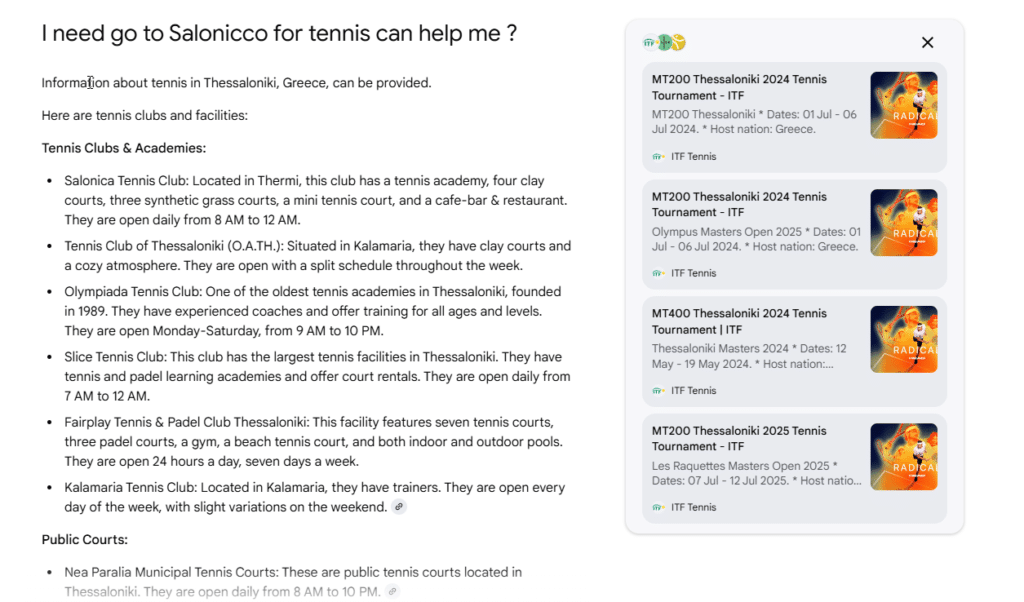
The AI returns a detailed list of the best restaurants in Parma, with detailed descriptions for each option. Each entry includes information on style, recommended dishes (such as torta fritta, Parma ham and handmade pasta) and strengths (atmosphere, service, ingredient quality). On the right, a visual carousel shows the restaurants’ Google profiles with reviews, price range, address and opening status. Star ratings and review counts help guide the choice. For example, Trattoria Corrieri and Ristorante Gallo d’Oro show high ratings and affordable prices, while Osteria dei Servi and Ristorante Cocchi are appreciated for the refinement and authenticity of their local dishes.
The link icon next to each name is an internal link (“dotted link”) to the business’s Google profile, letting users explore menus, hours and photos without leaving Google’s ecosystem. This example shows how AI Mode offers rich, contextual answers while keeping the user engaged in the search interface for a smooth, complete information experience.
 .
AI Mode architecture and how it works
Technically, AI Mode introduces a layered, contextualsearch architecture on top of Google’s classic index.
Broadly speaking (source: ipullrank.com), AI Mode’s internal process can be described as follows:
Understanding and rewriting the query: when the user asks a question in Google AI Mode, the system doesn’t treat it as a single isolated query. Instead it applies the “query fan-out”technique: the initial question is silently broken down and reformulated into a constellation of related sub-questions. Some of these derived queries are explicit (obvious subtopics of the question), others are implicit or predictive, aimed at anticipating the follow-ups the user might look for. In practice, AI Mode expands the search intent along multiple lines, exploring various aspects of the topic.
Parallel multi-query search: all the generated sub-questions are launched simultaneously across the search infrastructure. In this phase Google runs multiple searches in parallel to retrieve information from its web index, far beyond the surface of the classic 10 organic results. In standard mode, search just finds the most relevant results for the single query; in AI Mode, instead, there’s a “deep dive” into the web: dozens (or even hundreds, in Deep Searchmode) of queries are issued to explore every facet of the problem and find hyper-relevant content. Google has described this mechanism as the key to helping users “discover even more of the web that matches exactly what they’re looking for
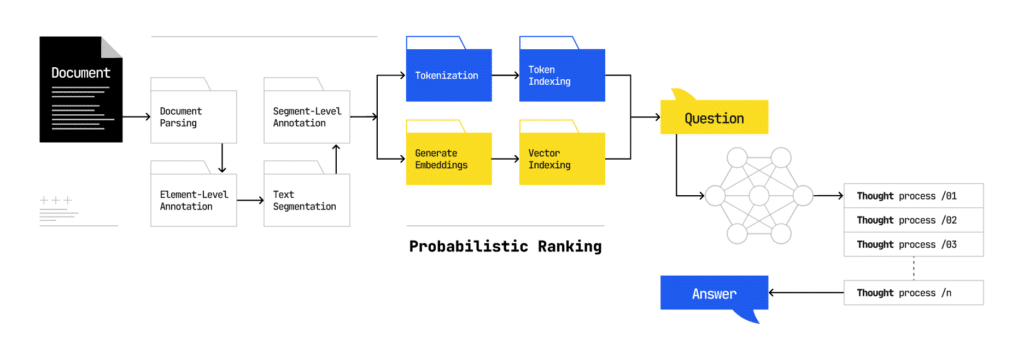
Passage-level content retrieval: unlike classic search oriented to whole pages, AI Mode takes a passage-levelapproach. This means Google’s index and retrieval models work at the level of individual paragraphs or sentences: each document is split into “chunks” (segments), and matching with queries happens on these. For each sub-query, the system extracts from web documents the passages specific passages considered relevant – for example, a particular definition, a statistic, a useful piece of description. In the backend, Google uses dense retrieval, meaning dense vector representations of both queries and text passages: every query and every document fragment is converted into a numerical embedding , and the similarity between these vectors determines which passages are considered relevant. This approach goes beyond exact keyword matching, also identifying content semantically related to the user’s request (e.g. synonyms, related concepts). Traditional keyword-based ranking metrics (TF-IDF, BM25), while they may be used in an initial filtering phase, are no longer at the center of the process: the AI Mode retrieval pipeline relies mainly on neural techniques of vector ranking and semantic similarity
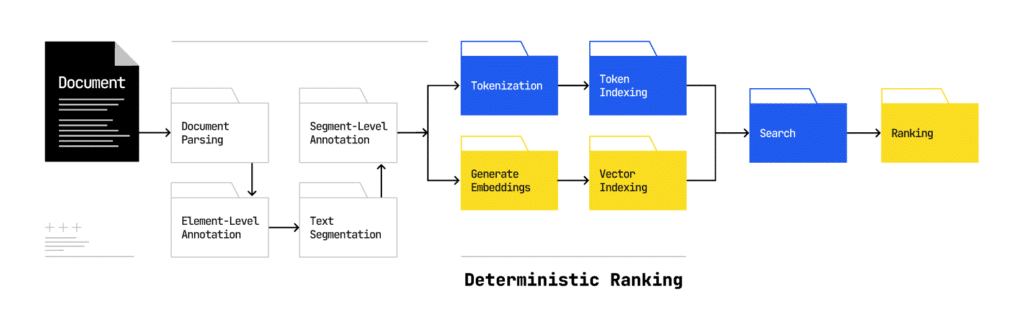
Dynamic ranking with language models: once it has a broad set of candidate passages (from many different sources), the system determines which information to use and in what order. This is where an “oblique,” LLM-mediated ranking, very different from the old deterministic ranking algorithm, comes in. Google has developed a method (described in a recent patent) in which the language model compares passages in pairs to assess which of the two better answers the user’s query. In practice, the model is repeatedly asked: “Given this question, which of these two texts is more relevant?” Through many pairwise comparisons between fragments, the system derives a final ranking of passages based on the model’s judgment. This approach introduces an element of relative reasoning: there’s no longer a fixed score for each document; relevance is assessed by comparing content directly. The result is a probabilistic, AI-mediated ranking, rather than a deterministic one as in Google’s classic algorithms
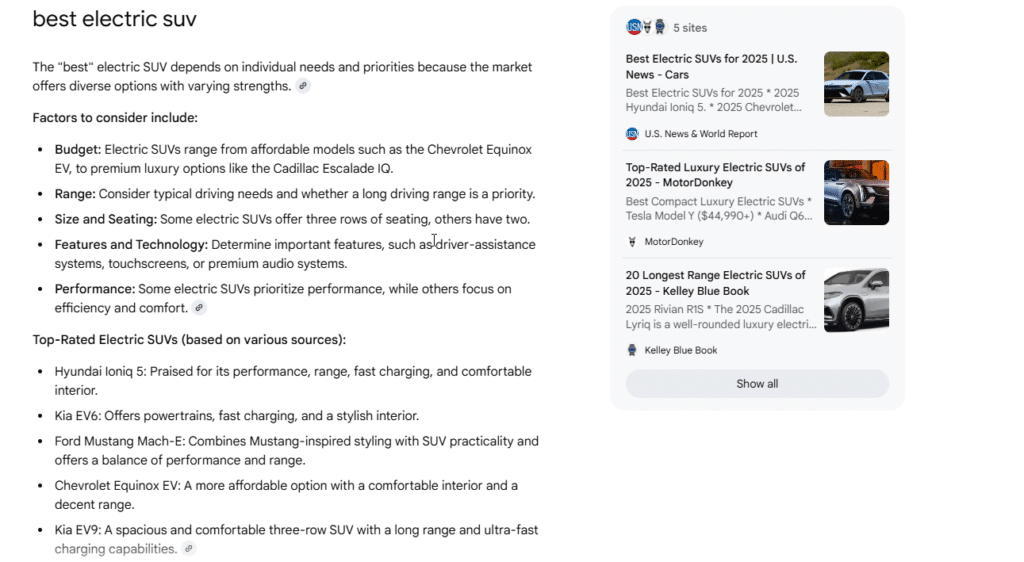
Synthesizing the answer in natural language: once the best passages are chosen, AI Mode moves on to generating the final answer. It should be stressed that the answer isn’t a direct verbatim quote from a single document, but a synthesis combined synthesis of information from multiple sources. The system works as a smart aggregator: it reorders, paraphrases and connects the various pieces of information to formulate a coherent, complete answer to the original question. In this phase, multiple specialized models come into play (a true AI ensemble): for example, a model optimized for summarizing content, a model for comparing diverging data or opinions, a model for fact-checking (cross-checking) and so on. Each of these modules contributes “a line” – that is, adds a piece of processed information – and finally a synthesis model (the director) assembles everything into fluent, natural text. The final product is a paragraph (or list) that directly answers the user’s query, often anticipating related sub-questions (thanks to the coverage provided by the fan-out) and providing additional context. For example, asking “What’s the best electric SUV?”, AI Mode might already include considerations on what “best” means for different users (range, price, features, etc.) without the user explicitly asking
Presentation and interaction: the generated answer is shown at the top of the page in a conversational format. The AI Mode interface is adaptive and modular: layout and visual elements can change depending on the type of information to present. A downstream LLM in the pipeline decides how best to display the content – for example as discursive text, a bulleted list, a comparison table, an image gallery or an interactive chart – based on the nature of the question and the user’s past preferences. This means the answer’s appearance can vary greatly from one query to the next: a statistics question might show a chart; a product comparison, a table; a place, perhaps an embedded map. The answer also includes references to sources: usually small citation icons or numbers that, when clicked, open the list of sources used (shown in a side panel or at the bottom). In this mode, then, the user immediately gets a “ready-to-use” solution, but can still expand and verify on external sites through the links provided.
Contextual memory and follow-ups: AI Mode supports ongoing conversation. After the first answer, the user can ask follow-up questions (by clicking suggested deep dives or typing new questions) and Google will keep the context context of the session. This means the system remembers what was previously asked and answered, to avoid repetition and provide consistent answers in the conversation. Technically, AI Mode implements a “search with stateful chat”, meaning a search chat with persistent state: a kind of long-term memory of the session is maintained, where each interaction updates the context. This memory isn’t built so much by saving every word as by generating an aggregate embedding of the conversation (a vector representation of the dialogue so far) that is added as input to subsequent turns. This way the AI “knows” what’s being discussed and can interpret new queries in continuity with the previous ones, just as a human assistant would. For example, if after asking about the “best electric SUV” the user asks “and for a family of 5?”, AI Mode will understand it still refers to electric SUVs and adapt the answer to that sub-context without repeating everything. This contextual persistence makes the search experience more natural and fluid.
In short, what looks like a single AI-generated result is actually the product of an elaborate chain of operations: from an initial query to dozens of secondary queries, hundreds of documents read and compared, and finally a text created from scratch by the AI based on the content found. AI Mode has been described as a “matrixed ballet of machine cognition” hidden behind the simplicity of the interface. This infrastructure implies a conceptual leap: it’s no longer about “ranking web pages” but about building answers through automated reasoning across multiple sources at once
Advanced personalization and dynamic results
One of AI Mode’s most innovative aspects is its strong personalization of results. Google Search has long partially personalized results (for example using geographic location or recent activity when you’re logged in), but AI Mode takes personalization to a higher level, thanks to AI-based techniques and in-depth user data.
Personal context and user embeddings: Google introduced the concept of personal context in AI Mode. Users can – on a voluntary basis – allow Google to use data from their Google account (such as Gmail, Google Calendar, search history, etc.) to enrich answers.
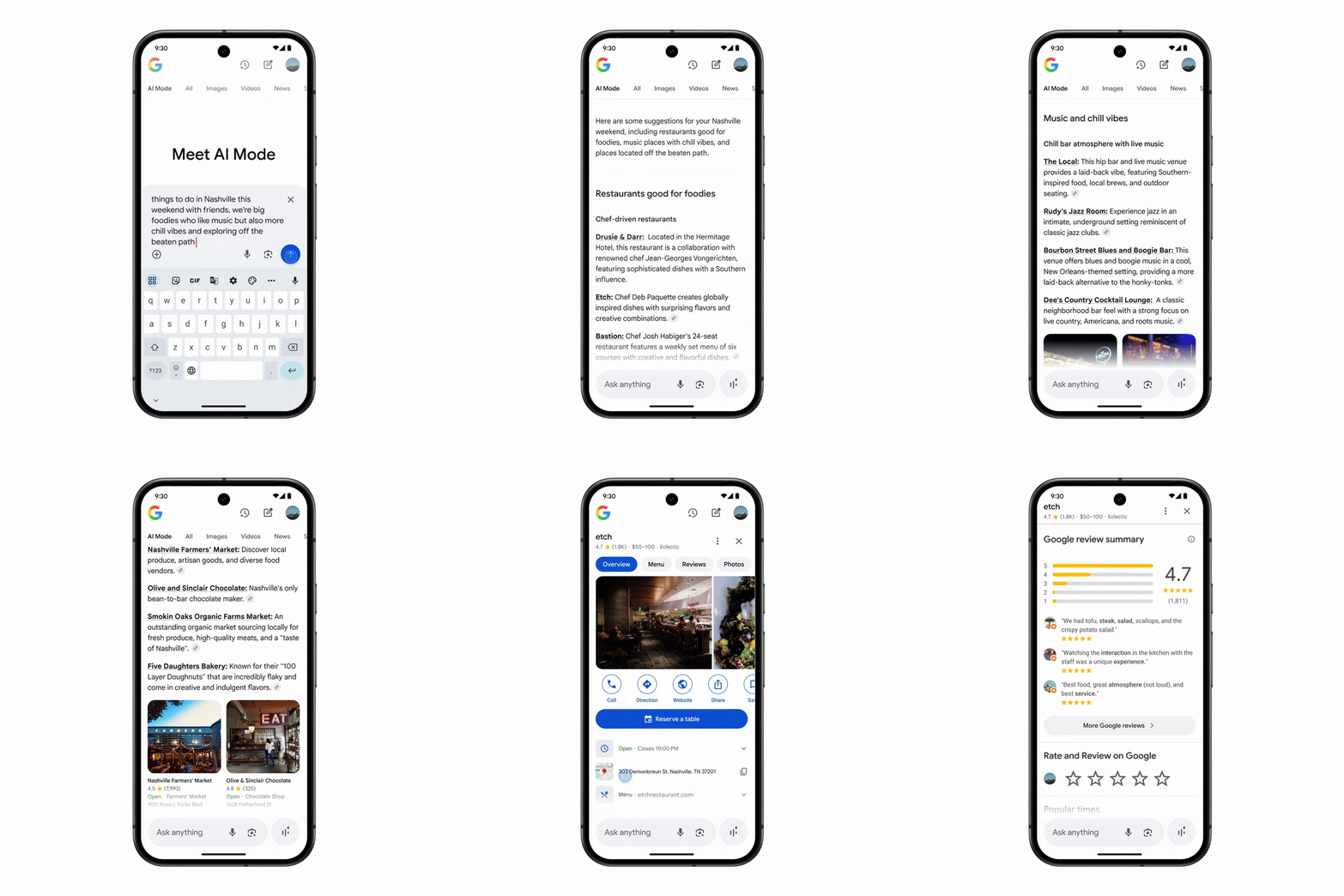
For example, by connecting Gmail, AI Mode can read relevant information (such as flight or hotel bookings) and use it to provide personalized answers. Google says this only happens if the user opts in and that the connection can be turned off at any time. The benefits, however, are considerable: in the example given at I/O 2025, searching for “things to do in Nashville this weekend with friends, we’re big foodies who like music”, AI Mode was able to recommend restaurants with outdoor seating based on the user’s past bookings and suggest events in the city near the hotel where the user would be staying (information taken from flight and hotel confirmations found in Gmail). In practice, the AI combined culinary tastes inferred from past searches, knowledge from travel confirmation emails and Google Maps information to generate a tailored answer – something unthinkable for a traditional search engine.
Example of a personalized answer using user data. In this Google demo animation, AI Mode provides personalized suggestions on restaurants and events in Nashville by combining the query context with personal information: confirmation emails (flights, hotel) and restaurant booking history. The result is adapted to the user’s preferences (e.g. venues with music and outdoor seating) and to their location during the trip. The ability to connect Gmail and other apps will give AI Mode a strongly proactivecharacter, bringing the search experience closer to that of a smart personal assistant.
Technically, this level of personalization is made possible by user embedding models. According to a recent Google patent, the system generates for each user an embedding vector that numerically represents their characteristics, preferences and intents based on long-term behavioral signals. This user embedding embedding acts as a “latent profile” of the user: a mathematical summary of all their past searches, clicks, interests shown, interactions with various Google products, etc. The embedding is then injected into the LLM’s inference process to shape the answers. In practice, for every new user query, the system considers not only the question itself but also this user vector, which influences every stage: from interpreting the intent (what the query really means for that specific user) to choosing which fan-out sub-queries to prioritize, to re-ranking passages by affinity with the user and even the tone/format of the generated answer
This mechanism enablesextreme real-time personalization without having to fully retrain the language model for each user. The same base model (Gemini) can serve billions of people, adapting answers “on the fly” thanks to the user embedding provided as extra context. It also ensures cross-product consistency: the same embedding could be used to personalize experiences on Search, on an assistant like Gemini (formerly Bard), on YouTube, on Google Shopping and other services, keeping underlying consistency in the recommendations and results shown to that user. A striking example is that one user received the same answer in both AI Mode and Gemini (the conversational assistant), a sign that there’s a common personalization layer driving both
The implications of this deep personalization are profound: two different users asking the exact same query in AI Mode could see different answers and cited sources, not because of differences in the ranking algorithm, but precisely because they’re different people. The search engine becomes memory-aware, aware of the user’s “memory.” For example, if user A has often interacted with high-quality scientific content in the past and user B hasn’t, asking both today to “explain climate change”, AI Mode might cite more technical, detailed sources for A, while for B it might keep simpler language and more introductory sources. Whether content is included in the results no longer depends only on general semantic relevance, but also onalignment with the user’s profile.
From an SEO perspective, this means classic “average position” has a very relative meaning in AI Mode: results are highly personalized and dynamic, so monitoring a page’s absolute position for a given query (as if it applied to all users) becomes ineffective. Traditional rank tracking tools – typically calibrated on generic, logged-out searches – risk missing a piece of content’s true visibility, because answers can become 1:1 (one-to-one) between AI and user. In other words, every user has their own tailor-made Google.
The role of Large Language Models (LLMs) in the new search engine
At the heart of AI Mode is the extensive use of large language models inside the search engine. Google has integrated an advanced language model – called Gemini – directly into how Search works. In particular, with the launch of AI Mode, a custom version called Gemini 2.5was introduced, designed specifically to provide reasoning and multimodal understanding capabilities within Search. This LLM is the component that lets Google move from simple word matching to true semantic and contextual understanding of queries and documents.
key capabilities of Gemini (LLM) in the context of AI Mode include:
-
Advanced reasoning: as described, the model can break down complex questions into sub-questions and infer logical connections between concepts. This technique, similar to chain-of-thought reasoning, lets AI Mode go beyond the surface: the LLM “thinks” about what information might be needed to fully satisfy the request and guides the system in retrieving it. In addition, through pairwise comparisons between passages, the LLM applies comparative reasoning to decide relevance (e.g.: “this paragraph answers better than that one because it also covers case X”). This approach introduces an element of “critical” intelligence into ranking: the model doesn’t just count occurrences, it argues about which content is most useful.
-
Natural language generation: Gemini is trained to produce coherent, grammatically correct, human-like text. So it can take raw information (a series of facts extracted from various sites) and turn it into a well-formulated answer with meaningful sentences. The tone is generally neutral and informative, but can vary when the context requires it (for example, it can explain complicated terms simply if it understands the query comes from a less experienced user). The LLM can also paraphrase third-party content, avoiding exact copies: if several pages provide the same concept, AI Mode can summarize it once in its own sentence. This has important implications for copyright and for the fact that AI answers often aren’t 100% attributed to a single source, because they’re an original rewording based on many sources
-
Multimodality: Gemini 2.5 is a multimodal model, meaning it can process inputs and produce outputs in different formats, not just text. For example, AI Mode can accept images as input (via Google Lens/“Search Live”) and understand their content to answer visual questions. It can also take numerical results or datasets and generate charts or tables as part of the answer. The LLM can “describe what it sees” in an image or extract the relevant data to build a visualization. This opens the way to a much richer search engine: if I ask “show me graphically the differences in return between two investments,” AI Mode can directly generate a comparison chart instead of listing links to financial sites.
-
Adaptability and context: thanks to contextual prompting, the LLM can shape answers based on specific contexts. As we’ve seen, theuser embedding is part of this context. But there’s more: for example, the LLM can be “instructed” to follow quality and safety guidelines (avoiding inappropriate language, unreliable results, etc.). Google has placed great emphasis on the quality and safety of AI answers, integrating filters and controls into the LLM to minimize hallucinations or gross errors. Compared with early generative AI versions (such as the AI Overviews of 2024, which sometimes gave inaccurate answers or were easily manipulated by spam), AI Mode with Gemini 2.5 aims for more reliable, “logical” answers, based on verifiable reasoning chains. Lily Ray, who tested AI Mode, noted that its answers “seem smarter and more logical” than the earlier AI Overviews, with fewer wrong or inconsistent statements. One example: Google Search’s older AI systems even got confused about Lily Ray’s age (answering with absurd values like 9 or 102), while AI Mode sensibly reasoned that such ages wouldn’t make sense given her professional profile – a sign of some common sense built into the model.
Large Language Models like Gemini are no longer confined to chatbots or separate products; they’re becoming an integral part of the search engine, redesigning its architecture. The classic search engine was based on inverted indexes and page ranking; the new search engine includes neural components that understand, synthesize and personalize information. This means SEO is no longer just about optimizing for a static algorithm, but also about considering how an AI model will interact with our content (read it, understand it, take it apart and reassemble it). In the coming years we’ll probably see ever closer integration between LLMs and search, with continuous improvements (Google talks about bringing Gemini’s “frontier capabilities” first to AI Mode and then gradually into core Search).
Key features introduced by AI Mode
Beyond the architectural differences, AI Mode brings a series of innovative features that enrich the search experience. Many were presented as previews at Google I/O 2025 and will be tested through Search Labs before any final release. Let’s look at the main ones:
Deep Search: “deep” research with detailed reports
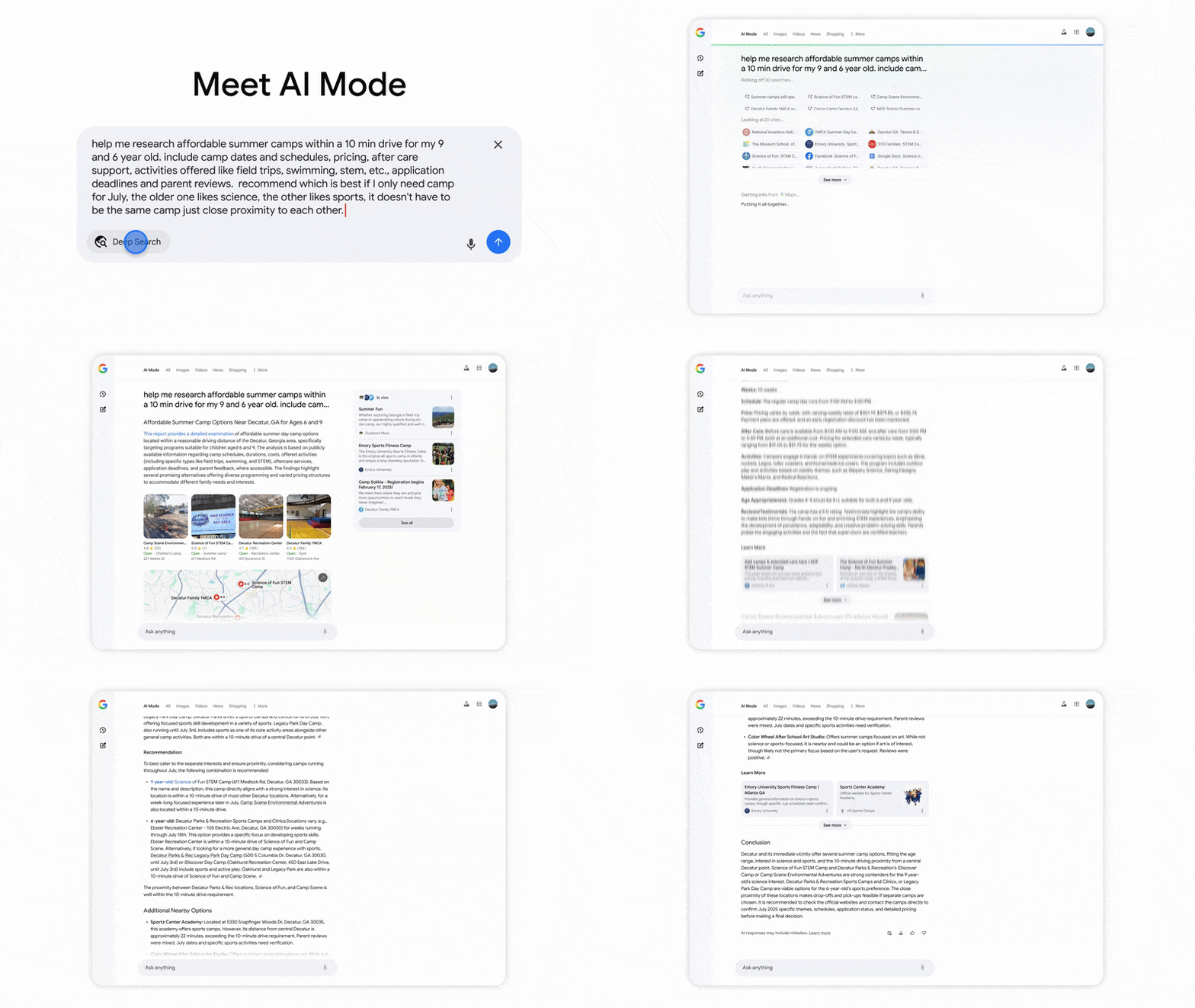
One of the most interesting new features is Deep Searchmode, designed for users who want maximum detail and depth in answers. By activating Deep Search in AI Mode (for example via a dedicated button in the interface), Google runs an even more extreme fan-out, issuing hundreds of sub-searches to cover every angle of the requested topic. The system then reasons across disparate information from many sources and assembles it into a full in-depth report, complete with precise citations of the original sources. The idea is to save users hours of research: instead of reading dozens of articles and PDFs, the user gets an expert-level summary document generated by AI in a few minutes. Google said Deep Search can produce expert-level answers with full references, making it a very powerful tool for academic research, investigative journalism, market analysis and so on.
Example of a Deep Search in action. This GIF (Google I/O 2025) shows AI Mode running a Deep Search: the progress bar indicates the hundreds of queries launched, and at the end a long report is produced with several sections, each with numbered references to web sources. Deep Search uses the same query fan-out technique, but “taken to the next level” according to Google, resulting in a detailed, richly documented answer, ideal for anyone who needs in-depth research without compiling it manually.
Live Search: real-time visual search
Another innovative aspect is the integration of Google Lens and augmented reality features into AI search. With the feature called Live Search, you can use your smartphone camera or AR devices to ask questions about what you see in real time. For example, pointing the camera at a broken engine and asking “how do I fix this part?”, AI Mode will recognize the object and give contextual explanations. During the presentation, Google showed how Project Astra (a Google research project on AR) has been brought into AI Mode: Search becomes a partner that can see what you see, enabling a back-and-forth about the real world framed by the camera. Imagine framing a plant and asking “what plant is this and how do I care for it?” – AI Mode will identify the plant (thanks to Lens image recognition) and give specific gardening advice. Live Search is a first step toward merging online search with perception of the real world, foreshadowing future use cases with AR glasses.

Personalized searches
Interactive charts and analysis
AI Mode can also generate custom charts and quantitative analysis in response to certain queries. This feature is triggered when the user’s question implies numerical comparisons or complex datasets. Google explained that AI Mode can analyze complex datasets and create dynamic charts on the fly, drawing on up-to-date data from the web. For example, asking “compare the home field advantage of two different baseball teams”, AI Mode will process statistics on those teams’ home/away wins and generate an interactive chart showing the differences. Similarly, for financial questions, it could plot the performance of two stocks. These charts are built using Google’s reliable sources (e.g. real-time sports data, financial databases), and let users see answers immediately instead of interpreting numbers in an article. It’s a kind of integration of Google data into search results, with the narrative power of AI explaining the chart in plain words.
AI Mode generates charts and analysis. In the image, for the (hypothetical) query comparing two baseball teams, AI Mode produces a interactive chart bar chart relating home performance. Below the chart, the AI also provides a text analysis (“team A tends to win X% at home…”) to guide the reading. All this happens in real time, using fresh data from Google sources and showing how search is no longer limited to text links but includes explanatory visual elements
AI Shopping and product search with agents
The shopping sector gets a major boost from AI Mode. Google has integrated its huge Shopping Graph (over 50 billion products, continuously updated) directly into AI answers, creating an AI-guided shopping experience. In practice, users can ask generic questions like “I’m looking for a cute travel bag” and AI Mode will start interacting to understand tastes and needs, showing relevant products along the way. For example, in the keynote it was shown that saying “a bag for a trip to Portland in May”, AI Mode launched a shopping query fan-out: it ran parallel searches to understand what makes a bag good for rain and long trips, then used those criteria to filter and suggest waterproof products with roomy pockets All presented in a visual panel on the right with product images and detailed cards, updated dynamically as the conversation progresses. Users can refine their requirements and see suggestions update in real time, also discovering new brands that match their needs. In short, AI Mode becomes a personal shopper that understands preferences expressed in words and picks the best-suited products from Google’s product graph.
But that’s not all: AI Mode also introduces agentic capabilities into the shopping process. “Agentic” means the AI doesn’t just recommend, but can also act on the user’s behalf for certain tasks. For example, if the user finds an interesting product, they can tell Google to track its price. With a click on “track price,” AI Mode will ask the user for some preferences (size, color, maximum budget) and then take care of watching the price and completing the purchase automatically at the right time. Concretely, Google will remember the purchase intent and, if the price drops below the set threshold, notify the user and can then add the product to the cart on the seller’s site and start checkout with Google Pay, with a simple tap to confirm from the user. This feature, reminiscent of a personal shopping assistant, will initially roll out to some US users and specific partners.
The agentic shopping experience in AI Mode. The image shows the sequence: the user tracks an item (e.g. a pair of shoes), setting the desired price and preferences; when the price drops, AI Mode notifies them and, on confirmation, completes the purchase automatically , filling in forms and processing payment (Google Pay). Google calls this feature “agentic” because the AI does the operational work (monitoring and checkout) for the user. The user still stays “in control” – deciding what and where to buy – but saves time by delegating the tedious steps to AI. Similar features could in future extend to other actions, such as restaurant bookings or appointments.

Automated actions (Agentic Actions)
Generalizing the concept above, Google is experimenting with integrating AI agents into search for various tasks. They’ve nicknamed this initiative Project Mariner, and the goal is for AI to perform tasks on the user’s request directly from search results. One example presented was: “Find 2 affordable tickets for this Saturday’s Reds game in the lower level”. On hearing this request, AI Mode started a query fan-out behind the scenes across various ticketing sites, analyzed hundreds of ticket options in real time (considering prices and availability) and compiled for the user a list of options matching the exact criteria (two seats together, lower level, cost within budget). The user can then choose the preferred option and complete the purchase, still inside the AI Mode environment. In this case the system even handled the filling of forms on third-party sites. Google stressed that, despite the automation, “the user is in control”: the AI won’t spend money without consent, but it can greatly simplify procedures like finding and booking tickets, which would normally require many manual steps.

Initially these agentic actions will be implemented for limited scenarios (event tickets, restaurant reservations, local appointments) and with specific partners (for example Ticketmaster, StubHub, OpenTable/Resy, Vagaro). The question remains open of how smaller or independent third-party sites will be able to participate: whether AI will in future be able to interact with any site (perhaps through standard APIs or protocols) to perform actions, or whether it will remain limited to commercial partnerships. Either way, the direction is clear: Google is turning search from an information retrieval system into a task executionsystem, where the line between searching and doing gets thinner.
Deep integration with the Google ecosystem
AI Mode makes full use of Google’s internal data and services to enrich answers. Besides the Shopping Graph already mentioned, it integrates the Knowledge Graph (to answer established encyclopedic facts), Google Maps and local data (to provide geolocated answers and business listings), Google Travel (flights, hotels), Google News (to draw on recent news) and more. When a user asks a question, the AI can weave these sources together seamlessly. For example, asking “best pizza in Milan,” AI Mode might provide a reasoned list of pizzerias, and each name might be linked through an icon to the restaurant’s Google Maps profile (rather than its website), showing reviews, hours, etc. Our own research on Milan highlighted exactly this: when AI Mode mentions businesses or places, it often adds “dotted” links that open an internal Google panel (e.g. the Google Business Profile) instead of leading to the official website.
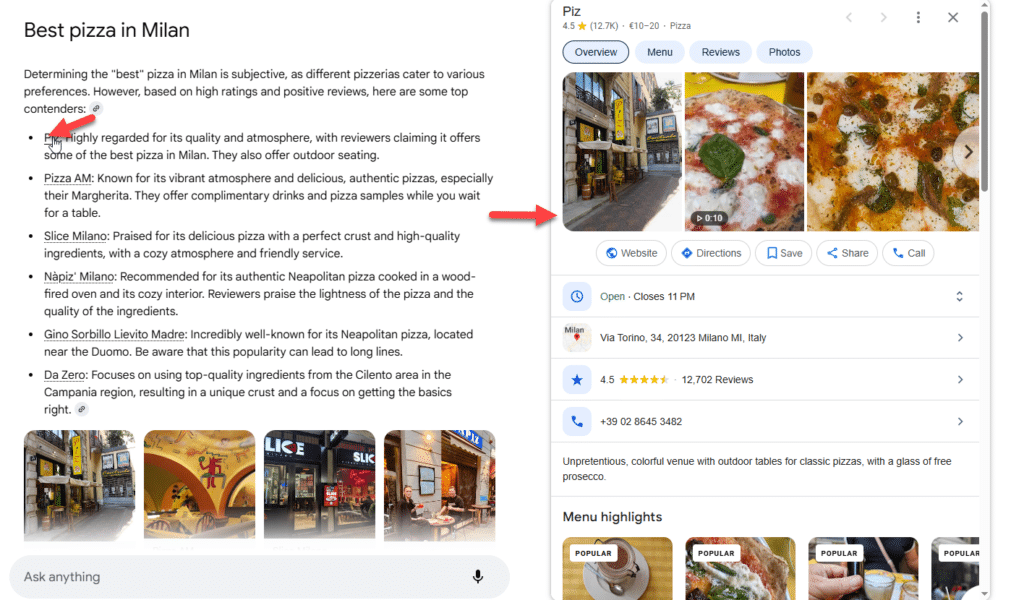
Even if the user explicitly asks for the link to the official website, AI Mode may keep offering the link to the Google listing, from which they can then go to the site, rather than a direct external link. This shows how the goal is to provide as much information as possible without users leaving Google. Of course, the external site link remains available (from the business listing you can reach the site, and Google keeps UTM parameters if present), but it’s an extra step that many users may not take if the information they want is already visible in the AI answer.
This multi-service integration lets AI Mode answer in a multifacetedway: a single answer can tell you a fact, recommend a product, show you a map and perhaps book you an appointment – all at once. For Google, it’s the realization of an extremely engaging, self-containeduser experience, where search is no longer a list of destinations but the destination itself.
SEO implications and strategic advice
The arrival of Google AI Mode is a paradigm shift for anyone working in SEO and content marketing. Below we analyze the main implications and how to prepare for this new era of search.
1. Organic visibility and traffic: toward zero-click
With AI Mode, Google provides comprehensive answers directly on its platform, which reduces users’ need to click through to external sites. In many cases, users may be satisfied with the AI-generated answer without visiting any traditional website. This phenomenon, which began with featured snippets and knowledge panels, explodes in AI Mode: it’s zero-click behavior taken to the extreme. For websites, this means a potential drop in organic traffic, even for content the AI actually uses to formulate the answer. In fact, AI Mode may draw on a site’s information and present it to the user without generating a visit (unless the user expands the citations and chooses to click).
An additional problem for SEOs is that this “AI-mediated” traffic is hard to track. Currently, Google has stated that in Search Console AI Mode data won’t be broken out separately in performance reports. Impressions and clicks generated within AI Mode will flow into the site’s overall data as part of Google Search, with no way to tell whether a click comes from a classic result or from AI Mode. It also appears that clicks from within AI Mode may not pass the traditional “google.” referrer, making them invisible in Google Analytics/GA4 too (a bit like what happened with “not provided”). In other words, if a user clicks a link in AI Mode, that traffic might appear as direct or as coming from Google Maps, etc., but not as “Google Search > AI Mode.” This complicates life for marketers, who struggle to quantify how many visits are actually coming thanks to their presence in AI results.
Google, for its part, suggests a change of perspective: in recent statements it emphasized that, although clicks may decrease, the quality of visits from (AI) search is higher, because a user who clicks after an AI answer is highly motivated and already has context. Google also recommends no longer measuring success only in terms of clicks and considering engagement and user satisfaction metrics instead. In practice, it’s preparing publishers for the idea that less organic traffic doesn’t necessarily mean less value, if that organic traffic is ultra-qualified. The fact remains that for many websites traffic is essential (e.g. publishers who monetize with ads) and the fear is of having content “plundered” by AI without getting visits.
What to do: in this scenario, it becomes important to get cited in the AI answer (when possible) and build a strong brand presence. If the AI mentions our site or uses it as a reference, making sure the site name is clearly visible (e.g. in the URL or brand mention) can increase the chance that users recognize the source and visit the site directly to learn more. Focusing on content that invites action or a visit – for example interactive tools, communities, exclusive offers – can also give users one more reason to click beyond the AI answer.
At YourDigitalWeb we help companies improve their AI visibility by building citations and sources so they can be seen. We work with AI every day and develop methods to support this evolution!
2. Dynamic ranking and the end of static “positions”
As illustrated, AI Mode revolutionizes the concept of ranking: there’s no longer a fixed Top 10 that’s the same for everyone, but a dynamic, multidimensional ranking. Our content could be used by the AI as part of an answer even if it wasn’t #1 for the original query, as long as it semantically and contextually matches one of the relevant subtopics. Conversely, we might rank first for the main query in classic mode, but if our content doesn’t answer any of the sub-questions the AI explores, we could be completely excluded from the AI answer. Mike King of iPullRank points out precisely that “ranking #1 for the main query doesn’t guarantee visibility in AI Mode”, because the AI selects passages based on alignment with the hidden fan-out queries, making appearing in AI Mode a “complex matrix event”
Moreover, deep personalization means that there’s no universal result: we might be included in the AI answer for one user (perhaps because our content exactly matches one of their past interests), but not appear for another user with the same query. Ranking becomes probabilistic, not deterministic. This challenges all the mental models of traditional SEO, which so far has relied on analyzing average SERPs and tracking standard positions.
What to do: SEOs will need to adapt their tools and approaches. One strategy could be to monitor their content’s presence in AI answers through simulated user profiles. For example, create several Google accounts with different histories (tech profile, newbie profile, localized profile) and observe how AI Mode appears for target queries, to understand whether and when your site is cited. You’ll also need to focus not just on ranking for the exact query, but on capturing related and contextual queries. One concept that emerges is the “synthetic query landscape”: imagining which sub-questions the AI might generate around a query and making sure you have content covering them. For example, for “best electric SUV,” the latent queries might be “longest range,” “family safety,” “affordable price” – an automotive site that wants to stand out should cover all these aspects in its content.
3. AI-optimized content: focus on passages and completeness
In the AI Mode era, optimizing means going beyond the page as a whole and taking care of content at the level of individual passages. As we’ve seen, LLMs will compare specific paragraphs across different sites and choose the clearest, most complete and relevant one for each subtopic. This means every paragraph of our article must be able to “hold up” in a direct comparison with competitors’ paragraphs. If our article has weak parts, ambiguous sentences or less precise information, we could lose that comparison even if the rest of the page is excellent. Elements such as the clarity, completeness and specificity of passages become crucial. For example, if we write a guide “10 tips to save energy,” and another site has a similar one but each tip is explained with concrete data while ours is generic, the AI will probably prefer the other site’s passages.
In addition, AI is very sensitive to semantics: using precise terms and maintaining good “embedding alignment” (vector alignment) with the topic is essential. Misleading content or content “inflated” with repeated keywords won’t help – in fact, an advanced LLM might penalize redundant or uninformative text.
What to do: first of all, improve the intrinsic quality of content. This means:
- Structuring articles to cover every relevant subtopic in depth (we could use content gap analysis techniques to identify which related questions to add).
- Treating every paragraph as an almost independent entity: it should have a clear key idea supported by details or examples. In other words, aim to create many “winning passages” within your content
- Avoiding fluff and filler; preferring direct sentences and verifiable information. Remember that an AI model will make a qualitative comparison, not a quantitative one: “which of these two texts answers better?”. So content must excel qualitatively, not just be present.
- Using schema and structured data where possible: this can help the AI extract accurate information more easily. For example, well-formatted tables with product specs, FAQ schema markup for questions/answers, etc., could be read and incorporated into AI answers with greater fidelity.
- Including unique perspectives and direct experience (E-E-A-T). If we provide first-hand experience or original analysis, we become an authoritative, differentiated source, increasing the chances that the AI draws on us. Conversely, commodity content (repeating things found everywhere) will be less likely to emerge.
In short, SEOs will need to embrace the approach of “relevance engineers” (“Relevance Engineers,” as Mike King calls them). Superficial SEO is no longer enough; you need a deep understanding of user intent, data and how an AI would process them, and then structure content accordingly.
- 4. The importance of brand and user engagement
With extreme personalization, user behavior and familiarity with the brand become indirect success factors. We’ve seen that Google builds a user embedding based on past clicks and preferences. This means that if, through other channels, we manage to get a user to interact with and appreciate our brand (for example via social media, newsletters, direct visits), that user will be more likely to see our content emerge in their future AI Mode searches too (because the user embedding will include positive signals toward us). Google has also shown that cross-platform consistency exists: the same results in AI Mode and the Gemini assistant when the user is the same. So building brand loyalty and recognition can literally influence personalized AI answers.
What to do: invest in brand marketing and community activities. This can mean creating high-value content that gets shares and traffic outside Google too (e.g. on social media or via referrals), increasing the site’s reputation (mentions in authoritative publications, quality backlinks), and generally getting users to search for our brand directly or engage with it. Mike King suggests influence users’ search behavior through other branding channels. A practical example: if we have a product or service, run campaigns that lead users to search for our brand name together with keywords (instead of generic keywords) – so Google will understand that for that user our brand is relevant in the industry. In a sense, it becomes crucial to be in the user’s mind so that Google’s AI picks us from its user-linked memory.
5. Rethinking SEO metrics and workflow
Finally, the arrival of AI Mode will force us to rethink some performance metrics and SEO workflows:
-
-
impressions in Search Console could increase enormously (since every Deep Search or query fan-out makes the site appear in more queries) but without a corresponding increase in clicks. We need to understand how to assess the“invisible” impact of being cited without clicks. New metrics may emerge, such as “presence in AI answers” or similar.
-
Classic SEO A/B tests (change the title and see how CTR changes) become hard, because CTR is diluted and conditioned by AI. It may make more sense to test content variations by measuring whether the citation rate in AI answers changes – but at the moment we don’t have direct tools for this. There will be room for new SEO tools dedicated to monitoring AI answers (a bit like today there are tools to track featured snippets).
-
Collaboration with the content team: even more central. SEOs will need to work closely with content strategists and editors to teach them to write in an “AI-friendly” way (but always user-first). For example, teaching them to include direct answers to questions in the text, use headings targeted at possible sub-questions, etc., so the AI can easily find the corresponding chunks.
-
Black-hat or manipulative techniques will probably lose effectiveness. You won’t be able to “fool” an LLM with keyword stuffing or link schemes – in fact, the risk is negatively training the model toward your site if bad practices are detected. So the focus should shift even more toward authentic quality.
-
Google Search AI Mode marks the beginning of a new era for search engines, in which the boundaries between search, assistance and action merge. For users, this means getting richer, more contextual and immediate information – with less effort and in an increasingly personalized way. For SEO professionals and content creators, it means facing unprecedented challenges: from the loss of traditional visibility to the need to adapt content so it can be understood and valued by artificial intelligence.
How can YourDigitalWeb help your business?
-
Search is changing. Google is introducing answers built by artificial intelligence, analyzing content more deeply, selecting specific passages and personalizing everything for the user. But it’s not just about AI. It’s about communicating better.
On one hand, you need structure, clarity and reliability for the new AI models. On the other, you need to be useful, readable and relevant for the people who actually read.
YourDigitalWeb works on both fronts. Not because talking about AI is trendy, but because today it’s the only serious way to build online visibility.
-
We optimize content and websites to be selected by AI answers, but also to guide the real user: from a question to a choice.
-
We study what the engine actually reads: we don’t stop at classic on-page SEO; we analyze how Google segments and uses content.
-
We help clients structure texts, data and formats that work both for neural models and for people looking for clarity, reliability and guidance.
We work with companies that want to build solid, technically refined content with a human tone. Companies that want to be found for what they know, not just for how they optimize.
We don’t promise magic. We offer a serious, transparent approach that combines advanced SEO skills with attention to communication. Because today, to be chosen, being there isn’t enough: you need to be understood.
If you want to take your online presence to the next level, we’re happy to listen. And we’ll help you do it right.
-
- Sources and contributions:
The information in this article is based on official Google statements (including technical documentation, announcements and demos at Google I/O 2025), detailed analysis by Mike King of iPullRank, observations and tests by SEO experts such as Lily Ray, as well as our own field tests. YourDigitalWeb ran tests on AI Mode to support the information and details

Marco Maltraversi
CEO and founder of YourDigitalWeb
He founded YourDigitalWeb in 2009 and is an SEO and GEO consultant with a background in software engineering. He has written books on SEO and artificial intelligence, including “Generative SEO” (Edizioni LSWR), teaches in university programs and runs the DeepSEO training program. He has spoken at SMAU, Web Marketing Festival and Search Tech.
One click and, when you search for SEO, AI and marketing, our articles will show up more often in Google’s Top Stories.