Table of contents 5 sections
Online search no longer runs through Google alone. A growing share of questions goes to AI assistants that answer with a short summary and cite their sources, while people who want more privacy or an independent index turn to alternative search engines. Below are the 10 most widely used AI search engines and assistants, plus 10 Google alternatives worth knowing, with what each does well, where it falls short, and what it all means for SEO.
10 AI search engines to know
These tools use large language models (LLMs) to understand natural-language questions, search the web, and return a ready-made answer, often with links to the sources. For a business, two things matter: whether your website gets cited, and how your brand is described.
-
ChatGPT Search – chatgpt.com
The web search built into OpenAI’s ChatGPT. It answers conversationally and shows the sources it used. It has become one of the main gateways to information outside Google. -
Google AI Mode and AI Overviews – google.com
Gemini-generated answers inside Google Search: AI Overviews appear above the results, while AI Mode is a dedicated conversational mode. Both change how people click on results. -
Gemini – gemini.google.com
Google’s assistant, connected to Search and to Google services such as Gmail, Drive, and Maps. Useful for in-depth research and document work. -
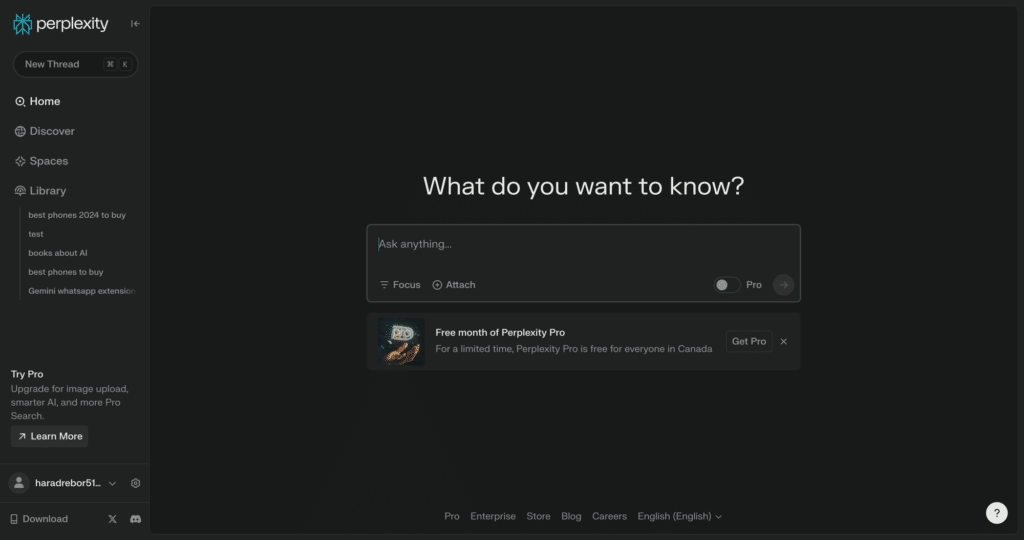
Perplexity – perplexity.ai
Built as an “answer engine”: every answer rests on numbered, clickable web sources. It also offers in-depth research (Deep Research) and its own browser. -
Microsoft Copilot – copilot.microsoft.com
Microsoft’s assistant, powered by the Bing index and built into Windows, Edge, and Microsoft 365. -
Claude – claude.ai
Anthropic’s assistant. With web search turned on, it reads pages and cites its sources; it is widely used for analysis and long documents. -
Grok – grok.com
xAI’s assistant, built into X: it combines web search with posts published on the platform. -
Meta AI – meta.ai
Meta’s assistant inside WhatsApp, Instagram, Messenger, and Facebook. For many people it is their first chatbot, because it already lives in the apps they use every day. -
You.com – you.com
One of the first engines to combine web results with chat. In recent years it has focused mainly on AI search for businesses. -
Kagi Assistant – kagi.com
Kagi is an ad-free, paid search engine; its assistant lets you use several AI models on top of Kagi’s search results.
Comparison table: AI search engines
| Name | Company | Strengths | Limitations |
|---|---|---|---|
| ChatGPT Search | OpenAI | Huge user base, conversational answers with sources | Cited sources can vary a lot from one question to the next |
| Google AI Mode / AI Overviews | Built into the most-used search engine, Google’s index | Fewer clicks to websites on many informational queries | |
| Gemini | Connected to Google services, in-depth research | The best features require a subscription | |
| Perplexity | Perplexity AI | Sources always visible, great for documented research | Smaller audience than ChatGPT and Google |
| Microsoft Copilot | Microsoft | Bing index, Windows and Edge integration | Experience differs between consumer and business versions |
| Claude | Anthropic | Accurate analysis, handles long documents | Less geared toward quick, search-engine-style lookups |
| Grok | xAI | Real-time access to posts on X | Social sources need fact-checking |
| Meta AI | Meta | Already inside WhatsApp and Instagram | Some features reach Europe later than the US |
| You.com | You.com | Pioneer of chat-based search, multiple models | Now more focused on the business market |
| Kagi Assistant | Kagi | No ads, choice of AI model | Paid service |
10 Google alternatives
These platforms focus on privacy, independence, or sustainability. Some run their own index; others show Bing or Google results without profiling you. That difference matters for SEO, too.

-
Bing – bing.com
Microsoft’s search engine. Its index also powers Copilot and several other services, so good Bing indexing matters more than it seems. -
DuckDuckGo – duckduckgo.com
The best-known privacy-focused engine: it doesn’t profile users and offers optional AI answers. -
Brave Search – search.brave.com
Runs its own independent index and shows AI summaries at the top of the results, with no tracking. -
Startpage – startpage.com
Shows results sourced from Google without passing your personal data to Google. -
Ecosia – ecosia.org
A Berlin-based engine that puts its profits into environmental projects such as tree planting. Together with Qwant, it is building a European search index. -
Qwant – qwant.com
A privacy-minded French engine and Ecosia’s partner in the European index project. -
Mojeek – mojeek.com
A British engine with its own crawler and an index built from scratch, with no tracking. -
Kagi – kagi.com
A subscription engine with no ads that lets you personalize results (for example, by blocking or boosting specific sites). -
SearXNG – docs.searxng.org
An open-source metasearch engine and the successor to Searx: it aggregates results from multiple engines and can be self-hosted. -
MetaGer – metager.org
A German metasearch engine run by a nonprofit association, with a strong focus on data protection.
Comparison table: alternative search engines
| Name | Index type | Strengths | Limitations |
|---|---|---|---|
| Bing | Own | Powers Copilot and other services | Much smaller market share than Google |
| DuckDuckGo | Mixed (third-party sources, mainly Bing) | Privacy, simplicity | Thinner local results |
| Brave Search | Own | Independence, AI summaries, no tracking | Coverage still smaller than the big engines |
| Startpage | Google results | Google-quality results with more privacy | Fewer features than Google |
| Ecosia | Mixed, moving to a European index | Sustainability, based in Europe | Limited advanced features |
| Qwant | Mixed, moving to a European index | Privacy, based in Europe | Performance varies by language and country |
| Mojeek | Own | Fully independent | Smaller index |
| Kagi | Mixed | No ads, customizable results | Paid |
| SearXNG | Metasearch | Open source, self-hostable | Quality depends on the instance you use |
| MetaGer | Metasearch | Nonprofit, data protection | Less modern interface |
How to get found on these engines: SEO and GEO
Working on visibility in AI engines is called GEO (Generative Engine Optimization). It starts from the same foundations as SEO, with a few extra points:
- Get indexed in more than one index: verify your site in Google Search Console and in Bing Webmaster Tools. Many AI assistants rely on Bing or on their own indexes.
- Let AI crawlers in: check that your robots.txt file doesn’t accidentally block the bots of the AI engines you want to reach.
- Clear, quotable content: direct answers in the first lines, verifiable data, definitions, and paragraphs that can be quoted on their own.
- Structured data: schema.org markup for your organization, products, articles, and FAQs helps these systems understand who you are and what you offer.
- Brand authority: mentions on trusted sites, reviews, and consistent business information across the web shape how assistants describe your brand.
- Monitoring: regularly check how ChatGPT, Perplexity, Gemini, and AI Overviews answer the key questions in your industry.

YourDigitalWeb helps companies with GEO consulting and advanced SEO: we analyze how your brand shows up in AI answers and build the content and signals that make it more likely to be cited.
A new way to search
AI engines don’t fully replace traditional search, but they change the user journey: many questions get answered without a click, and the sites cited in those answers gain trust. Google alternatives, meanwhile, are growing among people who want privacy and independence. For a business, the right strategy is to be present and consistent wherever customers search.
FAQ
What’s the difference between a traditional search engine and an AI search engine?
A traditional engine shows a list of links; an AI engine reads the pages and returns a ready-made answer, usually with its sources cited.
Do Google alternatives really protect your privacy?
Privacy-focused engines such as DuckDuckGo, Brave Search, Startpage, and Mojeek state that they don’t profile users. It’s still worth reading each service’s privacy policy.
Why does Bing indexing matter for AI visibility?
Because the Bing index is used by Microsoft Copilot and other search services: a site that is missing or poorly indexed on Bing may be invisible to those assistants too.
What is GEO?
It’s the set of activities that increase the chances of a website being cited in answers from AI engines such as ChatGPT, Perplexity, Gemini, and Google AI Overviews.
Which Google alternative has a positive environmental impact?
Ecosia puts its profits into environmental projects, including tree planting.

Marco Maltraversi
CEO and founder of YourDigitalWeb
He founded YourDigitalWeb in 2009 and is an SEO and GEO consultant with a background in software engineering. He has written books on SEO and artificial intelligence, including “Generative SEO” (Edizioni LSWR), teaches in university programs and runs the DeepSEO training program. He has spoken at SMAU, Web Marketing Festival and Search Tech.
One click and, when you search for SEO, AI and marketing, our articles will show up more often in Google’s Top Stories.