Table of contents 2 sections
Wikipedia’s recent decision to strictly limit the use of artificial intelligence in creating and editing articles is an important step in the digital information landscape. It isn’t a stance against technology, but a targeted move to preserve the platform’s founding principles: verifiability, neutrality and reliability.
The editor community has introduced a precise distinction between assistive and generative use of AI. In short, automated tools can support marginal tasks, such as copyediting or translation (though the limits on the latter are much stricter), but they aren’t allowed for building content. Every piece of information must be added, verified and contextualized by a human contributor.
Why Wikipedia made this choice
In recent months, Wikipedia has seen an increase in content produced or reworked with language models. The problem isn’t so much the form, often correct and fluent, as the substance. Automatically generated text tends to show recurring issues:
- unverifiable or non-existent citations
- plausible reconstructions not supported by sources
- oversimplification of complex topics
- difficulty staying consistent with encyclopedic guidelines.
In short, it’s content that requires more complex review work than text that’s clearly unsuitable. As a result, the workload for volunteers increases and the risk of errors grows. Hence some long-anticipated changes: the need for verifiable human-origin content, stricter editorial control, source evaluation remaining central at every stage and a higher risk of removal for non-compliant content. For those working on this, it also means that a formally correct text is no longer enough: the structure must meet precise encyclopedic criteria, every statement must be backed by authoritative sources and the tone must remain neutral. These guidelines have been in place for some time, but they will now be enforced even more strictly.
The impact on companies and brands
As is well known, a presence on Wikipedia still conveys authority, but the bar has risen further. Companies that want to create or update an entry must meet strict requirements such as:
- demonstrating real encyclopedic notability
- relying on independent, reliable sources
- avoiding any promotional approach
- respecting the dynamics of the editorial community.
In short, the risk is that the AI ban makes the system even more selective , and that content built with automated tools or without proper oversight may be removed quickly, with possible consequences for digital reputation too. In Italy, moreover, attention to the quality of online information has grown significantly. The debate on artificial intelligence, privacy and source reliability has raised awareness among both institutions and digital operators. For Italian companies, this translates into greater complexity in managing their presence on authoritative platforms. Wikipedia, in particular, requires a methodical approach that complies with its internal rules, which don’t always match the logic of traditional digital marketing.
Why it’s better to rely on a professional
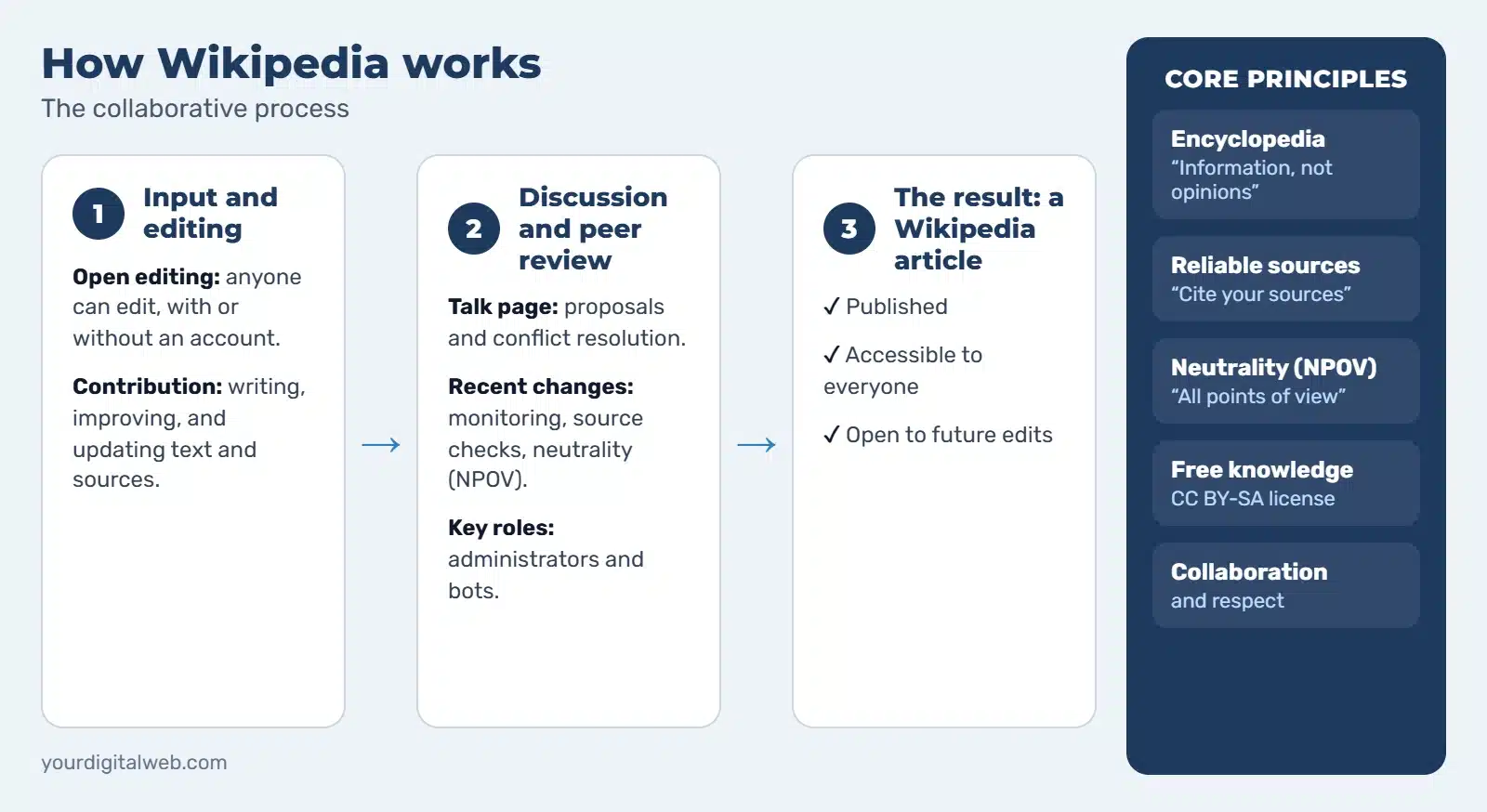
Managing a Wikipedia entry correctly means working within a system with its own, highly distinctive rules. It isn’t just about writing content, but about building a page that lasts over time and can pass checks, reviews and public discussions. That’s why specific skills are needed:
- in-depth knowledge of the policies
- the ability to select and validate sources
- experience managing revisions
- understanding of community dynamics.
In this scenario, support from specialized firms like ours becomes more than strategic, ensuring a professional approach that reduces the risk of removal and builds a presence consistent with the required standards. To learn more and get a free initial consultation on whether you can be included in Wikipedia in a stable, effective way, request a Wikipedia consultation now!

Roberto Rais
Esperto Wikipedia e GEO
On the YourDigitalWeb team, works on Wikipedia and Generative Engine Optimization projects, helping companies and professionals build an authoritative, verifiable presence that search engines and AI recognize and cite.
One click and, when you search for SEO, AI and marketing, our articles will show up more often in Google’s Top Stories.