Table of contents 8 sections
- MCP and ACP: the two building blocks of future e-commerce
- What WooCommerce can already do today
- How agentic commerce (ACP) works
- What changes for e-commerce operators
- WooCommerce is already on the right track
- From experience to opportunity
- Preparing your WooCommerce store today
- How other e-commerce platforms are moving
A profound change is underway in e-commerce: the arrival of agentic commerce. It means it’s no longer just the user who browses, chooses and pays, but an intelligent agent an AI system that can search, compare and buy on their behalf, securely and transparently.
It’s an evolution that will change how online stores interact with customers, and WooCommerce is already leading the way with two key acronyms: MCP and ACP
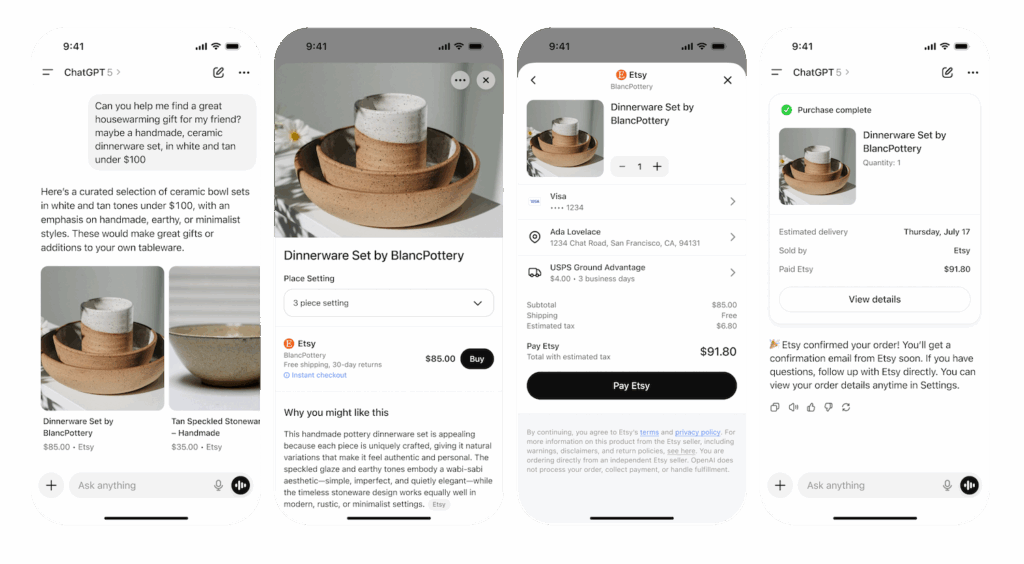
Here’s our article on how ChatGPT has integrated e-commerce systems into search
MCP and ACP: the two building blocks of future e-commerce
MCP (Model Context Protocol) is a universal language that lets AI models “talk” to digital platforms.
In plain terms: an AI agent can ask a WooCommerce site to show it products, prices, variants or orders, and receive structured, understandable answers updated in real time.
ACP (Agentic Commerce Protocol) goes further.
It’s the standard that lets an AI agent complete a purchase securely, without the user having to manually enter sensitive data like card numbers or shipping addresses.
Payment takes place through delegated tokens, a secure, temporary form of authorization: the agent acts, but the transaction stays fully under the user’s control.
In other words, it’s like having a digital assistant that can complete a purchase for you at a trusted store, following your instructions and respecting your limits.
What WooCommerce can already do today
In its latest versions, WooCommerce has started natively integrating support for MCP.
In practice, an online store can already expose its “abilities” that is, the functions an AI agent can use: search for a product, add it to the cart, check an order, update information.
This is the first concrete step toward an “AI-ready” store: a system that can talk directly with digital agents.
Imagine a user asking ChatGPT:
“Find me a pair of lightweight running shoes, size 9, under $100, with two-day delivery.”
If your e-commerce store is already MCP-compatible, the agent can query your catalog, read availability and prices, and show your products as ideal options.
Manual search is no longer needed, because the conversation itself becomes the buying engine.
How agentic commerce (ACP) works
ACP is the natural extension of this logic.
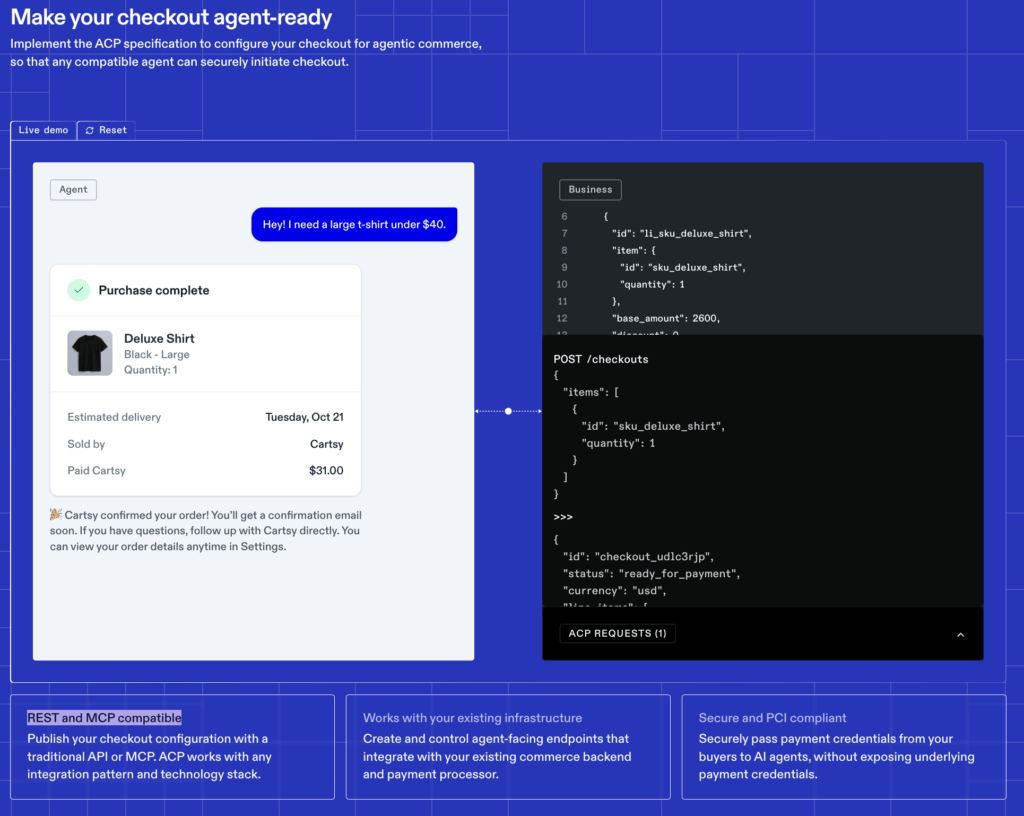
While MCP acts as the language, ACP adds the transactional layer: the agent doesn’t just find the product, but can complete the purchase on the user’s behalf, securely and verifiably.
Here’s the simplified flow:
The AI agent queries your store via MCP to read the catalog.
The user chooses the product directly in the chat.
The agent obtains a temporary, limited payment token.
The token is sent to your WooCommerce store.
The store processes the payment through the provider (e.g. Stripe) and confirms the order.
It all happens in a few seconds, with no forms and no friction, with the same security as a traditional transaction.
The experience is smooth, natural and, above all, driven by artificial intelligence.
What changes for e-commerce operators
For a merchant or a company that sells online, this shift is strategic.
Being compatible with MCP and ACP means making your store accessible to AI agents too, which are becoming the new intermediary between customer and brand.
A customer will be able to say: “ChatGPT, reorder the face cream I bought last month,” and the agent will be able to do it, if the store is ready.
This brings several tangible benefits:
-
New sales channels: your products can be discovered and bought outside your website too, directly through conversational assistants.
-
A more natural buying experience: the user doesn’t fill in forms or navigate endless menus: they talk and buy.
-
Fewer checkout abandonments: the agent handles the process immediately and without friction.
-
More precise data: interactions with the AI agent offer richer insights into customer behavior and preferences.
-
Built-in security: delegated payments remove the risks of handling sensitive data directly.
WooCommerce is already on the right track
MCP support in WooCommerce is currently in developer preview.
Not all features are ready, but the engine is there.
Upcoming versions will expand support for checkout operations, delegated payments and direct integration with providers like Stripe, which has already introduced its first ACP-compatible APIs.
This means an up-to-date WooCommerce store can already start preparing:
-
Enabling MCP endpoints.
-
Making the catalog queryable in a structured format.
-
Updating the payment gateway to versions compatible with secure tokenization.
-
Configuring access and authorization rules for trusted agents.
These steps lay the groundwork for a future where purchases happen inside the conversation, not just in the cart.
From experience to opportunity
We’re at a turning point: commerce will no longer just be digital, but autonomous.
Intelligent agents won’t replace the human experience; they’ll enhance it, making every interaction more personalized, faster and more consistent with the user’s real intent.
Companies that start integrating MCP and ACP now will have a huge advantage when this new mode becomes standard.
Those who wait risk staying invisible to the agents that will soon become the main buying channel.
Preparing your WooCommerce store today
Every e-commerce store is different, and adopting MCP/ACP requires a technical assessment:
APIs, security, payment flows, data structure and legal compliance.
You need an integrated strategy, not just a plugin.
This is where the right consulting comes in.
Implementing an “agent-ready” system means:
-
making the store recognizable to AI agents;
-
ensuring payments use secure, delegated protocols;
-
configuring feeds and manifests compatible with the new standards;
-
testing interactions between WooCommerce and real AI (like ChatGPT or other agent marketplaces).
With the right technical support, your store can become one of the first in Italy to sell directly to artificial intelligence.
How other e-commerce platforms are moving
It isn’t just WooCommerce exploring the future of agent-centric e-commerce. Other platforms are also actively investing in standards and integrations that enable interactions between intelligent agents and online stores. Here are some interesting scenarios:
Shopify
Shopify is one of the front runners in integrating with OpenAI and prototyping delegated checkout. It has already announced compatibility with the “Buy It in ChatGPT” model, letting users buy products directly inside AI conversations through compatible gateways and secure payment tokens. Shopify is developing APIs for agentic commerce and working on SDKs that let merchants enable this feature in a few clicks.
Magento / Adobe Commerce
As a highly customizable platform, Magento has an architectural advantage: it can be extended with MCP/ACP modules, and with some clients we’re already testing custom plugins that add agentic endpoints for catalog operations and delegated checkout. The main challenge is ensuring these extensions are secure, updatable and compatible with future versions of the platform.
BigCommerce
BigCommerce has announced a roadmap to support integrations with AI assistants and smart payment providers. The strategy is to offer “headless agentic commerce,” meaning a backend that exposes APIs external agents can call while the front end stays flexible for the business. This way merchants can start experimenting with AI agents without overhauling their site architecture.
Headless / API-first platforms
Platforms headless or API-first platforms (such as commercetools, Saleor, Medusa) are particularly well positioned for this evolution. Since they’re already decoupled, exposing agentic endpoints is more natural: you just add an ACP/MCP layer on top of the existing API. Some startups are already offering “agentic commerce modules” for these architectures, providing delegated payment modules, agentic manifests and transaction orchestration.
Want to know whether your e-commerce store is ready for this transformation?
We can help you check compatibility, configure MCP and prepare the ACP integration step by step, without disrupting your store’s current operations.
A small step today can put you at the center of the next online commerce revolution.

Davide Prevosto
Senior Developer and Technical Consultant
Senior developer and technical consultant at YourDigitalWeb, he handles the technical side of SEO and GEO projects. He co-authored the book “Generative SEO” (Edizioni LSWR) with Marco Maltraversi and Giovanni Sacheli.
One click and, when you search for SEO, AI and marketing, our articles will show up more often in Google’s Top Stories.