Table of contents 6 sections
Imagine having an unlimited advertising budget. Nice, right? Unfortunately, reality is different. Every euro invested has to bring a return. And yet we still see too many companies making the most expensive mistake in digital marketing: trying to sell everything to everyone.
If your message is aimed at “anyone with a wallet,” you’re talking to no one. Your marketing becomes background noise. In this practical guide from YourDigitalWeb, we leave outdated theories behind and show you how Data Intelligence can help you define your Target Audience with laser precision, turning anonymous visitors into loyal customers.
The Basics: Don’t Confuse the Lake with the Fish
The first step toward a failing strategy is confusing the Market with the Audience. It’s a distinction that saves thousands of euros in ad spend.
| Concept | Definition | Practical Example (Fitness Industry) |
| Target Market (The Lake) | The entire ecosystem of potential consumers in your industry. It’s broad and generic. | Everyone in Italy interested in getting back in shape. |
| Target Audience (The Fish) | The specific segment, defined by data and behavior, that you want to reach with that specific campaign. | Women, 30-45, new moms, looking for short 20-minute home workouts to get back in shape after pregnancy. |
The key point: You can’t use the same bait to catch a tuna and a trout. If you define your audience, you know exactly which bait (message), hook (product) and technique (channel) to use.
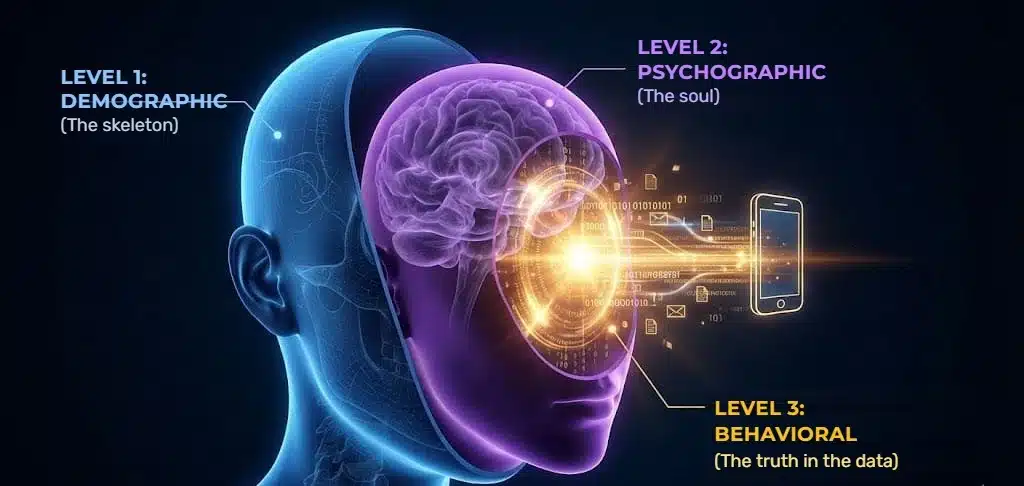
Anatomy of an Audience: The 3 Levels of Depth
Up to ten years ago, it was enough to say: “My target is men between 30 and 50.” Today, with digital content saturation, this approach is useless.
To find who will actuallybuy, we need to go down three levels, moving from what people are to what people do.
Level 1: Demographic (The Skeleton)
It’s the statistical foundation. It serves to exclude those who can’t be your customers.
-
Age, Gender, Location.
-
Income and spending power: There’s no point showing a Ferrari to someone looking for a used compact car.
-
Job role (in B2B): Are you talking to the technician or to the decision-maker who signs the check?
Level 2: Psychographic (The Soul)
Here we get inside the customer’s head. We need to understand what motivates them.
-
Values: Do they prefer saving money or status symbols? Sustainability or convenience?
-
Interests and Hobbies: What do they do when they’re not working?
-
Pain Points: What keeps them up at night? Your product must be the aspirin for their specific headache.
Level 3: Behavioral & Data Intelligence (The Truth)
People lie in surveys, but their clicks never lie. This is the level on which we at YourDigitalWeb build winning strategies.
-
Purchase history: What have they already bought?
-
Interaction frequency: Are they occasional visitors or “super fans” who read every email you send?
-
Device: A user browsing on an iPhone 15 Pro Max often has a different propensity to spend than someone using an 8-year-old desktop PC.
From Theory to Practice: Advanced Targeting Examples
Let’s see how to turn a vague idea into a profitable target.
Example A: Premium Artisan Coffee E-commerce (B2C)
-
❌ Generic Target (Failing): “Anyone who drinks coffee in Italy.”
-
✅ YourDigitalWeb Target Audience: “Men and women, 30-55, living in large urban areas (Milan, Rome, Turin). They have a medium-high income. They follow ‘slow food’ and wine-tasting pages. They’re not looking for a quick caffeine hit, but for an experience. They use Instagram to discover new niche brands. They’re willing to spend €25 for 250g of coffee if the producer’s story is convincing.”
Example B: Shift Management Software for Restaurants (B2B)
-
❌ Generic Target (Failing): “All restaurants.”
-
✅ YourDigitalWeb Target Audience: “Owners or Restaurant Managers of independent venues with at least 15 employees. They’re stressed by managing shifts manually on Excel or WhatsApp. They want to reduce scheduling errors and save time on weekends. They’re pragmatic, not very tech-savvy, and want a ‘set and forget’ solution that works on a tablet.”
Example C: High-End Boutique Gym (Local Business)
-
❌ Generic Target (Failing): “People in the neighborhood who want to lose weight.”
-
✅ YourDigitalWeb Target Audience: “Professionals (lawyers, managers) working within 3 km of the gym. They have little time (a 1-hour lunch break) and want maximum efficiency and privacy. They’re not interested in bodybuilding, but in ‘functional training’ to manage work stress. They appreciate premium services such as clean towels and private luxury showers.”
The Secret Weapon: Defining the “Anti-Persona”
Sometimes, knowing who you DON’T want is more important than knowing who you do want.
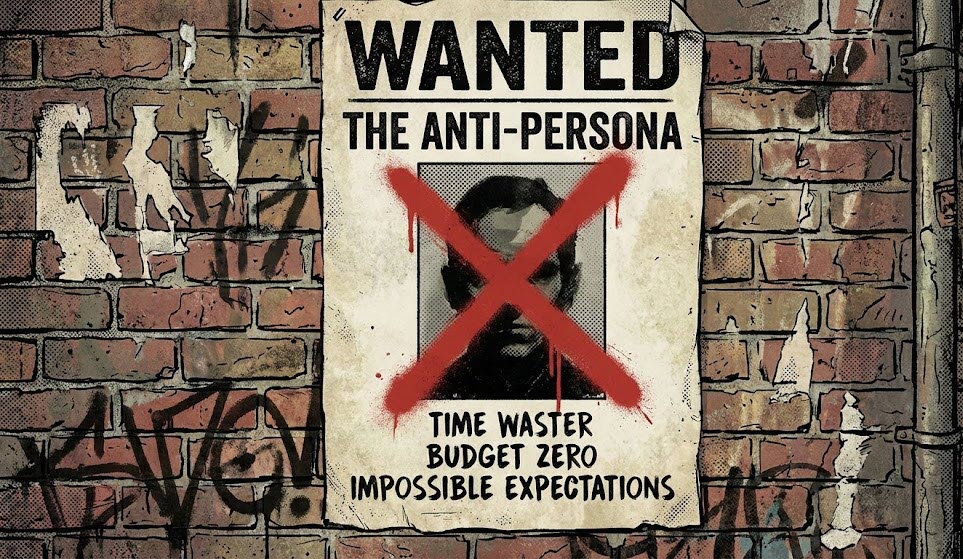
The Anti-Persona is the customer who costs you more than they bring in. The one who asks for endless discounts, has unrealistic expectations or simply isn’t ready for your premium service.
If you define the Anti-Persona, you can write your marketing copy to actively repel them.
Example: If you’re a high-end consultant, writing on your website “Our services start at €5,000” is a great way to keep away the “free-quote hunter” Anti-Persona and attract only serious clients.
FAQ: Frequently Asked Questions about Target Audience
Q: If I narrow my target too much, don’t I risk losing sales opportunities?
A: It’s the opposite. In digital, specificity sells. If you try to talk to everyone, your message will be so watered down that no one will feel involved. Better to have 50% of a niche market than 0.01% of the global market.
Q: Can I have more than one Target Audience?
A: Absolutely. Most companies have 2 or 3. What matters is creating separate campaigns and messages for each. Don’t send the same email to the CEO (who wants ROI) and the IT technician (who wants ease of use).
Q: How often should I update my audience definition?
A: The market isn’t static. Think about how TikTok changed habits in two years. We recommend a light review every quarter and an in-depth data analysis every year, or whenever you launch a major product.
Stop Guessing, Start Hitting the Target
Defining your Target Audience isn’t an academic exercise to do once and lock in a drawer. It’s the compass that guides every single marketing decision: from your website copy to choosing the influencer to work with.
Without a clear definition, you’re flying blind.
Do you feel your marketing is talking to the wrong people?
Often the problem isn’t the product, it’s who you’re showing it to. At YourDigitalWeb, we don’t use crystal balls: we use Data Intelligence to discover who your ideal customers really are and where to find them.
👉 [Contact us today for a preliminary analysis of your audience and stop wasting budget.]

Roberto Rais
Esperto Wikipedia e GEO
On the YourDigitalWeb team, works on Wikipedia and Generative Engine Optimization projects, helping companies and professionals build an authoritative, verifiable presence that search engines and AI recognize and cite.
One click and, when you search for SEO, AI and marketing, our articles will show up more often in Google’s Top Stories.