Table of contents 8 sections
- The Definitive Guide to TikTok Timing Strategy in Italy
- 1. The Algorithmic Ecosystem: Semantic Search and Indexing
- 2. Temporal Psychographics: How Italian Users Behave
- 3. Data Analysis: The Best Times to Post in Italy
- 4. Industry Deep Dive: Vertical Chronobiology
- 5. Critical Technical Factors: Shadowbans, Fingerprinting, and Bots
- 6. Advanced Strategies: AI and What’s Next
- 7. The A.R.T. Method
The Definitive Guide to TikTok Timing Strategy in Italy
In today’s digital landscape, the question “What time should I post on TikTok?” is no longer just a scheduling detail. It has become a complex question of algorithmic engineering, behavioral psychology, and predictive analysis. For years, marketers and creators relied on static tables and generic heatmaps, hoping that timing an upload to a statistical traffic peak would be the key to going viral. A closer look at how the platform works today, however, shows that this strategy, taken out of context, is outdated, and can even backfire for anyone working in a complex market like Italy.
This report, written for the professional audience of YourDigitalWeb and structured as a high-level strategic analysis, explores the new frontier of “digital chronobiology”: the study of users’ biological, psychological, and social rhythms, cross-referenced with the processing cycles of the AI systems that run TikTok’s ecosystem. We are no longer operating in a simple social graph built on personal connections, but in a predictive, semantic interest graph , where the “when” is inseparable from the “what,” the “why,” and above all “how” the algorithm interprets the content.
TikTok has completed its transformation: it is no longer just a passive entertainment platform (a “lean-back experience”). It has become a primary visual search engine, an integrated e-commerce platform (TikTok Shop), and a key discovery tool for Gen Z and Gen Alpha, with growing influence on B2B decision-makers and Millennial consumers too. As a result, finding the best time to post requires a holistic understanding of three converging factors that define visibility today:
-
Semantic Indexing Latency (SIL): The technical time the AI needs to process, “watch,” “listen to,” and categorize content before it can distribute it effectively.
-
The temporal psychographics of Italian users: Specific behavioral patterns such as revenge bedtime procrastination and the Sunday scaries, which change attention curves dramatically compared with global averages.
-
The content lifecycle: Managing the “cold start” phase, the importance of early engagement, and the long tail of SEO that turns videos into evergreen assets.
The goal of this analysis is to break down the usual conventions and offer a detailed, tactical view of how to win the For You feed (FYP) in Italy, moving past the oversimplified “usual tables” and taking a scientific approach to content distribution.
1. The Algorithmic Ecosystem: Semantic Search and Indexing
To understand when to post, you first need to understand how TikTok handles the time variable. The algorithm no longer thinks in strictly chronological terms. While freshness (recency) is still a factor, semantic relevance and the interest prediction have become the dominant drivers of distribution.
1.1 From “Push” to “Pull”: TikTok as a Visual Search Engine
Unlike the chronological feeds of the past, which showed content in order of arrival, TikTok now works as a sophisticated hybrid between an ultra-personalized TV channel and a semantic search engine. Users don’t just passively “receive” content; they actively search for it, or it’s suggested to them based on highly accurate predictive behavioral models.
The timing implications of this shift are critical. If TikTok is a search engine, then content has to be indexed properly before it can be distributed effectively. Posting exactly at peak traffic could turn out to be a strategic mistake, like trying to sell a product from the shelf while it’s still sitting in the warehouse. The system needs a technical window to figure out who to show the video to.
The platform’s move toward a search-centric model means visibility doesn’t end in the first few hours after posting. With Google indexing TikTok videos more and more aggressively and showing them directly in its SERPs (search engine results pages) for how-to queries, product reviews, and trends, your timing strategy has to account not only for the immediate impact on the For You feed but also for long-term discoverability.
1.2 The Indexing Latency Theory (the Pre-Indexing Window)
Technical data and empirical analysis point to a technical time window that can be described as semantic indexing latency. During this interval, which can range from 30 to 90 minutes after upload, TikTok’s AI runs a deep, multidimensional scan of the uploaded content. This process isn’t instant and involves several analysis technologies:
-
Computer vision: The algorithm analyzes every frame to recognize objects, settings, brands, on-screen text and, crucially, facial expressions and visual context.
-
NLP (natural language processing): The audio is automatically transcribed (speech-to-text), captions are analyzed semantically, the main keywords are extracted, and the system evaluates the tone of voice.
-
Safety and compliance check: An automated review checks for policy violations, audio copyright issues, or sensitive content that could call for limited reach (a preventive shadowban).
Your timing strategy therefore has to factor in this “machine time.” If you post at 8:00 p.m. (a hypothetical peak) and indexing takes 60 minutes to categorize the video well enough to match it with the right audience, the video might only enter the main distribution flow (the For You page) at 9:00 p.m., when peak attention is already fading or changing.
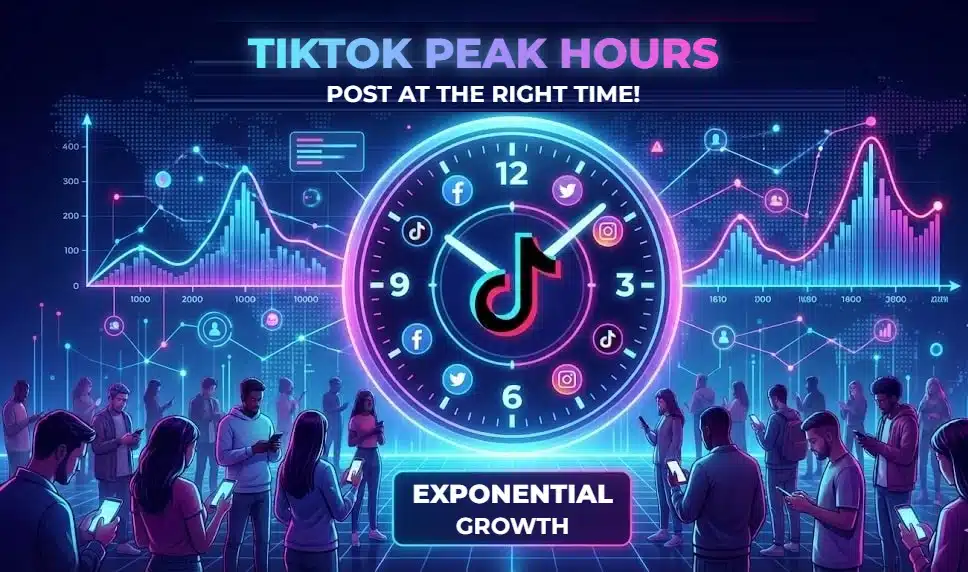
Strategic insight: The winning tactic isn’t to post during the peak, but to get ahead of it. You need to calculate a strategic offset (a negative time shift). Posting about 60 to 120 minutes before your audience’s expected peak activity gives the algorithm time to finish semantic indexing, test the content on a small sample (the seedphase), and add it to the pool of viral candidates right when the main wave of users logs on.
1.3 How Much Each Metric Weighs: Watch Time vs. Early Engagement
To pin down the perfect time, you need to know which metrics the algorithm is trying to maximize at that moment. The algorithm’s priorities have been clearly mapped out :
| Algorithmic metric | Estimated weight | Timing implication |
| Watch time and completion rate | 40-50% | Long videos (over 1 minute) need times of day when users have time to watch (evenings, weekends). |
| Early engagement | 25-35% | Interactions in the first hour are crucial. Posting when your community is active (even if it isn’t the absolute peak) is vital. |
| Engagement quality | 15-20% | Saves and shares count more than likes. They require useful content, often tied to moments of planning or buying. |
| Recency and pattern interrupt | 5-10% | Novelty helps, but it can’t make up for weak or poorly indexed content. |
This hierarchy suggests that your posting time should favor not just passive viewing but the user’s ability to watch the whole video. Posting a 3-minute video at 8:30 a.m., while users are standing on a crowded bus or driving, dooms it to a low completion rate, killing its future reach no matter how good it is.
1.4 Search Everywhere: Google’s Impact and the Long Tail
Another layer of complexity comes from the convergence of social media and traditional search engines. “Search everywhere optimization” means TikTok videos compete not only for fleeting attention in the feed but also for stable rankings in search. Google and AI platforms index video content based on relevance signals that build up over time.
This slightly eases the obsessive pressure over the “exact minute” for evergreen content (tutorials, reviews, explainers) and shifts the focus to metadata quality. For trend-driven content (trending sounds, challenges), however, timing is still critical: jumping on a trend 24 hours after its peak means missing the wave of algorithmic virality that favors recency.
2. Temporal Psychographics: How Italian Users Behave
Italy has unique cultural, social, and behavioral traits that make global posting tables (often based on US or UK data) ineffective and misleading. Italian daily rhythms, with later mealtimes, longer lunch breaks, and a distinctive work culture, create distinct windows of opportunity that you need to use strategically.
2.1 Revenge Bedtime Procrastination: Italy’s New Prime Time
A key psychological phenomenon for your content strategy is revenge bedtime procrastination (staying up late to “take back” personal time). This behavior describes the deliberate, often unconscious, decision to sacrifice sleep to reclaim personal free time, especially among people who feel they have little control over their daytime lives because of demanding work schedules.
In Italy, where the workday often runs until 18:30-19:00 and dinner (a cherished moment for socializing or family life) happens between 8:00 and 9:30 p.m., the window of “me time” inevitably slides late into the night.
-
Psychographic analysis: Users scrolling between 11:00 p.m. and 2:00 a.m. aren’t simply “awake”; they’re in a specific psychological state, looking for gratification, escape, or entertainment with alow cognitive load. Research also indicates that during this time slot, people become more receptive to content that strikes a deep emotional chord, existential reflections, or solutions to personal problems such as anxiety and productivity.
-
Strategic implication: For B2C brands and personal brands, posting reflective content, ASMR, intimate storytimes , or pure entertainment late in the evening (targeting the 10:30 p.m. to 12:30 a.m. viewing window) can reach a loyal audience that is less distracted than during the chaotic daytime and more inclined to engage emotionally (long comments, shares via DM).
2.2 The “Sunday Scaries” and the Sunday Anxiety Economy
Sunday is no longer a day of digital disconnection. On the contrary, the Sunday scaries (anticipatory anxiety about the workweek ahead) drives millions of users to compulsive scrolling on Sunday afternoon and evening, to numb their worries or to try to organize the week in their heads.
-
Behavioral data: Global and local statistics show significant activity peaks on Sundays between 4:00 and 10:00 p.m. This isn’t random traffic; it’s traffic driven by a psychological need for control or distraction.
-
Content insight: This is the critical moment for aspirationalcontent, planning content (meal prep, calendar organization, “reset routines”), or reassurance. For a B2B company like YourDigitalWeb, Sunday evening (after 9:00 p.m.) can be a surprisingly effective tactical slot for reaching managers and professionals who are mentally preparing for the workweek, with content on leadership, market trends, or productivity tips for Monday morning.
2.3 The “Digital Coffee”: The Commuting Window (7:00–9:00 a.m.)
In Italy, the morning routine is sacred but increasingly digital. The commute (commuting) and breakfast are moments of passive but highly alert consumption.
-
Behavior: Users look for quick updates, news, motivation, or “snackable” content they can consume in short bursts (on public transportation, waiting for coffee, during short breaks). Attention is high, but time is fragmented.
-
Strategy: Posting between 6:30 and 8:00 a.m. lets the content get through the indexing phase and be served exactly when users open the app at 8:15 on the train or subway. Videos should be short, with readable captions (many people watch without sound in public) and an immediate visual hook .
2.4 Italy’s Extended Lunch Break (1:00–2:30 p.m.)
Unlike English-speaking markets, where lunch is often a quick sandwich at the desk, the lunch break in Italy is still a real pause. The 1:00–2:30 p.m. slot sees a consistent spike in mobile use.
-
Opportunity: It’s the ideal time for light content, teasers for evening lives, or quick updates. Users have one hand on their fork and the other on their phone. Engagement is often limited to likes and fast scrolling, with fewer in-depth comments.
3. Data Analysis: The Best Times to Post in Italy
By combining global datasets from authoritative sources such as SocialPilot and Influencer Marketing Hub with the specifics of the Italian market , we can outline a tactical timing map. It’s essential to distinguish between peak time (consumption) and strategic posting time (which includes the indexing offset).
3.1 The Italian Weekly Matrix
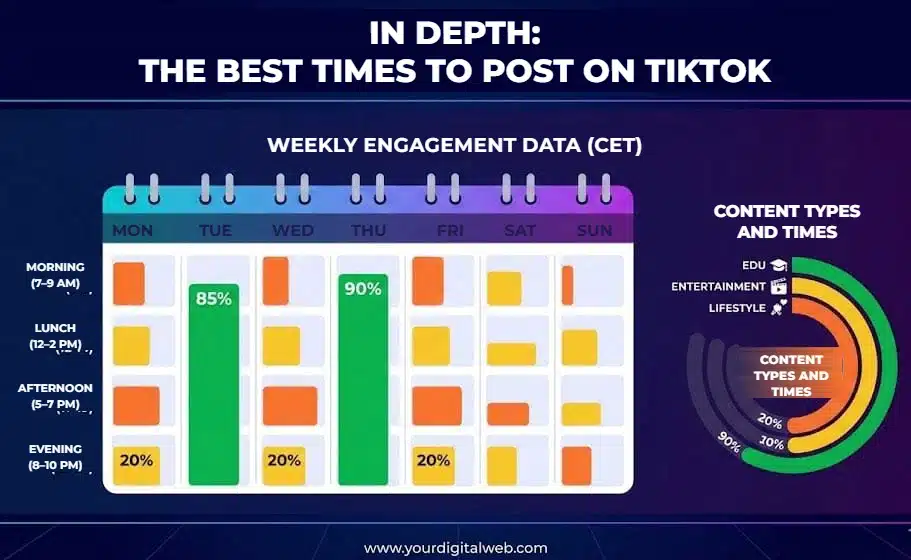
The table below summarizes the high-yield windows of opportunity for the Italian market.
| Day of the week | Peak window (consumption) | Strategic posting time (with offset) | Ideal content type | Psychological/technical rationale |
| Monday | 09:00 – 11:00 | 07:30 – 08:30 | Motivational, news, educational |
“Wake up and start”: users look for energy and information to tackle the week. |
| Monday | 22:00 – 23:30 | 20:30 – 21:30 | Light entertainment, relaxation | Unwinding after the first workday. revenge bedtime procrastination. |
| Tuesday | 16:00 – 18:00 | 14:30 – 15:30 | B2B, tutorials, deep dives | Afternoon productivity peak; extended coffee break. A time for learning and work. |
| Wednesday | 09:00 – 11:00 | 07:00 – 08:00 | Trends, viral challenges |
Midweek: looking for novelty and distraction. High global traffic. |
| Thursday | 12:00 – 14:00 | 10:30 – 11:30 | Food, lifestyle, e-commerce |
Italian lunch break. Mental planning for the weekend begins. |
| Thursday | 19:00 – 21:00 | 17:30 – 18:30 | Shopping, reviews, unboxing |
“Pre-weekend vibes”: growing willingness to buy on TikTok Shop. |
| Friday | 18:00 – 20:00 | 16:00 – 17:00 | Pure entertainment, comedy | The official start of the weekend. Short attention spans, a desire for instant fun. |
| Saturday | 09:00 – 11:00 | 08:00 – 09:00 | Slow content, vlogs, long tutorials |
Free time in the morning. Users are more relaxed and open to long videos (over 3 minutes). |
| Saturday | 19:00 – 22:00 | 17:30 – 18:30 | Fashion, events, social |
Getting ready for the evening (“Get Ready With Me”). High but fragmented mobile activity. |
| Sunday | 16:00 – 23:00 | 14:30 – 15:30 | Weekly recaps, planning, “cozy” content |
the Sunday scaries and afternoon boredom. A very long, continuous viewing window. |
3.2 How Italy Differs from Global Data
It’s crucial to note how blindly applying global data can lead to mistakes in Italy. Many international studies suggest late-night weekday slots (for example, Tuesday at 2:00 or 4:00 a.m. EST) to capture a global audience. For a brand focused on the Italian market, though, posting at 4:00 a.m. on a Tuesday means the video will sit through 3 to 4 hours of local “dead air” before Italy wakes up. That gap can signal low interest to the algorithm (low-velocity engagement), hurting later distribution.
In Italy, the global evening peak of 7:00–8:00 p.m. often dips (“the dinner dip”) because it coincides with families preparing or eating dinner. The real peak in quality engagement starts again from 9:30 p.m. onward, when the TV goes on or people go to bed with their phones.
3.3 The Role of the Algorithmic “Warm-Up”
The “warm-up” technique isn’t limited to the controversial practice of “warming up the account” (simulating human activity to avoid anti-bot filters); it also applies strategically to the content itself. Posting in “pre-peak” slots (for example, 2:30 p.m. for a 4:00 p.m. peak) allows the video to:
-
Get through the algorithmic cold start phase.
-
Build up its first Early engagement metrics (which account for 25–35% of the algorithmic weight) on a sample of early adopters or very loyal users.
-
Reach the mass audience at peak time with an existing base of social proof (visible likes and comments), which psychologically increases the likelihood that new viewers will engage.
4. Industry Deep Dive: Vertical Chronobiology
For an agency like YourDigitalWeb or its clients, a generic approach isn’t enough. User behavior varies dramatically depending on search intent and market niche.
4.1 B2B and Professional Services: Where LinkedIn and TikTok Converge
LinkedIn and TikTok now overlap strategically. Professionals increasingly use TikTok for informal learning (“edutainment”) and to discover tools. Case studies like that of YourDigitalWeb itself (for example, talks on AI and prompting ) show that technical content has its own space.
-
Best B2B times: Business decision-makers (CMOs, CEOs, marketing managers) tend to consume educational or industry content at two specific moments shaped by their work routine:
-
Early morning (6:30–8:00 a.m.): While catching up on the news, having breakfast, or commuting to the office. It’s information time.
-
Lunch break (1:00–2:00 p.m.): A moment to unwind, but still focused on light work topics.
-
-
Content: Quick case studies, AI tool reviews , and agency “behind the scenes” content work best when posted early in the morning (Tuesday to Thursday), ready to be consumed as bite-size learning. Sunday evening is another tactical slot for leadership or visioncontent, tapping into the weekly planning mindset.
4.2 Food and Beverage: The “Crave” Effect and Taste-Driven Virality
For food clients, timing is biological, driven by the circadian rhythms of hunger. Trends like tanghulu (candied fruit),hot honey , or tahini coffee show that food on TikTok is a visual experience that triggers instant desire.
-
Hunger triggers: Posting at 11:00 (before lunch) or at 17:00 (before dinner or happy hour) taps into the physiological triggers of hunger. Viral recipe videos posted at these times see significantly higher conversion rates (or saves to try later) because users are biologically primed to “eat with their eyes.”
-
The Sunday factor: Sunday morning (9:00–11:00 a.m.) is the golden window for comfort food or Sunday brunchrecipes. It’s when users have time to cook or are deciding what to make for Sunday lunch. Elaborate recipes like baked pasta or complex trends hit their peak completion rate.
4.3 Fashion and TikTok Shop: The Science of the Impulse Buy
With TikTok Shop expanding and consolidating in Italy and Europe , direct selling through videos and lives has become central. Fashion and retail thrive on impulse purchases and “retail therapy.”
-
Shop prime time: Data indicates that evening live shopping sessions (20:00 – 22:00) generate 22% more conversions than standard videos. The reason is both logistical and psychological: users are at home, relaxed, sitting on the couch (not on the move), with their credit card at hand or saved in a digital wallet.
-
Launch strategy: Case studies such as Miriade on TikTok Shop show that a coordinated launch (shoppable videos plus a live session) should happen when the audience is available for extended interaction. Starting a live at 8:00 p.m. lets you build the audience and hit peak sales around 9:00 p.m.
5. Critical Technical Factors: Shadowbans, Fingerprinting, and Bots
A perfect timing strategy is useless if the account is technically compromised. TikTok’s security systems are extremely sophisticated at detecting non-human behavior.
5.1 Avoiding Shadowbans for “Bot Behavior”
Posting with robotic precision (for example, every day at exactly 9:00:00) is a red flag for anti-spam filters, which use behavioral analysis to identify bots and unauthorized automation.
-
Human time variance: It’s crucial to introduce “natural variance” into your posting times (for example, 9:03 one day, 8:54 the next, then 9:12). This simulates imperfect human behavior.
-
Device fingerprinting: TikTok creates a unique fingerprint of the user’s device and network connection. Managing multiple accounts from the same device, or mass posting from a single IP at “non-human” hours (for example, in rapid succession in the middle of the night), can lead to a shadowban or severe visibility limits. Your timing strategy has to look organic: the account should “sleep” when a person sleeps.
5.2 Handling Re-Uploads
A common mistake is deleting and immediately re-uploading a video that didn’t perform well in its first hour. The algorithm recognizes the video file’s fingerprint (hash) and penalizes re-uploads as duplicate content or spam. If a video posted at the wrong time flops, the fix isn’t an immediate re-upload. Instead, analyze why it failed and reschedule a modified version (new edit, new music, new metadata) in a different time window after letting the account “cool down.”
6. Advanced Strategies: AI and What’s Next
Looking beyond the immediate horizon, trends are emerging that will further redefine the concept of time on TikTok.
6.1 AI Avatar Influencers and 24/7 Coverage
The rise of AI-generated influencers and synthetic avatars is changing the rules of time coverage. These “creators” don’t sleep and can run sales livestreams or Q&As around the clock.
-
What it means for human brands: Brands will start using these technologies to cover “dead” hours (2:00–5:00 a.m.) and reach night owls or international time zones without forcing human staff into grueling shifts. Real emotional connection, however, will remain the domain of the hours covered by humans.
6.2 Semantic Consistency as a Timing Driver
The algorithm rewards consistency. If your account covers B2B marketing and you post a cooking video at 3:00 a.m., you create a semantic dissonance that confuses indexing and dilutes the account’s authority.
-
Tactic: Stay consistent not only in topic but also in timing by content type. If your technical tutorials always go out on Tuesday mornings, the algorithm will “learn” to expect and process that kind of content in that specific window, optimizing distribution to your most loyal followers, who have developed a viewing habit.
7. The A.R.T. Method
There’s no universal “magic hour” that works for everyone. There is, however, a scientific method for finding your own magic hour. For YourDigitalWeb and its readers, we recommend adopting the A.R.T. framework (Analyze, Rotate, Test).
Phase 1: Analyze (your own timing)
Don’t blindly trust national averages. Use TikTok’s native Analytics (available for Business Accounts) to find out when your followers are active.
-
Go to
Creator tools > Analytics > Followers. -
Identify your peak activity hours and subtract 60 to 90 minutes (the indexing offset rule). That’s your real posting time.
Phase 2: Rotate (time clusters)
Don’t always post at the same time, to avoid saturation and the bot effect. Create 3 strategic time clusters and rotate your content across them:
-
Morning glory (7:30–8:30 a.m.): For educational, news, and motivational content (high attention).
-
Lunch rush (1:00–2:00 p.m.): For quick trends, memes, and light interaction (high frequency).
-
Night owl (9:30–11:00 p.m.): For deep storytelling, lives, and community building (high emotion).
Phase 3: Test and indexing check
Track not just views but the source of your traffic in the first 4 hours.
-
If a video posted at 10:00 a.m. gets most of its traffic from the For You page after a few hours, indexing worked and the timing was right.
-
If traffic only comes from your profile, the timing or the content didn’t trigger algorithmic discovery. Try posting earlier next time.
Success on TikTok doesn’t belong to whoever has the most precise clock, but to whoever best understands how the algorithm and human biology keep time together.

Valentina Turchetti
Co-founder of YourDigitalWeb
Co-founder of YourDigitalWeb, she works on digital strategy, lead generation and communication for companies. She speaks at marketing events and talks, from TTG to Social Media Strategies.
One click and, when you search for SEO, AI and marketing, our articles will show up more often in Google’s Top Stories.