
Table of contents 14 sections
- In short: the six points to remember
- What happened on September 8, 2026
- The detail that changes everything: in the EU the Supplier Unit is scaled back
- The second deadline: September 30, 2026
- What really changes in the user journey
- What a hotel needs to do technically: the three levels
- An automatic check on the four Supplier Unit signals
- What a hotel shouldn’t do
- Case study: Hotel Rossi, a four-star in Florence
- Operational checklist for a hotel
- A necessary clarification: no one can guarantee you the Supplier Unit
- FAQ
- So?
- Sources
If you run a hotel, these days you’ll have read that “Google changed everything in Europe”, that hotel SEO is over or that you need to install a feed to keep appearing in results. Before spending a single euro, let’s put things in the right order: for a property that sells its rooms directly, the picture is much less complicated than it’s made out to be, but there are two real deadlines to handle by the end of September.
On September 8, 2026, Google published official documentation for two new blocks that appear in the SERP for users in the European Economic Area: Aggregator Unit and Supplier Unit. The same day it announced it had removed some features from European travel search. And from October 1 a second change takes effect, this time global and unrelated to the DMA, concerning how your rate gets into the Google ecosystem.
In this guide you’ll find what has really changed, what hasn’t changed at all and the complete list of technical work to do on your website, Google Business Profile, Hotel Center and booking engine. With concrete examples, not alarmist headlines.
In short: the six points to remember
-
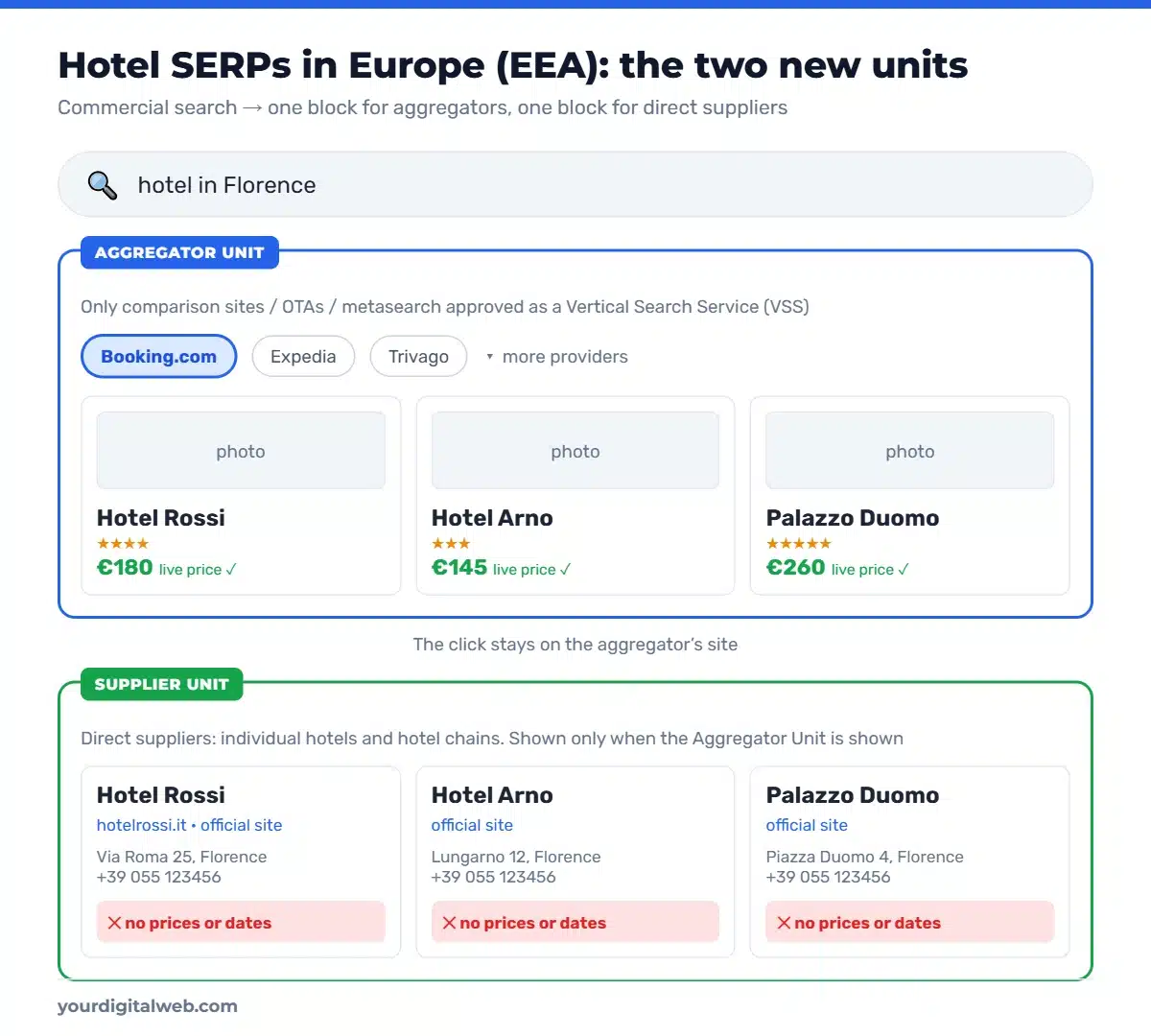
- Two distinct blocks appear in the European SERP: one reserved for comparison sites (Aggregator Unit), one for direct suppliers like individual hotels (Supplier Unit).
-
- A hotel doesn’t need to become a comparison site, doesn’t need to build dedicated feeds and can’t pay to get into the Supplier Unit.
-
- For Supplier Unit eligibility, Google states that data accessible by crawling the website is enough.
-
- The Supplier Unit only appears when the Aggregator Unit appears too, and it can be placed above or below it.
-
- In the European Union that block has been scaled back: no real-time rates, no date filter, no descriptive labels.
-
- From October 1, 2026 Google stops sourcing rates from third parties for hotel ads: those without their own feed drop out of Hotel Ads inventory.
Free tool
Want to know how your property is doing right now?
L’Hotel Intelligence Auditor analyzes your website and returns identity and data consistency, competitor rates, speed, reviews, SERP visibility and booking engine friction. It includes the DMA check on the four Supplier Unit signals.
Analyze your hotel for free →You’ll need your website URL, city and email. The tool works on desktop.
What happened on September 8, 2026
The context is regulatory, not algorithmic. On July 23, 2026 the European Commission fined Google €460 million for self-preferencing in results related to shopping, hotels, transportation and sports, giving it sixty days to comply with the Digital Markets Act and threatening periodic penalties of up to 5% of daily global turnover.
The response came on September 8 with the reorganization of European commercial searches and two documentation pages on Search Central. The pages never mention the DMA, and the features are described as available only in the European Economic Area.
In statements reported by Reuters, Google called the change the biggest quality reduction in Search’s history and claims that previous adjustments had already cut free traffic to European businesses’ direct bookings by 30%. It’s a partisan position, within an open dispute with the regulator, but the direction is clear: more space for intermediaries, less useful surface for those who sell directly.
Aggregator Unit: the comparison sites’ block
It’s the space reserved for vertical search services: OTAs, comparison sites, metasearch engines, directories. It covers searches for hotels, flights, long-distance ground transportation and products.
-
- To participate you need Google’s approval as a Vertical Search Service (VSS).
-
- You need content relevant to the query and to send data via direct feeds or real-time APIs.
-
- Only one aggregator at a time is expanded, the best-ranked one, with photos, rates or ratings.
-
- Users can switch to another available provider. The click still stays within the aggregator’s website.
Supplier Unit: the direct suppliers’ block
It’s the space reserved for those who provide the service first-hand. In the documentation for the lodging sector, Google explicitly mentions individual hotels and hotel chains.
-
- Stated requirements: serving users in the European Economic Area and being a direct supplier.
-
- No data beyond what’s accessible by crawling the website. There’s no sign-up form for individual hotels.
-
- The block only appears when the Aggregator Unit is present, and can be placed above or below it, based on the relevance and quality of results for that specific query.
| Element | Aggregator Unit | Supplier Unit |
|---|---|---|
| Who it’s for | OTAs, comparison sites, metasearch engines, directories | Direct suppliers: individual hotels and chains |
| Approval | Required as a Vertical Search Service | No public registration procedure |
| Data required | Direct feeds or real-time APIs | Data accessible by crawling is enough |
| When it appears | On certain commercial searches | Only if the Aggregator Unit is present |
| Click destination | The aggregator’s website | The property’s official website |
The detail that changes everything: in the EU the Supplier Unit is scaled back
This is the part missing entirely from most articles published in recent days, and it’s the one that most affects a hotelier’s daily work.
Along with the release, Google announced it had limited the direct suppliers’ block for users in the European Union. In the box reserved for your hotel real-time rates no longer appear, you can’t filter by stay dates and descriptive labels disappear such as “budget” or “boutique”. In the same announcement the company said it was removing the vacation rentals unit from the European SERP, specifying that the related feeds continue to power Maps and google.com/hotels. The updates, where relevant, also extend to AI Overviews and AI Mode.
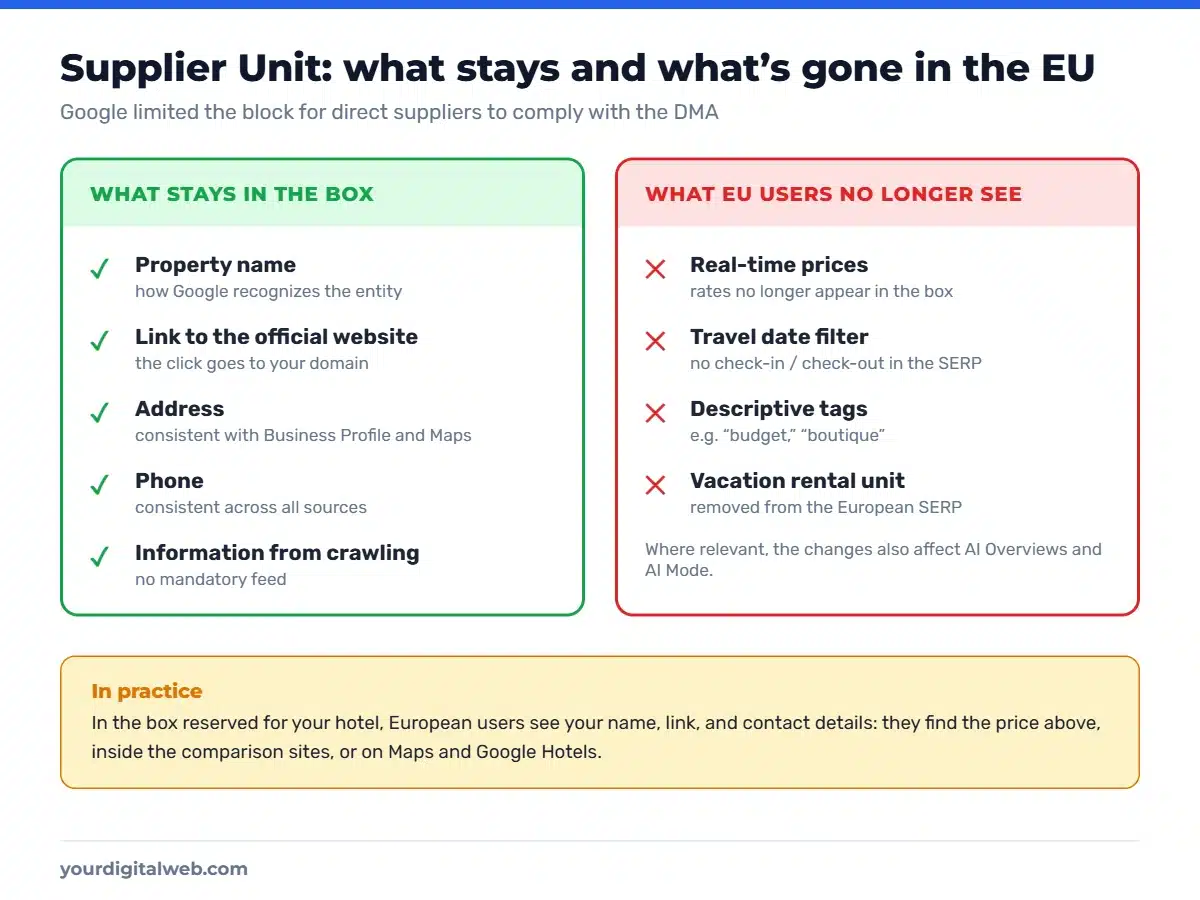
The practical consequence is clear. The block that was supposed to balance the push toward intermediaries now behaves, for European users, like a basic listing: name, link to the website, address, phone. Anyone who wants to know how much the room costs on those dates finds out from the comparison sites placed alongside, or leaves the results page for Maps or Google Hotels, where the rate is still shown.
In fairness: outside Google, no one has yet measured the new layout’s real behavior at scale, and the percentages circulating come from the company itself. That’s why direct monitoring of your own queries, which we cover below, is worth more than any forecast right now.
The second deadline: September 30, 2026
This change has nothing to do with the DMA, isn’t limited to Europe and has a precise date. Google is shutting down third-party rates for hotel ads: until now some advertisers took part in Hotel Ads without sending their own rates, because Google sourced them from third parties.
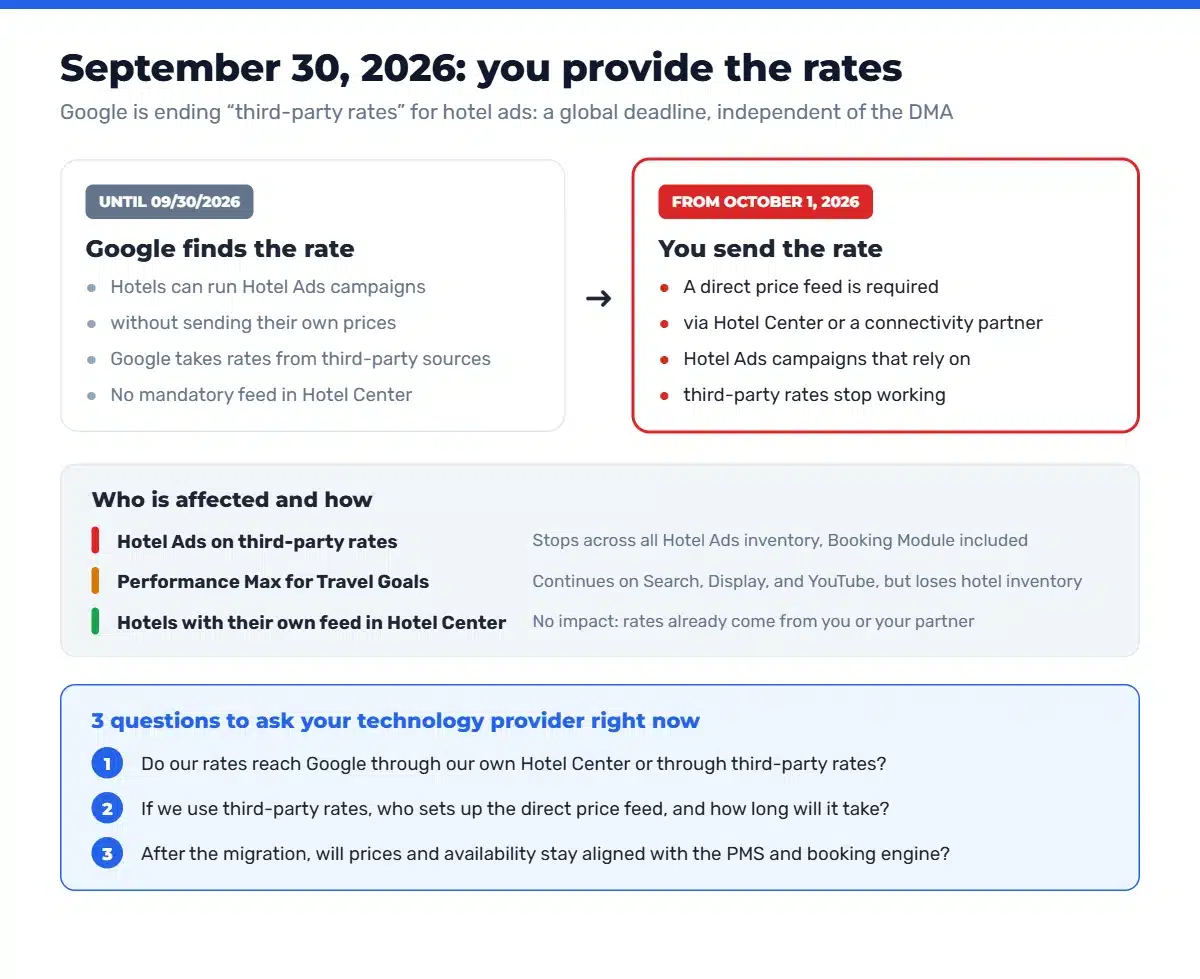
After September 30, 2026 that source goes away. According to Hotel Center documentation, campaigns relying on it stop serving across all Hotel Ads inventory, including Booking Module and Travel Promotion Ads. Performance Max for Travel Goals campaigns keep running on Search, Display and YouTube, but lose access to hotel inventory. To stay present you need a direct price feed, set up through an integration partner or a Hotel Center account, linked to Google Ads, with the campaigns recreated.
If your metasearch is managed in-house or by an agency, now is the time to check where your rates come from today. It’s a ten-minute check that saves you from discovering the problem with campaigns stopped, right in the middle of the fall booking season.
Approaching deadline
Don’t know where your rates to Google come from?
We’ll handle it: we check the rate connection with your booking engine or channel manager, verify price accuracy and tell you if action is needed before September 30.
Request a consultation →What really changes in the user journey
Before these changes, a hotel’s presence on Google played out across organic results, Maps, Google Business Profile, Google Hotels, Free Booking Links and Hotel Ads. None of these channels disappears. A new surface is added and, above all, the point where users see the rate changes.
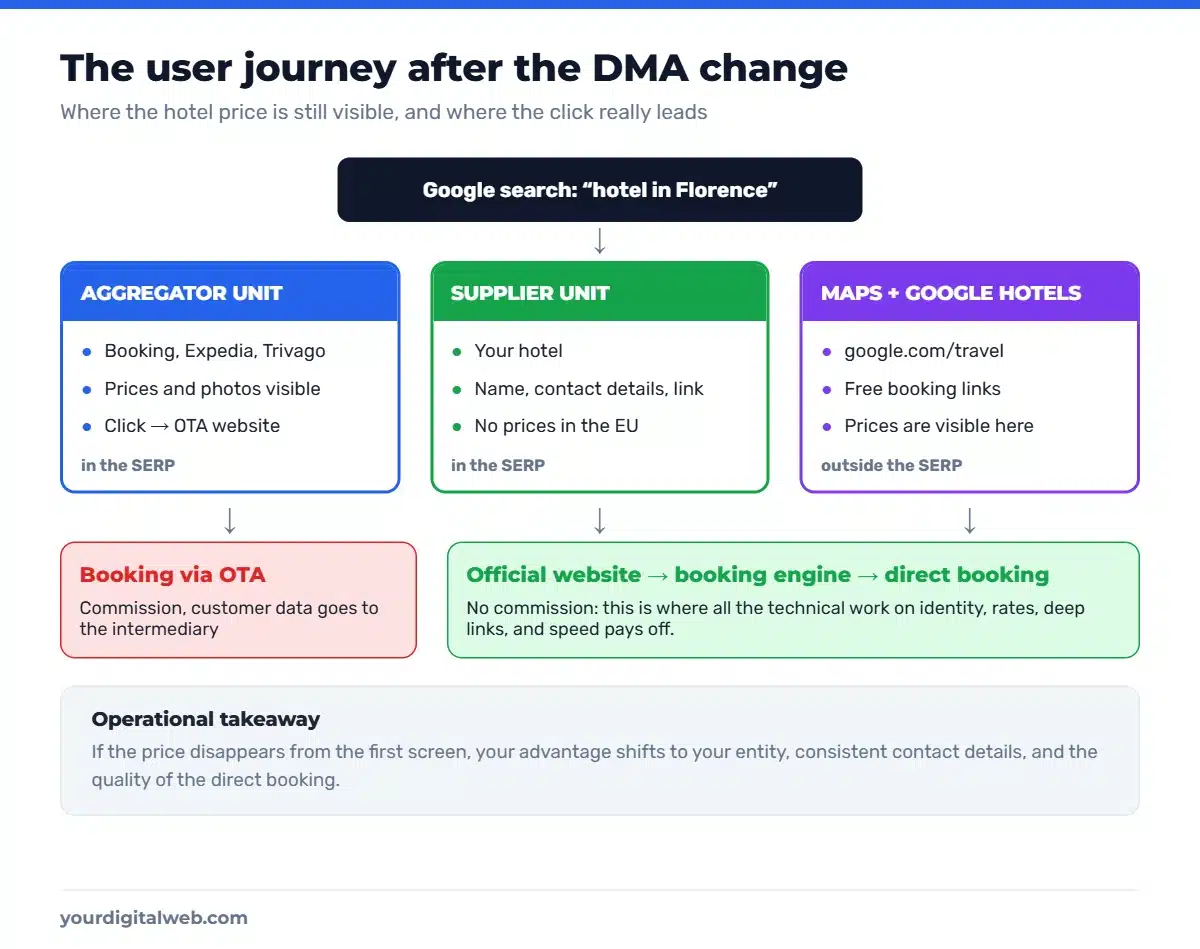
The critical point is all here: someone searching “hotel in Florence” first sees comparison sites with photos and prices, then the hotels’ block without prices. If your official website isn’t immediately recognizable, fast and credible, you rarely win that comparison. That’s exactly the ground we work on in marketing for hotels and tourism: reducing dependence on OTAs by making the direct channel technically flawless.
So hotel SEO no longer matters?
Exactly the opposite. Google states it identifies the direct supplier using the information reachable by crawling the website: which means what your website can communicate to a crawler becomes the admission criterion for the block. If your key information lives inside a JavaScript widget or an iframe, you’re complicating a job that should be elementary.
The question is no longer just which keywords you rank for, but: does Google recognize the property as an entity? Does it know which is the official website? Do rates arrive where they should? Does the user land on the right booking? It’s work that combines Technical SEO, local SEO and hotel distribution.
What a hotel needs to do technically: the three levels
The work is divided into three levels, and the order matters: first digital identity, then rate distribution, finally measurement. Skipping the first level and starting with feeds is the most expensive mistake we see.
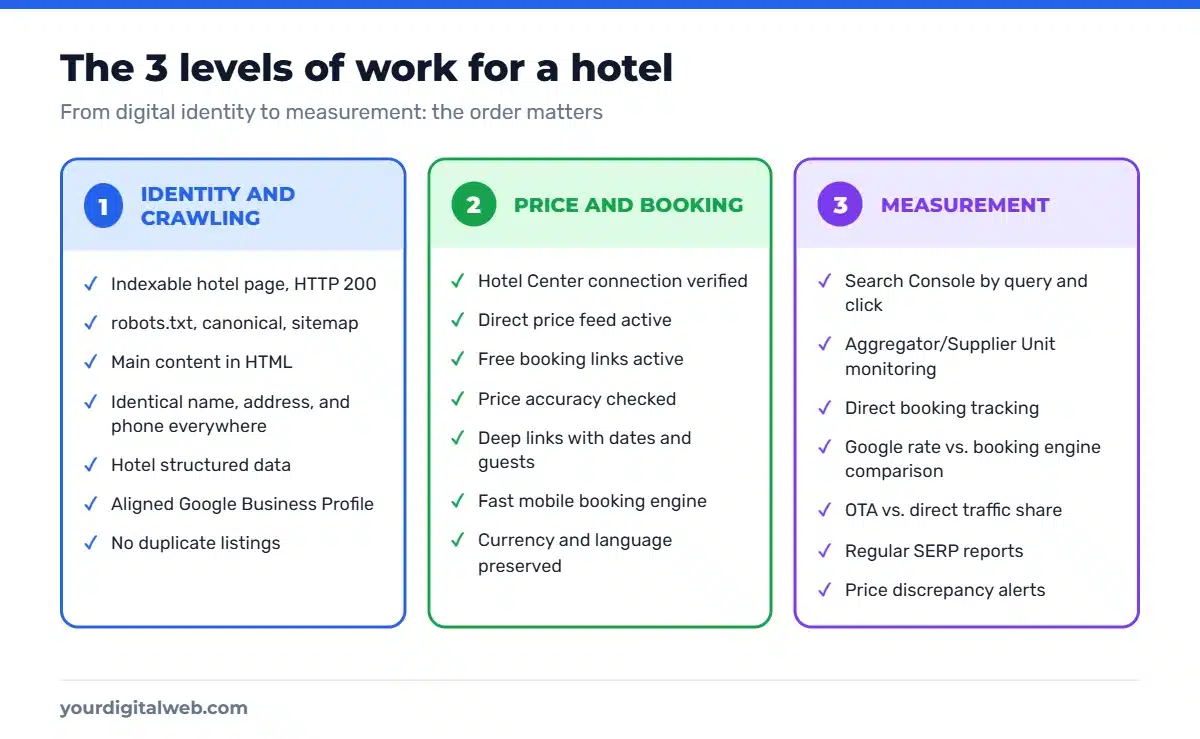
1. The website must be genuinely crawlable
The first question isn’t “which plugin do we install”, but “can Google read our website”. The property’s main page must respond with a 200 status code and be accessible to crawlers without obstacles.
-
- No accidental blocks in the robots.txt file
-
- No meta robots noindex left over from development
-
- A correct, self-referencing, consistent canonical
-
- Included in the XML sitemap with no redirect chains
-
- Internal links in HTML, not generated exclusively by script
-
- Main content accessible without user interaction
-
- Correct mobile rendering and a valid HTTPS certificate
The typical problem case is a homepage containing little more than a JavaScript application, with name, address, amenities and rates loaded later by external systems. Google can render JavaScript, but when the business’s very identity is at stake it makes no sense to introduce avoidable technical dependencies.
2. Google must understand unambiguously which hotel it’s looking at
It happens more often than you’d think. On the website the property is called Hotel Palazzo Firenze, on the Google Business Profile Palazzo Hotel Firenze, on the booking engine HP Firenze, on a third-party portal Palazzo Firenze Collection.
To a person these are nuances. To a system matching databases they’re four potentially distinct entities. The official name, address, phone, coordinates, URL, category and brand must be kept aligned: it’s the old NAP consistency applied to an ecosystem that now reasons in entities, not pages. The hotel should be treated as a single digital entity represented across different systems.
3. A complete property page, not a showcase
From the main page it must be immediately clear who you are, what category you are, exactly where you are, what you offer and how to book. A structure that works:
-
- A title combining name, category and location
-
- Rooms and room types, amenities, breakfast, parking
-
- Location with real distances from points of interest
-
- Check-in and check-out times
-
- FAQs, offers and a call to book direct
You don’t need to stuff the page with keywords. You need to genuinely describe the property, in the language your guests use to search for it.
4. Hotel structured data
Let’s set a boundary right away: structured data isn’t a requirement Google states for the Supplier Unit. No one can promise that adding markup will get you into the new box. It does remain one of the most effective ways to make the page’s information explicit and strengthen semantic understanding of the entity.
<script type="application/ld+json"> { "@context": "https://schema.org", "@type": "Hotel", "@id": "https://www.hotelrossi.it/#hotel", "name": "Hotel Rossi", "url": "https://www.hotelrossi.it/", "telephone": "+390551234567", "priceRange": "€€€", "address": { "@type": "PostalAddress", "streetAddress": "Via Roma 25", "addressLocality": "Firenze", "postalCode": "50123", "addressCountry": "IT" }, "geo": { "@type": "GeoCoordinates", "latitude": "43.7696", "longitude": "11.2558" }, "sameAs": [ "https://www.google.com/maps/place/?q=place_id:XXXXXXXX" ] } </script>Markup must describe what really exists on the page and at the property. No invented data, no extra stars: untruthful markup is a problem, not a shortcut.
5. An aligned Google Business Profile
With the new setup, the profile carries more weight than before, because it’s one of the sources Google uses to build the entity. Check the name, address, phone, official website, pin location, primary and secondary categories, photos, amenities, check-in and check-out times, facilities and any duplicate profiles to remove.
The goal is simple to state and rare to find in an audit: website, Business Profile and Maps telling exactly the same story.
6. Check how your rates reach Google
Here we move to the second level. Many properties already have an active connection through their booking engine, channel manager, PMS or CRS without realizing it. There’s just one question to ask your provider:
Are our rates and availability distributed to Google through our own Hotel Center account or through Google’s third-party rates?
The answer completely changes the priorities for the coming weeks, because of the end-of-month deadline. Before developing any new integration you need to know what already exists.
7. Google Hotel Center
Hotel Center isn’t a requirement for the Supplier Unit: it’s a different system, the platform partners use to manage rates, availability, property matching, landing pages, Free Booking Links and the data connected to Hotel Ads.
The right strategy isn’t choosing between the Supplier Unit and Hotel Center. They’re two distinct ecosystems and you need to cover both.
8. Free Booking Links
Free Booking Links let the official website appear on Google Hotels surfaces with its own rate without paying for the click. Google charges nothing for presence or clicks in this feature.
They shouldn’t be confused with the Supplier Unit: the former is a rate distribution system inside Google’s hotel products, the latter is a European search surface that, for EU users, doesn’t show the rate at all today. For an independent property we work on both.
9. The booking link must arrive with the search already filled in
It’s the work with the best effort-to-result ratio. The user searched for Florence, October 15–17, two adults. If after the click they land on the homepage and have to re-enter everything, a significant part of that traffic is already lost.
Google supports destination URLs with dynamic variables for property, language, currency and itinerary dates. Conceptually:
https://booking.hotelrossi.it/book
?checkin=2026-10-15
&checkout=2026-10-17
&adults=2
¤cy=EUR
&language=itFewer steps means fewer drop-offs before confirmation. It’s conversion rate optimization applied to distribution, not a detail to put off.
10. Price accuracy: the rate on Google and the rate on the website must match
Google enforces a specific price accuracy policy: the base price, taxes and fees sent must match those shown on the landing page and during the booking process. Checks also take place after redirection to the partner’s website, and inaccurate offers can be restricted.
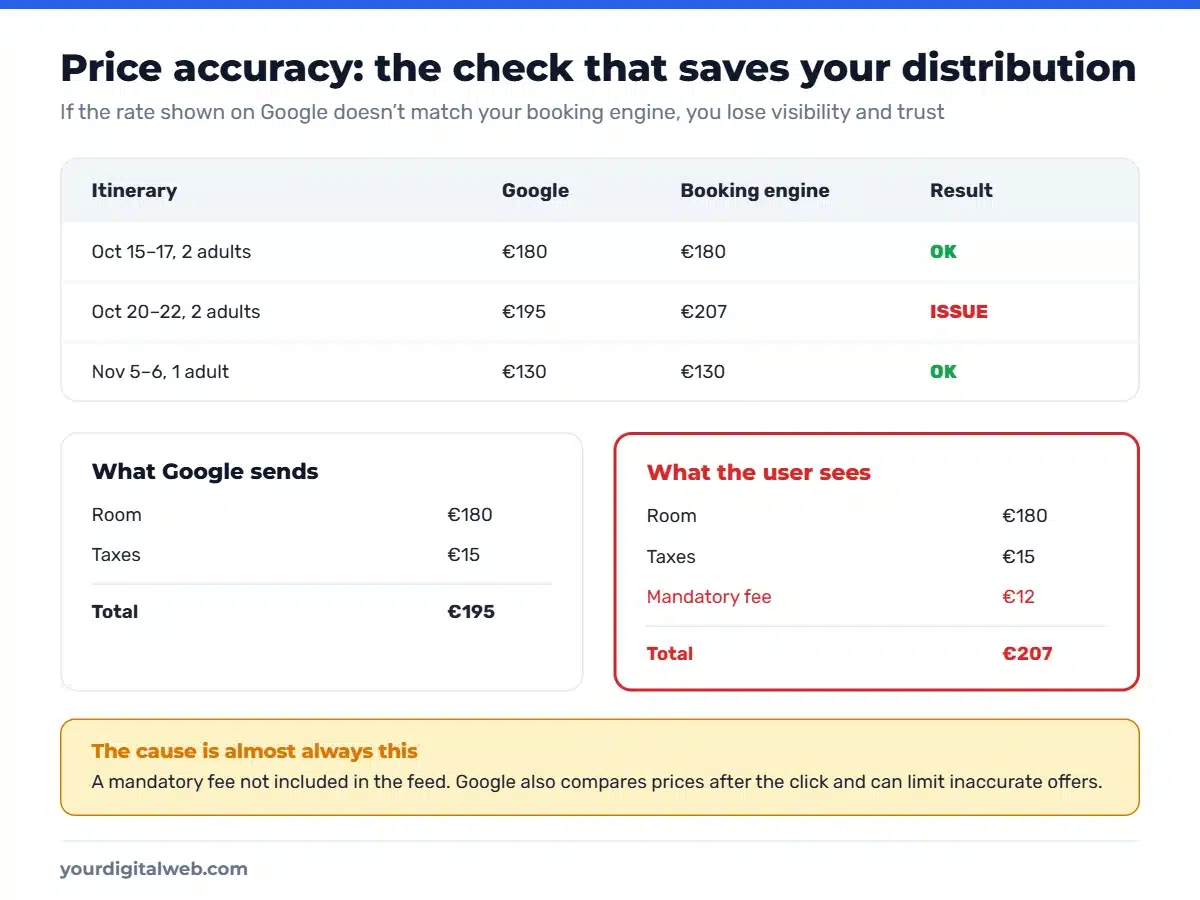
The most frequent causes of mismatch: rate not updated, missing taxes, a mandatory surcharge excluded from the feed, different occupancy, currency conversion, changed availability, wrong room type mapping.
11. Synchronized rates and availability
A common scenario: the PMS shows €215, the booking engine €215, Google still €189. For a property doing revenue management with frequent changes, slow distribution is a margin problem, not just a consistency one.
To check with your provider: update method and frequency, errors in the logs, rate coverage, availability, room mapping, restrictions. Knowing you’re connected isn’t enough: the quality of the connection is what counts.
12. The booking page affects ranking too
For Free Booking Links, Google lists among its signals user preference, offer value, landing page experience and historical price accuracy. It also specifies that you can’t pay for a better position. The booking engine, then, isn’t an operational detail: it’s part of the visibility strategy.
-
- Does booking work well on smartphones?
-
- How many seconds does the engine take to load on a mobile network?
-
- Are dates and number of guests kept after the click?
-
- Does an Italian user land in Italian and in euros?
-
- Is the rate shown really available all the way to the last step?
13. Content aligned with the real offer
Once the infrastructure is fixed, you work on relevance. Parking, spa, pool, restaurant, proximity to the station can’t live in a row of icons: they need to be explained, with real costs, hours, how they work and distances.
That’s how you capture the searches that bring bookings, like “hotel Florence with parking”, “hotel near Santa Maria Novella” or “4-star hotel Florence center”. It doesn’t mean creating dozens of artificial pages: it means describing what you offer well and covering the search intents that concern you.
14. Monitor the new SERP
Search Console remains essential, but it doesn’t show the visual structure of the results page. For a single property it’s worth defining a sample of 30–100 strategic queries and tracking them periodically, even manually at first.
For each query we record: presence of the Aggregator Unit, presence of the Supplier Unit and its position relative to the other block, presence of our hotel, competitors detected, which aggregator is expanded first, photos used, click destination. That’s how you stop discussing the DMA in theory and start measuring its impact on your bottom line.
An automatic check on the four Supplier Unit signals
Many of the checks described above can be done by hand, but they take time and tools. That’s why we added a dedicated DMA module to theHotel Intelligence Auditor, the free tool that analyzes a property starting from URL, city and email.
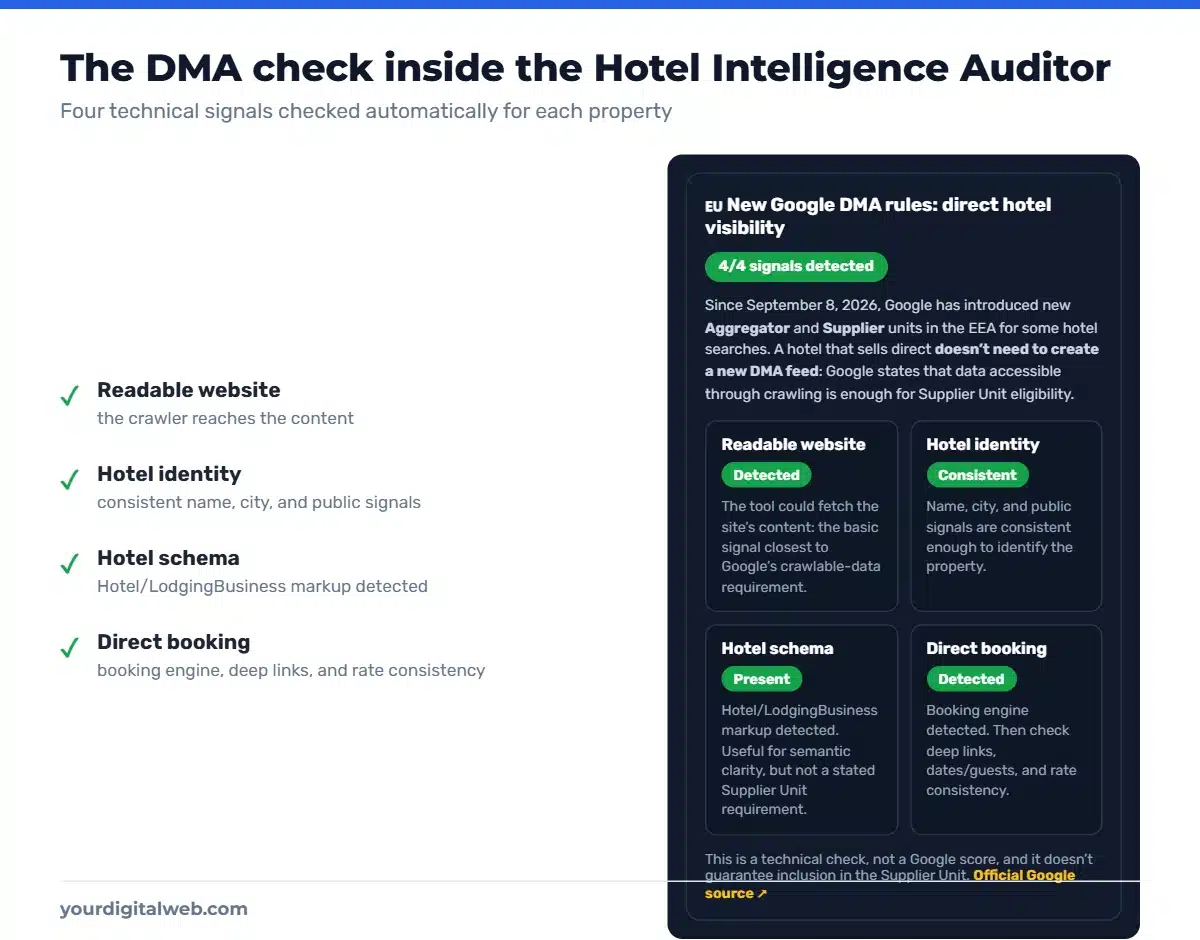
The four signals checked are the ones that really matter for a direct supplier:
-
- Readable website — the crawler can acquire the page content. It’s the signal closest to the requirement Google states for Supplier Unit eligibility.
-
- Hotel identity — name, city and public signals are consistent enough to identify the property unambiguously.
-
- Hotel schema — presence of Hotel or LodgingBusiness markup, useful for semantic clarity even though it isn’t a stated requirement.
-
- Direct booking — detection of the booking engine, as a starting point to check deep links, dates, guests and rate consistency.
A necessary clarification, because easy promises abound in our industry: it’s an informational technical check, not a Google score, and it doesn’t guarantee appearing in the Supplier Unit. It helps you understand in two minutes whether the technical prerequisites are in place or something basic is missing.
The full report goes beyond the DMA and also covers identity data consistency, price comparison with competitors, speed with LCP and CLS on mobile and desktop, review analysis with benchmarks, SERP visibility and AI-friendly signals, booking engine friction, typical guest profile and local seasonality.
Hotel Intelligence Auditor
Run the DMA check on your property
Enter URL, city and email and get the report with the four Supplier Unit signals, speed, competitor comparison and the quickest actions to increase direct bookings.
Start the free analysis →The tool works on desktop. Available for the Italian, English, German, French and Spanish markets.
What a hotel shouldn’t do
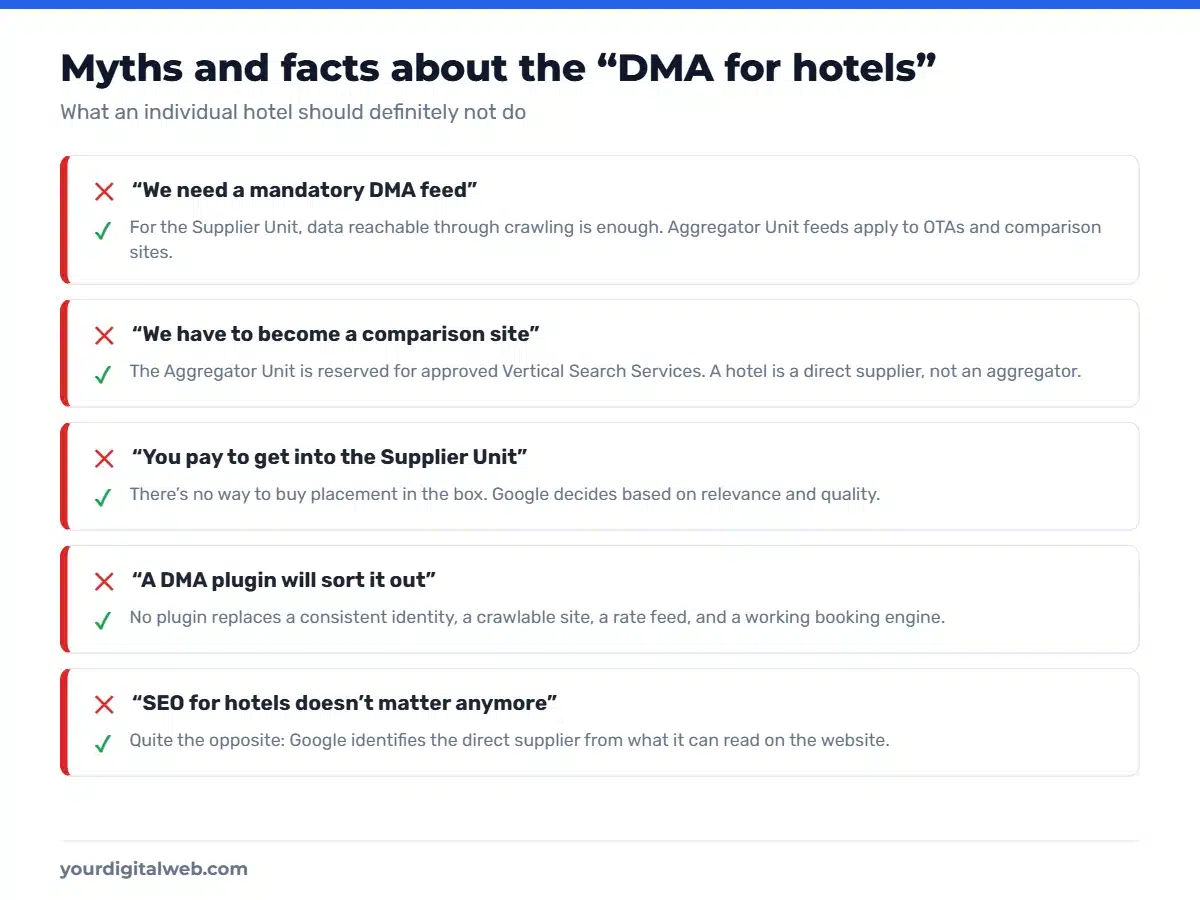
The feed described in the Aggregator Unit documentation concerns providers that want to participate as aggregators. It isn’t the feed of a hotel selling its own rooms. If someone offers you a packaged “DMA compliance” service, ask them which documentation requirement it would be meeting.
Case study: Hotel Rossi, a four-star in Florence
A WordPress website, an active Google Business Profile, an external booking engine, a channel manager, presence on Booking.com and Expedia. Here’s how a real project is structured.
-
- Website check. Indexable, correct canonical, but the Hotel schema is missing, the footer address is incomplete and some key information lives inside widgets. We fix it.
-
- Business Profile. The phone number differs from the website’s and the link to the official website is set up incorrectly. We align the data.
-
- Technology provider. The channel manager already sends rates to Hotel Center with a dedicated account: no migration needed before September 30. If the answer had been “we use third-party rates”, this would have become the top priority.
-
- Free Booking Links. Active, but on some itineraries Google shows €180 and the booking engine €192. The problem is a mandatory fee excluded from the feed. We fix it.
-
- Landing page. Google sends users to the booking engine’s homepage without keeping the dates. We implement the deep link.
-
- Monitoring. Across fifty searches, the property shows up well for “hotel Florence parking” and almost never for “four-star hotel Florence center”. We work on entity, content and local relevance.
That’s a project. It isn’t “installing the DMA”.
Operational checklist for a hotel
Priority 1 — Identity and crawling
-
- Valid HTTPS and a property page responding with a 200 status code
-
- No accidental noindex, correct robots.txt, consistent canonical
-
- Updated XML sitemap and a website fully usable on mobile
-
- Identical name, address, phone and coordinates across all sources
-
- An official website that’s clearly identifiable and valid Hotel structured data
Priority 2 — Google ecosystem
-
- Verified profile, correct primary category and URL
-
- Updated photos, complete amenities, check-in and check-out times
-
- No duplicate profiles and correct property matching on Google
Priority 3 — Rates and direct booking (by September 30)
-
- Identify the provider and understand how rates reach Google today
-
- Check for dependence on third-party rates and, if so, activate a direct price feed
-
- Check Free Booking Links, rate coverage and availability
-
- Check mandatory taxes and surcharges in the feed and test price accuracy on at least five itineraries
-
- Implement the deep link with dates, guests, language and currency
-
- Test the booking engine on mobile, stopwatch in hand
Priority 4 — Measurement
-
- Search Console and booking engine analytics connected and readable
-
- Tracking of direct bookings and Free Booking Links
-
- Periodic tracking of rates, commercial queries and presence in the two units
-
- Comparing booking volume between the direct channel and OTAs
Consulting
Want us to run this checklist for you?
We analyze the entire chain: website crawling, entity and data consistency, Business Profile, rate connection, price accuracy and booking engine. We deliver an action plan with priorities, timelines and responsibilities, ready to hand to your technology provider.
Request a quote →We reply within one business day. Offices in Milan, Parma and Casalmaggiore.
A necessary clarification: no one can guarantee you the Supplier Unit
A property can have a flawless website and still not appear on every search. Google decides when to show the Aggregator Unit, and therefore when the Supplier Unit can appear, and which results are most relevant for that query.
There’s no public formula like “make these five changes and you’ll be first”. Anyone selling a guaranteed position in the new box is promising something Google’s documentation doesn’t provide for.
FAQ
Does a hotel need to register to appear in the Supplier Unit?
No. Google doesn’t indicate any registration procedure for individual hotels. The stated requirements are serving users in the European Economic Area and being a direct supplier, and you don’t need to provide data beyond what’s accessible by crawling the website.
Do I need a new DMA feed?
No, not for a property that sells its own rooms directly. The feeds described in the documentation concern Vertical Search Services that want to participate in the Aggregator Unit: OTAs, comparison sites and metasearch engines.
Why doesn’t the rate appear in my hotel’s box?
Because Google limited the Supplier Unit for users in the European Union, removing real-time rates, date filters and descriptive labels. It doesn’t depend on your property. The price stays visible on Maps and on google.com/travel, if the feed is configured correctly.
What happens on September 30, 2026?
Google is shutting down third-party rates for hotel ads. Campaigns that depend on that source stop serving on Hotel Ads inventory, including Booking Module. To continue you need a direct price feed through Hotel Center or a connectivity partner. It’s a global deadline, not tied to the DMA.
Do Free Booking Links cost money?
No. Google doesn’t charge for presence or clicks on Free Booking Links, and you can’t pay for a better position.
Is having the lowest rate enough to appear first?
No. Google cites several signals, including user preference, offer value, landing page experience and historical price accuracy.
Does your tool’s DMA check guarantee presence in the Supplier Unit?
No, and we say so in the tool itself. It’s an informational technical check on four signals: website readability, identity consistency, presence of Hotel markup and booking engine detection. It isn’t a Google score and doesn’t guarantee appearing in the block.
Do the changes also affect AI Overviews and AI Mode?
Google stated that the updates apply, where relevant, to AI-based experiences too. It’s an evolving area and should be monitored in the coming weeks.
Are businesses outside the European Economic Area affected?
The two units are documented as features of the European Economic Area only. The September 30 deadline on third-party rates, however, is global and also affects properties working in non-EU markets.
So?
The DMA doesn’t force hotels to rebuild their websites or develop mysterious feeds. But it is changing how aggregators and direct suppliers are represented in European commercial searches, and it’s doing so by taking away from hotels exactly the element they competed on best: the rate on the first screen.
The right response is to make the whole chain solid: property identity, website, Google entity, rate, availability, booking engine, confirmation. Those who already have this infrastructure in order start ahead. Those with inconsistent data, a website that’s hard to interpret, unsynchronized rates or a Google connection no one has checked in years have just a few weeks to act before the end-of-month deadline.
Because the real opportunity isn’t appearing in the new box. It’s reducing dependence on OTAs and increasing the official website’s ability to capture and convert the demand Google keeps generating.
Two ways to get started, today
You can start on your own with the automated analysis, or have us work on your property with a tailored action plan.
Sources
-
- Google Search Central, Aggregator unit in Google Search and Supplier unit in Google Search, documentation published on September 8, 2026
-
- Google Search Central, documentation on regional differences in search features
-
- Google Actions Center, lodging: Hotel Aggregator Unit and Supplier Unit
-
- Google Hotel Center: platform, Free Booking Links, price accuracy policy and destination URL variables
-
- Google Hotel Center, About Google third-party rates for hotel ads, with the September 30, 2026 deadline
-
- Reuters and Skift, September 8, 2026, on Google’s statements and the features removed in Europe
-
- European Commission, decision of July 23, 2026 on the €460 million fine

Davide Prevosto
Senior Developer and Technical Consultant
Senior developer and technical consultant at YourDigitalWeb, he handles the technical side of SEO and GEO projects. He co-authored the book “Generative SEO” (Edizioni LSWR) with Marco Maltraversi and Giovanni Sacheli.
One click and, when you search for SEO, AI and marketing, our articles will show up more often in Google’s Top Stories.