Table of contents 6 sections
The integration of direct purchases inside ChatGPT with partners like Etsy (already live in the US) and, soon, Shopify isn’t just commercial news. It’s the embryo of a new digital ecosystem in which traditional search, e-commerce and classic SEO risk losing their central role to a model in which AI becomes discovery engine, interface and checkout.
It’s no exaggeration to speak of a radical transformation: ChatGPT no longer just shows answers, it becomes the “storefront” and the “cart” itself. This shift in power raises deep questions for people working in digital, particularly in search engine optimization and the future scenarios of Answer Engine Optimization (AEO) and Generative Engine Optimization (GEO).
How “Instant Checkout” works in ChatGPT
-
Conversational interaction: the user describes what they’re looking for (“I want a minimal white desk lamp”) and the AI suggests relevant products.
-
Algorithmic ranking: results aren’t sponsored in the classic sense, but ranked by relevance, price, availability and compatibility with instant checkout.
-
Internal transaction: the user buys without leaving the chat. Payments and sensitive data are handled directly within the platform.
-
Seller commission: the business model charges fees to merchants, not consumers.
Implications for e-commerce
-
Less friction → fewer steps = potentially higher conversions.
-
Website disintermediation → the brand loses direct contact with the user. The customer–company relationship risks being mediated exclusively by AI.
-
Dependence on the ranking algorithm → it won’t be enough to “optimize a website”: it will be crucial to make sure your product data is perfectly readable and “preferable” in the model’s eyes.
-
Centralization of power → AI decides which products to show. Anyone who doesn’t appear in the chat’s answer is effectively invisible.
Classic SEO vs AEO vs GEO: the key differences (even for those who don’t love acronyms 🙂 )
SEO (Search Engine Optimization)
-
Focus on rankings in Google and Bing SERPs.
-
Tools: keyword research, link building, technical SEO (crawlability, speed, Core Web Vitals).
-
Output: a list of results ranked by query.
AEO (Answer Engine Optimization)
-
Goal: appearing as a direct answer inside conversational engines (ChatGPT, Gemini, Perplexity).
-
Tools: structured data, semantic markup, knowledge graph optimization, Q&A-format content.
-
Output: a concise answer that mentions the brand or shows a product.
-
Drawback: it risks reducing organic traffic going to websites, because the answer is “closed” inside the AI.
GEO (Generative Engine Optimization)
-
An evolution of AEO: here the focus is educating the generative model itself so it “prefers” to cite or show your content/products.
-
Tools: structured feeds, direct APIs, proprietary data provided to LLMs, optimizing images/catalogs for semantic embeddings.
-
Output: the AI doesn’t just answer with text, it generates personalized experiences (e.g. a set of product recommendations with direct purchase).
-
Drawback: you enter opaque territory, with no transparent rules like in classic SEO.
Beyond the acronyms: what’s left of SEO is the substance 🙂
Some argue that this proliferation of acronyms (AEO, GEO, AIO, ASE…) is more semantic marketing than real methodological innovation. After all, talking about SEO for ChatGPT or SEO for AI answer engines isn’t very different from talking about SEO for YouTube or SEO for TikTok: the context changes, not the essence… as Giorgio Taverniti rightly says
The same principle always remains at the core: understand people’s needs and create the best possible resource to meet them. This pairing – need > resource – doesn’t change with the arrival of LLMs, nor with the integration of e-commerce into chats. Technology evolves, of course, but the model is always a flow of input and output. The input may be invisible (embeddings, semantic signals, implicit preferences), but the logic stays the same: if you don’t really understand what the user needs, no technical optimization will save you.
Acronyms are useful because the market asks for them and clients recognize them, but they don’t have real methodological meaning. Talking about “Search Ecosystem Optimization” is perhaps the most honest approach: studying the entire search ecosystem – which today includes Google, but also ChatGPT, TikTok, Amazon and any other discovery platform – and optimizing in an integrated way. It’s not a race to invent the trendiest acronym, it’s the timeless discipline of optimizing the meeting between need and content… though I do love using acronyms 🙂
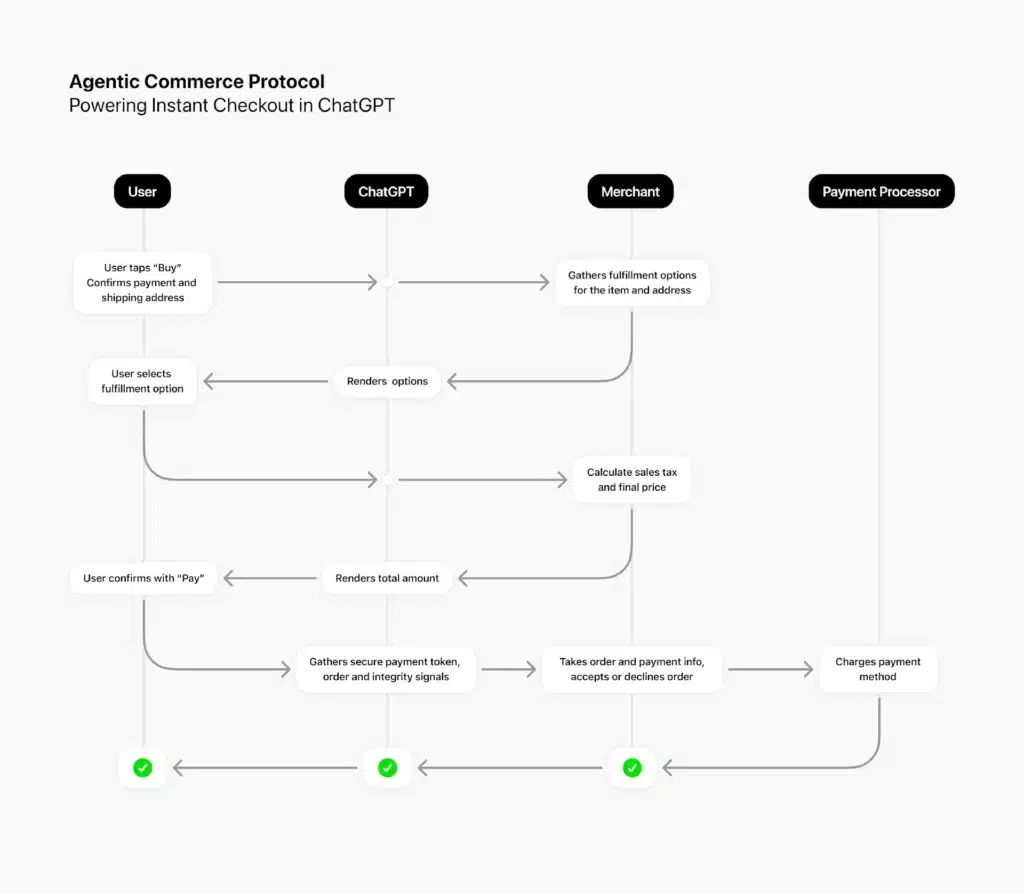
Why is this move an example of pure AI?
Many call it “SEO 2.0”, but here traditional SEO is no longer enough.
-
There’s no SERP, there are no blue links.
-
Visibility depends on the structure of the merchant’s data and on how the AI interprets a product’s relevance.
-
Content isn’t there to “drive traffic”, but to be the content itself inside the generated answer.
In this scenario, if you’re not in the AI’s knowledge graphs or datasets, you’re out of the market; what counts is how well your data is optimized to be ingested, understood and reproduced by a generative model.
Drawbacks and risks….?
-
Ranking opacity: unlike SEO, there’s no Search Console to understand why a product does or doesn’t appear.
-
Lock-in risk: sellers depend on the APIs and criteria of a single AI.
-
Erosion of branding: the user experience is mediated by the chat, not the brand’s website. Logo, tone of voice and storytelling risk disappearing.
-
One-way monetization: if OpenAI in the future introduced sponsorship logic “disguised as organic”, the market would find itself trapped.
-
Ethical and legal implications: privacy, payment handling, fair competition between merchants.
Advanced strategies for companies and marketers
-
Extreme structured data: not just schema.org, but XML/JSON feeds optimized for AI ingestion.
-
Product embeddings: preparing catalogs with “semantically rich” descriptions and images that LLMs can easily interpret.
-
Brand presence in conversational AI: experimenting with prompt engineering and query shaping to understand how AI mentions the brand.
-
Hybrid SEO: keep covering classic SEO (Google remains essential) but allocate budget to tests (APIs, knowledge graphs, conversational optimization), or whatever we want to call them, thinking in terms of intent and more.
-
Competitive monitoring: study how competitors appear in AI answers and adapt your strategy
Personally, I see this move as revolutionary but dangerous.
OpenAI isn’t just “entering e-commerce”: it’s redefining the very concept of online visibility. It’s no longer about ranking on a SERP, but about being inside the AI’s answer.
Those who adapt early can win huge competitive advantages.
Those who stay anchored to traditional SEO risk total invisibility.
The key question for the coming years will no longer be “how do I get to Google’s first page?”, but “how do I get into a generative model’s answer?”.
Marco Maltraversi
CEO and founder of YourDigitalWeb
He founded YourDigitalWeb in 2009 and is an SEO and GEO consultant with a background in software engineering. He has written books on SEO and artificial intelligence, including “Generative SEO” (Edizioni LSWR), teaches in university programs and runs the DeepSEO training program. He has spoken at SMAU, Web Marketing Festival and Search Tech.
One click and, when you search for SEO, AI and marketing, our articles will show up more often in Google’s Top Stories.