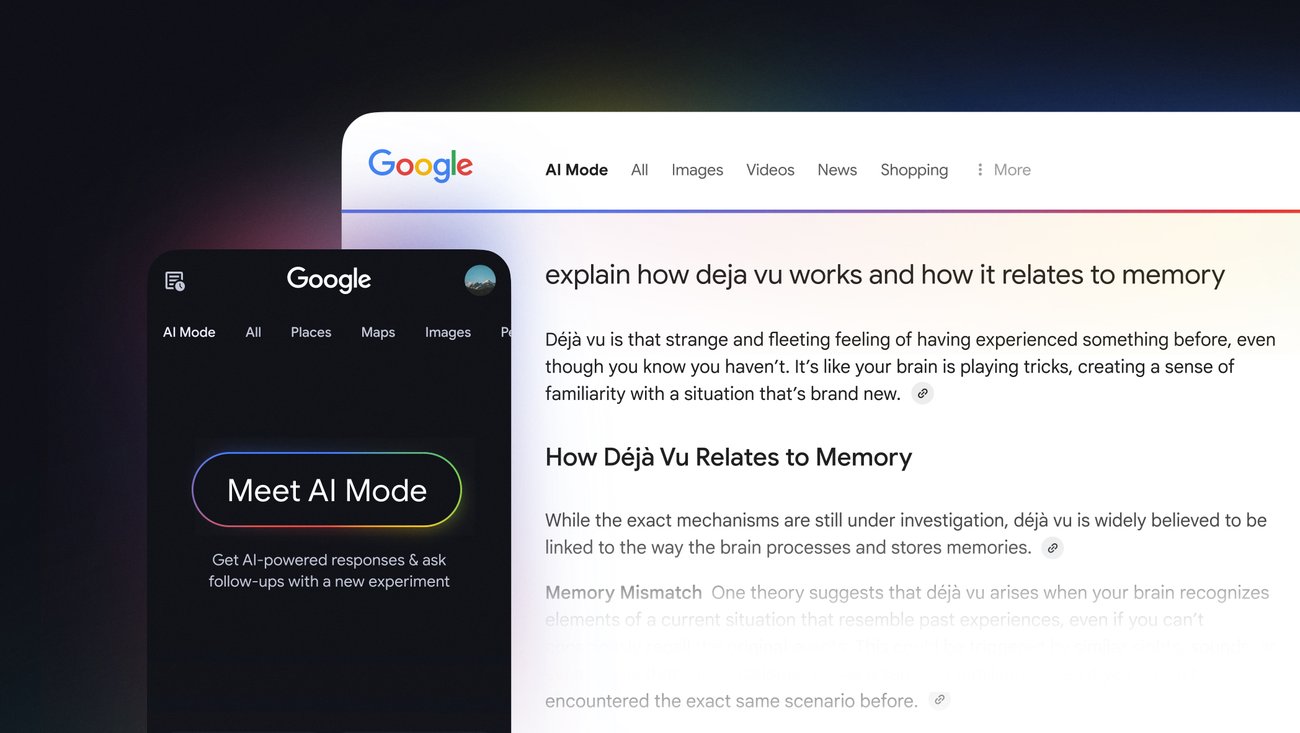
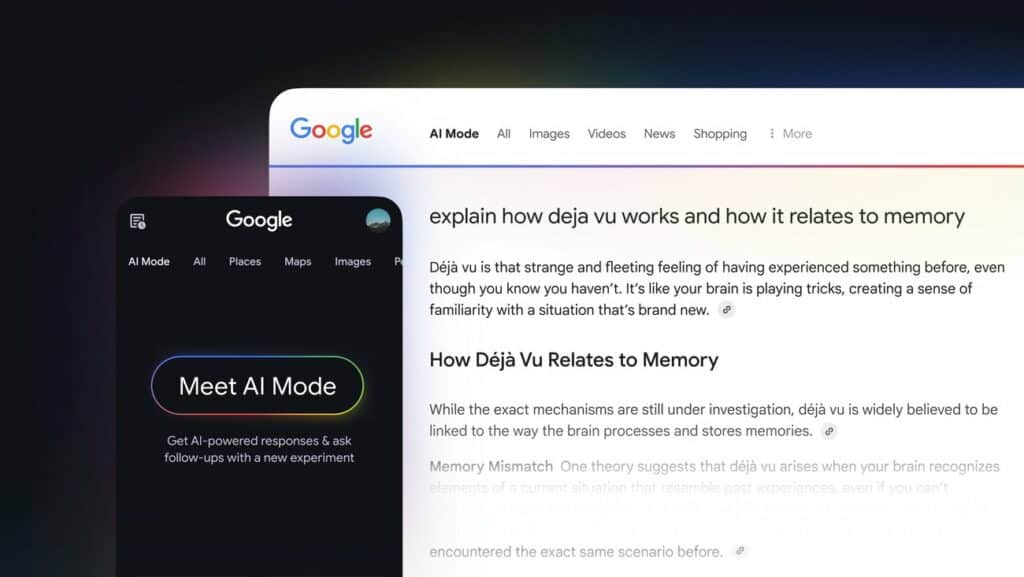
Since October 8, 2025, Google’s AI-powered search mode called AI Mode has also been available in Europe, in more than 40 countries and 38 new languages, including Italian. Here you can read Google’s official announcement 🙂
Google promises much more sophisticated answers, especially for long, complex, nuanced questions: no longer just a list of links, but a contextual summary, with the option to upload images and ask specific questions about them. In other words, multimodality.
At the same time, many online publishers and content creators are already raising serious concerns: a substantial part of traffic to websites (especially informational ones) could disappear if users settle for the summary answers provided by AI Mode.
How AI Mode works
-
It’s based on advanced language models (including versions of Gemini), with the ability to reason and break the question down into subtopics to get broader, more detailed answers.
-
The interface appears as a separate tab among Google’s results: it doesn’t immediately replace traditional search, but offers a parallel path, with an invitation to explore the original web content if you want.
-
The system has been adapted to the European context: it’s not just a matter of translating the interface, but of taking into account local preferences and cultural nuances in how certain information is requested or interpreted. At the European launch, there are no ads inside AI Mode; advertising experiments are underway in the United States.
What is AI Mode?
-
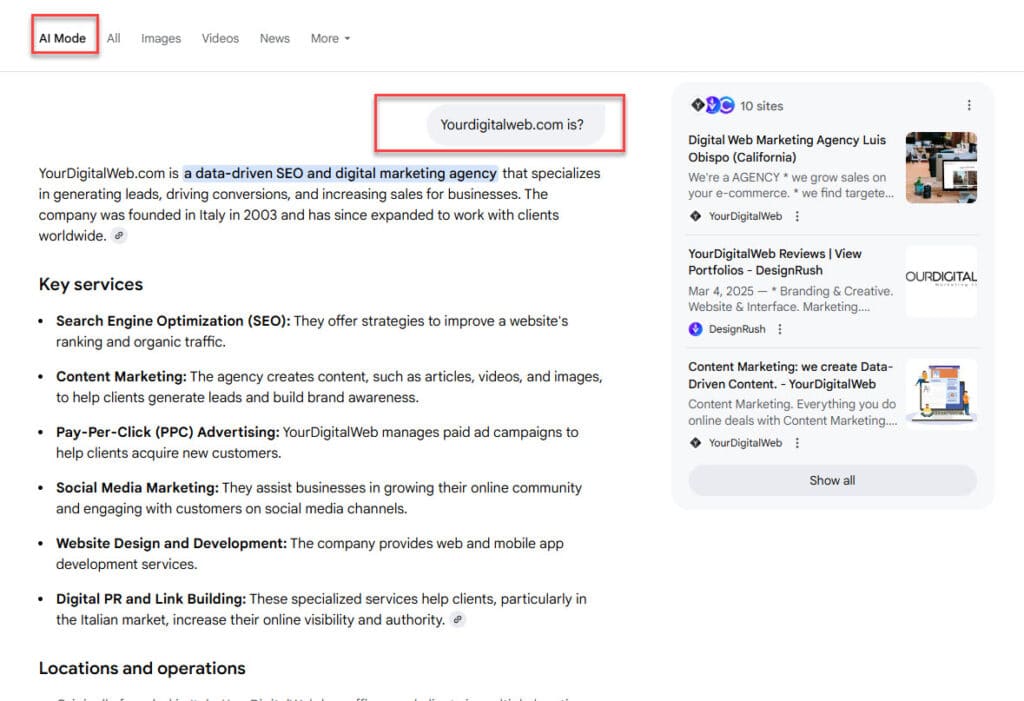
AI Mode is Google’s AI-powered search mode, designed to answer complex, detailed questions in a single step, so users don’t have to run many separate searches.
-
It uses advanced language models (a customized version of Gemini 2.5) to understand nuances, contexts and implicit meanings in questions.
-
It uses a technique called query fan-out, which breaks the initial question into sub-questions, runs parallel searches across various sources, then synthesizes the results and builds a coherent, detailed answer.
-
It also works with multimodal input: not just text, but also voice, photos or images uploaded by the user.
-
It can handle follow-ups: the user can ask further questions that stay “linked” to the initial context, without repeating everything.
-
Some advanced features (such as restaurant reservations, bookings, personalized options) are already being tested or rolled out to selected users.
The advantages
-
-
For users: richer, more precise answers, even to complex questions that previously required several searches or more time.
-
Greater ability to handle long, detailed requests: conversational, hypothetical, hyper-specific questions.
-
Multimodal support: not just text, but also visual content if provided as input.
-
Potential growth in search volume: Google says many questions now being asked hadn’t been asked before, or not in that way. This means AI Mode can surface new information needs.
-
Issues and concerns
-
-
Some publishers report organic traffic losses of up to 70 % for certain types of content, when users get “direct” answers without clicking on external links.
-
The question of who is responsible for errors in AI answers: the line between generated content, even if based on real sources, and original content isn’t always clear.
-
The copyright problem: how much of the value generated by AI comes from pre-existing content produced by authors, journalists and bloggers? And to what extent will these authors be compensated or credited?
-
The risk that the “free web” and the plurality of sources are weakened if a few players (like Google) become the single point of answers.
-
Regulation may step in (in Europe it’s already evolving) with requirements on transparency, accountability, use of training data, etc.
-
Expected impacts for different “players” in the web ecosystem
| Player | Possible effects | How to react / adapt |
|---|---|---|
| Informational sites and news outlets | Potential drop in clicks; reduced visibility; risk of losing ad revenue | Diversify monetization (subscriptions, direct sponsorships, unique content, in-depth pieces only site visitors can access). Focus on niches and quality; use formats that drive engagement. |
| Blogs, tutorials, guides, practical content | Some generic content could be “replaced” by the summary; very original or specialist content less so | Create distinctive, in-depth, authoritative content; update it regularly; encourage interaction (comments, community). More careful SEO: structure information so engines, including AI, recognize it as a valuable source. |
| End users | Better efficiency, more immediate answers; less need to scroll through many results | Always check the original sources; don’t treat generated answers as final in critical cases (medical, legal, financial, etc.). Use AI as a starting point, not an end point. |
| Advertisers / marketers | New opportunities tied to longer, more conversational search intents; but “AI-native” ad experiences may not be available everywhere right away | Monitor changes in search behavior; adapt campaigns to longer queries and broader intents; be ready for some forms of advertising to move inside AI experiences. |
| Regulators and lawmakers | Need to update rules on transparency, accountability, data use and competition | Monitoring, quality standards regulations, ethics guidelines, possible compensation obligations for sources, transparency obligations on how AI selects and uses information. |
Our view
The launch of AI Mode is a crucial, inevitable stage in the evolution of the search engine toward something more powerful, more conversational and more digitally intelligent.
But precisely for this reason, it becomes essential that not all informational value stays locked inside the “Google box”. If AI is an intermediary, fine; if instead it becomes the exclusive or “final” filter, we risk losing diversity, independence and control over information.
I believe coexistence between AI and the “traditional” web will be possible, but it will depend a lot on:
-
transparency about how AI composes answers, which sources it uses and how much (and how) it presents them
-
ways of compensating or recognizing the value created by original authors/publishers
-
educating users to use generated answers correctly (not as absolute truth, but as a starting point)
How to prepare: YourDigitalWeb’s operational checklist
-
-
Analysis of current queries
-
Identify long, complex and conversational queries that bring traffic.
-
Study the variants: natural synonyms, different ways of asking the same thing.
-
-
Creating “AI-friendly” content
-
Logical structure: title → introduction → effective subheadings → clear paragraphs.
-
Include Q&A sections, FAQs, step-by-step explanations, definitions and use cases.
-
Use multimedia elements (images, infographics, tables, embedded videos) with useful descriptions/captions.
-
Optimize load times, mobile usability, accessibility, and meta titles and descriptions that reflect user intent.
-
-
Structured data and markup
-
Schema.org where useful (FAQ, how-to, articles, products, reviews, etc.).
-
Semantic annotations that help AI “understand” the content.
-
Check that content isn’t fragmented and is topically consistent.
-
-
Monitoring and metrics
-
Keep an eye on changes in organic traffic, but not just the number of clicks: also assess time on site, conversions and interactions.
-
Test long queries or full sentences to understand how users really search.
-
Check whether you appear in generated answers (search for your brand/content as a cited source).
-
-
Strategic adaptation
-
Balance generic informational content with differentiated, high-value content (exclusivity, originality, depth, case studies, opinions, unique data).
-
Work with your audience: comments, feedback, regular updates, engagement.
-
Consider advanced or third-party analytics tools if needed, to understand visibility in AI searches.
-
-
Keep up with the change: do you want to appear in AI results?
YourDigitalWeb.com can support companies throughout the journey: from identifying the audience’s real questions, to designing structured content optimized for the new AI search modes, to monitoring actual interactions and how success metrics evolve.

Marco Maltraversi
CEO and founder of YourDigitalWeb
He founded YourDigitalWeb in 2009 and is an SEO and GEO consultant with a background in software engineering. He has written books on SEO and artificial intelligence, including “Generative SEO” (Edizioni LSWR), teaches in university programs and runs the DeepSEO training program. He has spoken at SMAU, Web Marketing Festival and Search Tech.
One click and, when you search for SEO, AI and marketing, our articles will show up more often in Google’s Top Stories.