Table of contents 10 sections
- From keyword to selectable answer
- Why generic content loses strength
- Information Gain: the technical value of original content
- Micro-intents: the page as a cluster of answers
- Answer Block: writing for users, crawlers and language models
- Entities: the brand must be recognizable as an information node
- Technical structure: HTML, headings and semantic data
- Lead Loop: measuring content beyond rankings
- The YourDigitalWeb method for AI-Driven SEO
- What the WMF 2026 slides cover
SEO isn’t being replaced by artificial intelligence: it’s becoming more selective, more contextual and more measurable.
As search engines, conversational assistants and answers generated by Large Language Models evolve, online content can no longer just “cover a keyword.” It has to be designed to be understood, verified, extracted and linked to a precise user intent. For an SMB this shift is decisive. Smaller companies don’t compete by copying big portals or producing generic pages at scale. They compete when they turn their real experience into structured content, original data, verifiable proof and measurable conversion paths. This is the topic Marco Maltraversi, CEO of YourDigitalWeb, addressed in his talk “AI-Driven SEO: how SMBs can compete and win online” at WMF 2026.
Download the slides from the WMF 2026 talk
From keyword to selectable answer
For years, many SEO strategies were built around a linear logic: find a keyword, produce content, optimize the title and meta description, get rankings. Today this approach is incomplete.
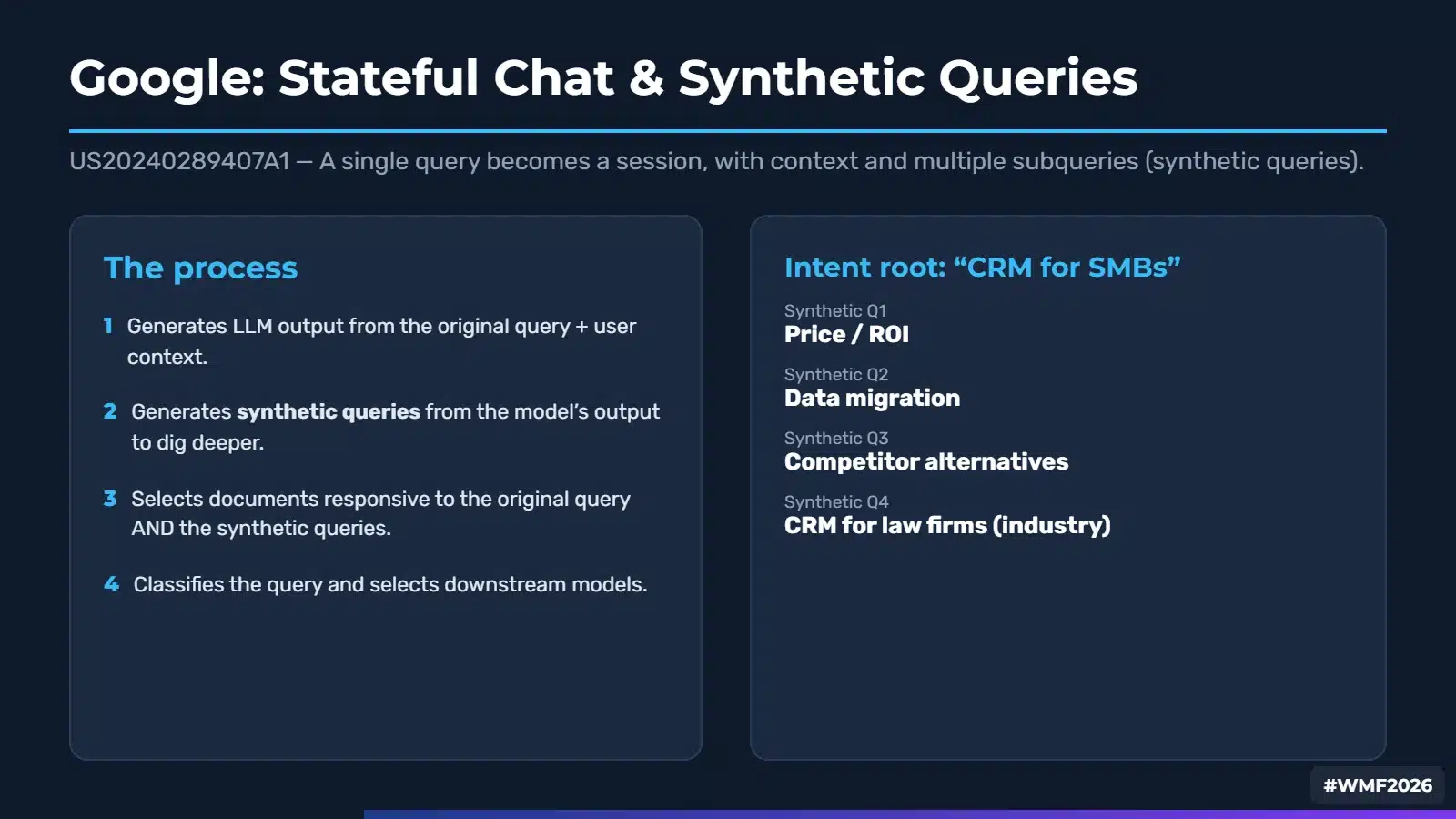
Queries have changed. Users don’t just search for “SEO service,” “marketing agency” or “management software.” They ask more detailed questions, compare options, ask about costs, limits, alternatives, timelines, use cases and decision criteria. Search becomes conversational. The engine doesn’t just assess whether a keyword is present: it tries to understand whether a page contains useful passages that fit the context and are self-contained enough to be summarized. That’s why an effective page must be designed as a sequence of technical answers, not as a simple descriptive text.
Why generic content loses strength
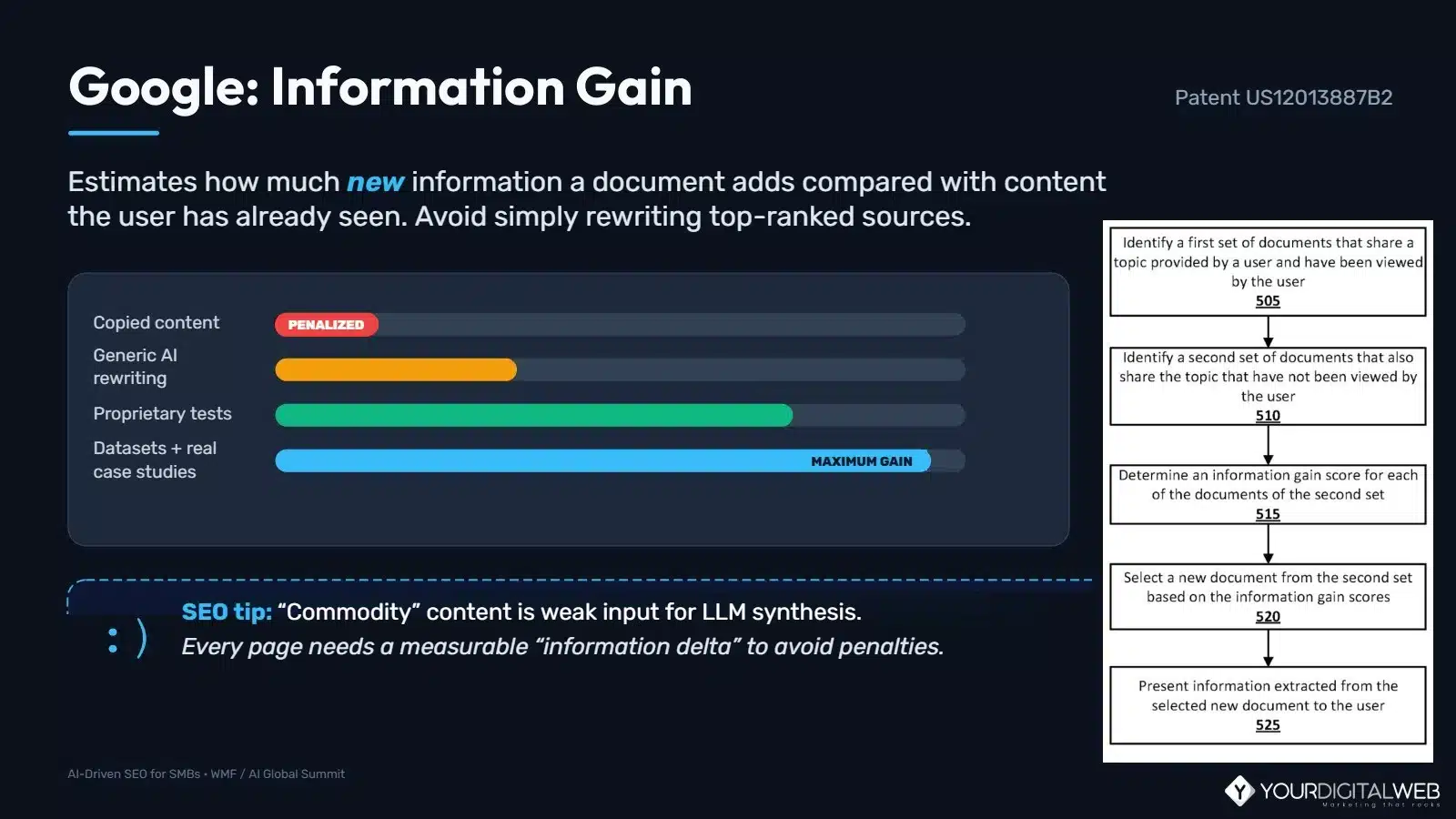
One of the most common problems on company websites is interchangeable content. Copy that talks about “quality,” “professionalism,” “tailored solutions” and an “expert team,” but with no data, examples, operational differences or verifiable proof. In generative search, this content becomes weak because it adds no new information. It’s easy to summarize but hard to cite as a useful source. A truly competitive page must instead contain elements that set the company apart:
- data collected first-hand;
- project experience;
- documented processes;
- real cases;
- proprietary images, tests, measurements or examples;
- decision criteria useful to the user;
- updates tied to the market or the operating context.
This is where SEO meets strategic consulting: writing better isn’t enough. You need to know what information to draw out of the company and how to turn it into useful content for people, crawlers and generative systems.
Information Gain: the technical value of original content
A central concept in AI-Driven SEO isinformation gainthe incremental value a page adds compared with what is already online. In practice, a page that repeats concepts competitors have already published has little informational potential. A page that introduces proprietary data, comparisons, observations, tests or processes sends a stronger signal.
This doesn’t mean publishing all of the company’s know-how. It means selecting the right information, organizing it readably and making it clear enough for engines to interpret. For example, an SMB selling technical products can simply describe features already listed in suppliers’ catalogs. Or it can build a page with in-house measurements, customers’ recurring problems, comparison tables, usage notes and selection criteria. In the second case the content becomes an asset. YourDigitalWeb works exactly at this level: identifying the company’s real information assets and turning them into SEO architecture, without reducing them to simple generated text.
Micro-intents: the page as a cluster of answers
A traditional SEO page often tries to cover a broad topic. A page designed for generative search must instead capture a network of micro-intents. A micro-intent is a specific question that arises within the user’s decision journey. It can concern price, comparison with an alternative, fit with a need, implementation time, a solution’s limits or the expected return. Each micro-intent should have its own section, with a clear heading and an immediate answer. You don’t necessarily need to reveal every operational detail, but you must give readers enough context to see there’s a method behind it. The most effective structure follows a simple logic:
| Element | SEO function |
|---|---|
| Specific question | Aligns the section with the user’s real need |
| Short answer | Makes the passage extractable and understandable |
| Proof or data | Increases credibility and differentiation |
| Controlled deep dive | Shows expertise without losing focus |
| Next step | Connects the content to conversion |
Answer Block: writing for users, crawlers and language models
An Answer Block is a self-contained section, readable even outside the rest of the page, built to answer a precise question. It’s a useful technique because engines don’t only analyze the document as a whole. They also assess passages, headings, context, semantic consistency and whether a piece of text can work as a standalone answer. An effective block doesn’t start from a generic heading like “Information” or “Details.” It starts from a natural query:
- how much does an SEO project cost for an SMB?
- when does it make sense to use AI in content production?
- what data do you need to make a page more authoritative?
- how can you tell whether an SEO strategy generates real leads?
The answer must be concise, technical and verifiable. Operational detail can be measured out: enough to demonstrate expertise, without turning the content into a complete checklist anyone could replicate.
Entities: the brand must be recognizable as an information node
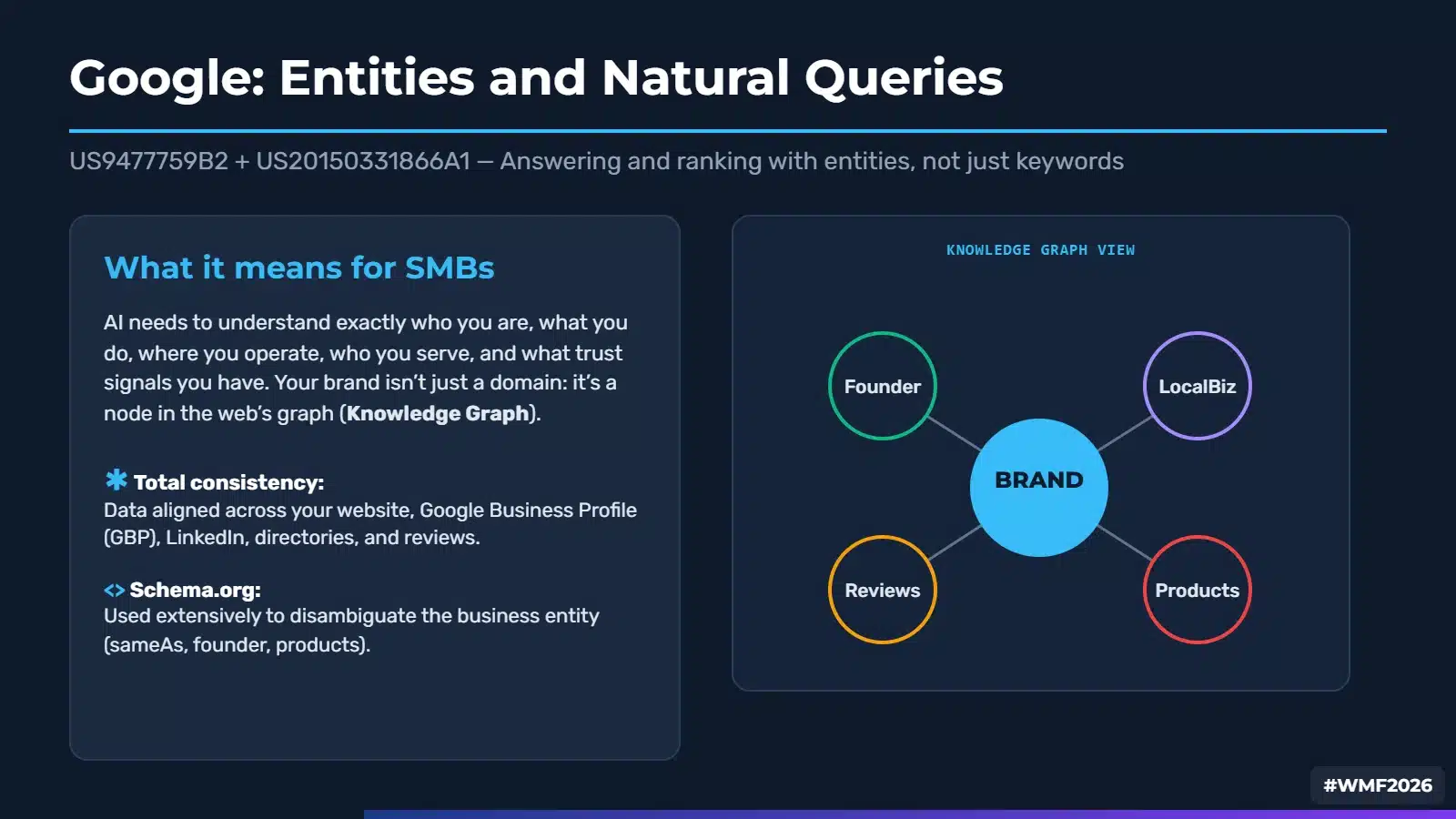
Modern SEO isn’t just about pages and keywords. It’s also about the company’s digital identity. Search systems need to understand who the brand is, what it offers, where it operates, which people it’s connected to, which official profiles represent it and which external signals confirm its reliability. This means working on consistency across the website, Google Business Profile, LinkedIn, directories, reviews, structured data and corporate pages. An inconsistent brand creates ambiguity. A well-structured entity, on the other hand, makes the engines’ job easier: it reduces confusion, strengthens the link between sources and makes the company’s scope of expertise clearer. SMBs often underestimate this, but it becomes important especially when competition shifts from simple visibility to semantic recognizability.
Technical structure: HTML, headings and semantic data
Content quality isn’t enough if the page is badly built. A correct HTML structure helps crawlers and language models interpret the relationships between sections, headings, tables, images, captions and calls to action. Headings must describe the real content of the section. Tables must be native, not simulated graphically. Images must have consistent alt text. Structured data should disambiguate the entity, not fill the page with useless code. In an AI-Driven SEO strategy, the page is designed as a technical document:
- an H1 consistent with the main topic;
- H2s tied to micro-intents;
- H3s used to specify subtopics;
- HTML tables for comparable data;
- FAQs only when they answer real questions;
- schema markup consistent with entities, services and content;
- internal links to genuinely useful resources.
The difference isn’t aesthetic. It’s interpretive.
Lead Loop: measuring content beyond rankings
AI-oriented SEO can’t be judged only by average position or organic traffic. You need a measurement system that connects content, micro-intents and conversions. This approach shows which sections generate qualified contacts, which pages produce sales inquiries and which topics really influence the decision journey. Rankings remain important, but they’re not the only indicator. For an SMB, these also matter:
- quote requests;
- tracked phone calls;
- downloads of materials;
- qualified form sign-ups;
- interactions with specific sections of the page;
- conversions assisted by informational content.
Content thus becomes part of the sales system. It doesn’t just bring visits; it produces measurable signals along the acquisition journey.
The YourDigitalWeb method for AI-Driven SEO
The most common mistake is thinking that using an AI tool is enough to get a modern SEO strategy. Tools speed up production, but they don’t replace analysis. Without a method, the risk is creating copy similar to what’s already online: correct in form but weak in information. The technical work starts before writing:
- analysis of intents and natural queries;
- mapping of existing content;
- identifying information gaps;
- gathering data, proof and proprietary assets;
- designing the semantic structure;
- technical page optimization;
- measuring behavior and conversions;
- continuous updates based on the data collected.
This is where YourDigitalWeb adds value: not in simply producing copy, but in building an SEO system that can talk to search engines, generative systems and real users.
What the WMF 2026 slides cover
The slides from the talk present the technical framework behind AI-Driven SEO for SMBs, focusing on content architecture, information signals, passage structure, entities, measurement and adapting to new search scenarios. The material isn’t meant as a generic SEO guide. It’s a technical outline for understanding how the logic of selecting, summarizing and evaluating content changes when AI-based systems come into play. Download the slides to explore the method and see the full structure of the talk:
Download the AI-Driven SEO for SMBs slides

Marco Maltraversi
CEO and founder of YourDigitalWeb
He founded YourDigitalWeb in 2009 and is an SEO and GEO consultant with a background in software engineering. He has written books on SEO and artificial intelligence, including “Generative SEO” (Edizioni LSWR), teaches in university programs and runs the DeepSEO training program. He has spoken at SMAU, Web Marketing Festival and Search Tech.
One click and, when you search for SEO, AI and marketing, our articles will show up more often in Google’s Top Stories.