Table of contents 13 sections
- Classic SEO vs SEO with AI: the key differences
- How search engines with generative AI work (RAG)
- “AI-friendly” content: optimizing copy and pages for LLMs
- Markup and structured data: speaking the language of machines
- AI-based SEO tools: the SEO specialist’s new arsenal
- Visibility and SEO strategy in the AI era: practical tips
- GEO (Generative Engine Optimization)
- Why GEO isn’t really that different from SEO
- The pillars of Generative Engine Optimization
- GEO metrics: measuring success
- GEO and SEO: complementary strategies, not alternatives
- Getting started with GEO: first concrete steps
- Want to bring your brand into AI answers?
Search engines are entering a new era dominated by generative artificial intelligence. Google has introduced AI Overviews and AI Mode, AI search modes that answer users’ questions directly, while Microsoft integrates Copilot into Bing. Emerging AI-native engines like Perplexity.ai and LLM tools like ChatGPT are radically changing the way we find and consume information online. As a result, Search Engine Optimization has to evolve: it’s no longer enough to aim for the “10 blue links” on the first page, you need to optimize content so it’s understood and used by AI algorithms in their answers. Users get information immediately in the SERP, often without clicking any external result (the zero-clickphenomenon). YourDigitalWeb, always attentive to these developments, has already integrated AI-ready strategies to ensure maximum visibility for its clients in this new ecosystem too.
Classic SEO vs SEO with AI: the key differences
The arrival of large language models (LLMs) in search engines has brought deep changes to how search works and, as a result, to which SEO tactics are effective. The following table briefly compares the elements of traditional SEO with those of SEO in the AI era:
| Aspect | Traditional SEO (deterministic) | SEO with AI (LLM) (probabilistic) |
|---|---|---|
| User query | A single query, often short and keyword-based. | Longer, conversationalqueries; the AI picks up on nuances and generates implicit sub-questions. |
| Information retrieval | The engine searches whole pages with keyword matching; index based on tokens and links. | The engine searches specific text passages (paragraphs) using semantic similarity (vector embeddings). |
| Result ranking | A fixed ranking of results (Top 10) determined by static algorithms (e.g. PageRank, BM25), the same for all users. | Dynamic, personalized ranking: the LLM evaluates content iteratively (pairwise comparisons) and the result can vary by user and context. |
| Output in the SERP | A list of existing snippets/text (rich snippets, meta descriptions) with links to the website. | An answer synthesized by AI that combines information from multiple sources, presented in natural language directly in the SERP (with citations/links to sources). |
| User interaction | Users have to click on results to get complete information. | Users get an immediate answer; clicks to the website only happen to dig deeper (more quality than quantity of traffic). |
| SEO strategies | On-page optimization (title, H1, keyword density), link building, user experience and known signals. | Optimizing content for relevance and clarity for AI: semantic structure, structured data, E-E-A-T authority and complete coverage of a query’s subtopics. |
In other words, old SEO aimed to convince a relatively predictable, static algorithm, while AI SEO has to win over an artificial intelligence that “reads” and summarizes the web for the user. The organic result is no longer a simple numerical position, but the chance to become part of a generated answer. This requires content that’s more structured, complete and easy to interpret by machines.
How search engines with generative AI work (RAG)
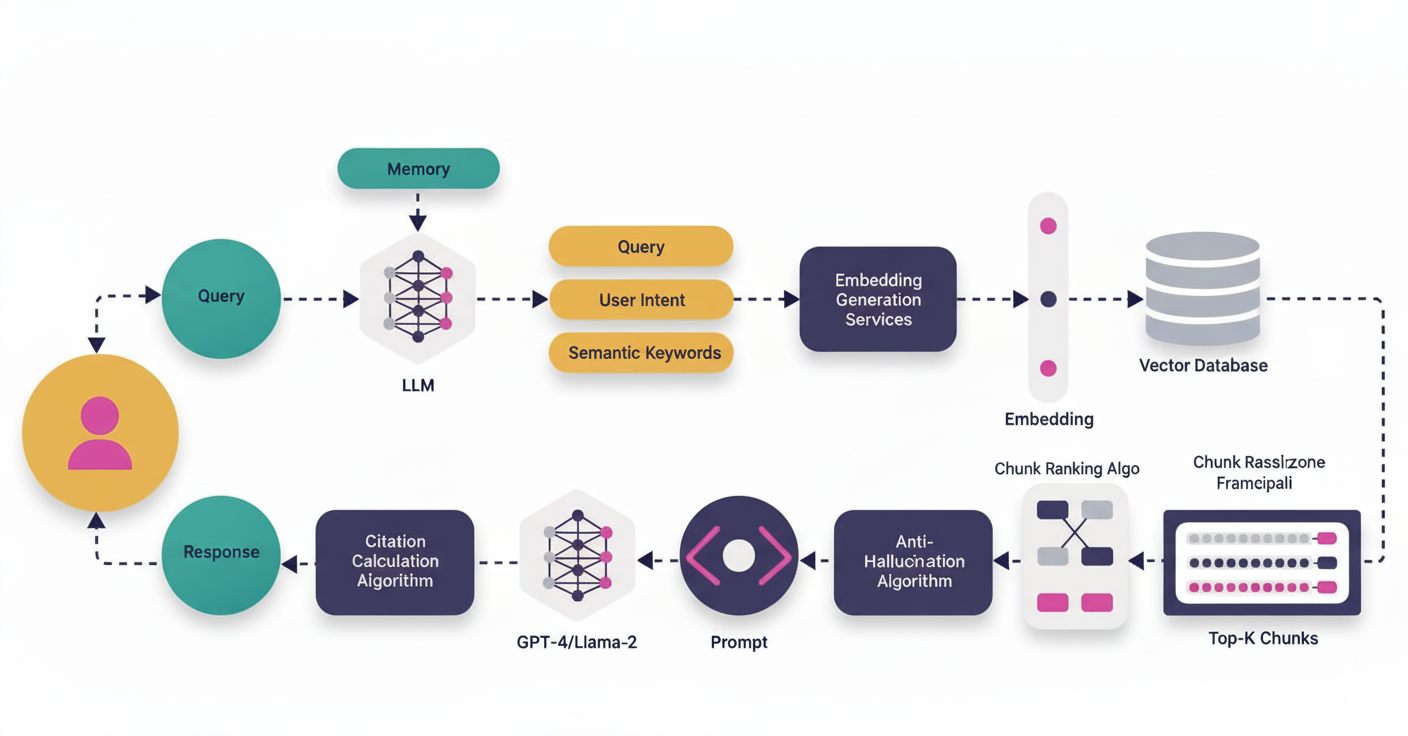
To adapt your SEO strategy, it helps to understand broadly how an LLM-based search engine processes queries and generates answers. Google AI Overviews (or AI Mode) introduces an advanced search pipeline, often described as Retrieval-Augmented Generation (RAG), which combines information retrieval and language generation. Here are the main steps, simplified:
-
Query understanding and expansion – When a user asks a complex question, the AI doesn’t treat it as a single query. It applies a query fan-out: the initial question is silently split into multiple related sub-questions. Some of these derived queries are explicit (obvious subtopics), others implicit or predictive, designed to anticipate details the user might want to know. For example, for the query “is Bryce Canyon or Arches National Park better for a family with young kids and a dog?”, the AI engine breaks it down into various questions: data on Bryce Canyon, on Arches, family comparisons, dog-friendly trails, and so on. This broadens the search intent by exploring every facet of the request.
-
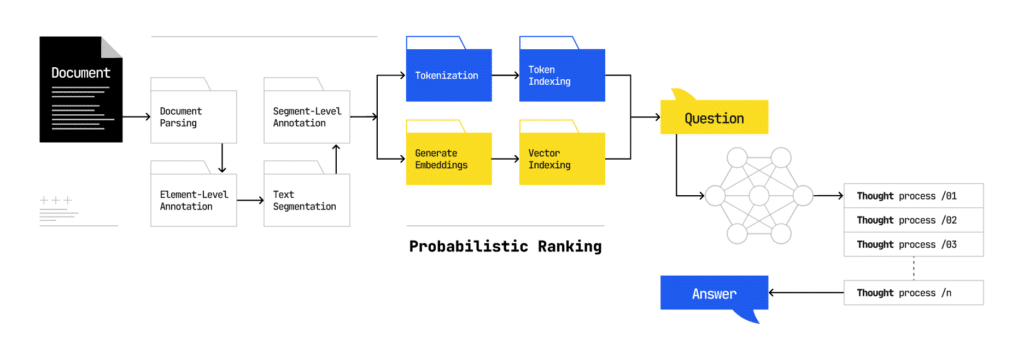
Parallel search for relevant passages – For each generated sub-question, the engine runs searches in parallel across the web (well beyond the traditional 10 results). In this phase the system performs a deep search: l’: Google’s index is searched in depth to find specific text passages (not just whole pages) relevant to each sub-question. Every web document has previously been split into chunks (passages, paragraphs) and turned into numerical vector embeddings . The search works by comparing similarity between vectors: passages semantically close to the query are retrieved even without an exact keyword match. In practice the engine works at the sentence/paragraph level, going beyond lexical matching thanks to dense retrieval. This makes it possible to pull specific information (e.g. a definition, a statistic, a specific description) even from pages that aren’t necessarily at the top of classic results.
-
Ranking with language models – Once an extensive collection of candidate passages (from different sources) has been gathered, the LLM comes in to decide which information to use and in what order. Instead of assigning static scores to documents, the AI makes iterative comparisons between pairs of passages (pairwise comparisons) to assess which ones best answer the user’s query. This method, also described in recent Google patents, leads to AI-driven “probabilistic” ranking: there’s no longer a fixed position, but a selection of relevant fragments based on the model’s comparative judgment. The system evaluates, for example, “given the question, which of these two texts gives a more complete and accurate answer?” repeated across many combinations, until an optimal set of information to use emerges. This approach introduces an element of “reasoning” into ranking: relevance is no longer a deterministic formula, but the result of the AI’s decision-making process.
- Simplified example – the traditional search pipeline (deterministic): the classic index returns an ordered list of results based on static factors (keywords, links, algorithmic rank). Users see titles/descriptions as provided by the website and choose which link to open.
Simplified example – the new pipeline AI (probabilistic): the query is expanded into sub-questions; the AI engine retrieves multiple relevant passages and evaluates them with an LLM through iterative comparisons, also taking user context into account. The final output for the user is an answer generated by AI that combines the selected content (with any source citations).
-
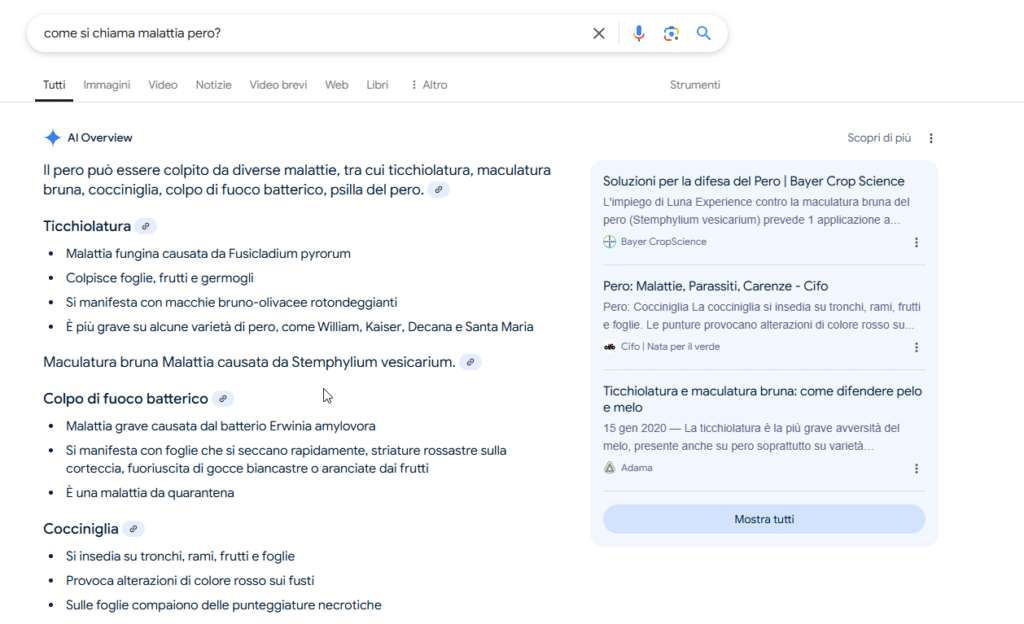
Synthesis and answer generation – Finally, the LLM composes the final answer in natural language. It’s not about quoting a single document verbatim, but about synthesizing and paraphrasing information from various selected passages. The AI reorganizes contributions from different sources into a coherent discourse, often enriching it with connectives and additional explanations to give the user the most complete answer possible. In the case of Google AI Overviews, the generated answer also shows numbered references (citations) linked to the original sources: by clicking, users can expand the view and see exactly which websites were used for each part of the answer.
Example of a generative answer on Google: for the complex query about two national parks, the AI produces a snapshot with the comparison, integrating key data from several sources. On the right are links (with thumbnails) to three cited sources, while the “claw” icon at the top lets you expand and see the references for each sentence.
-
Personalization and dynamic results – An innovative aspect of AI search isadaptation to the user’s profile. Google, for example, uses user embeddingmodels: it builds a vector representation of each user’s interests and context based on search history, clicks, location and so on. This means the AI answer can be personalized. Two people asking the same question might see variations in the answer if the system “knows” (from their embedding) that they have different needs or preferences. For example, a user with a history of technical searches might get a more in-depth answer with specialist sources, while a beginner gets a more introductory one. The SERP becomes dynamic and tailored to the user, definitively breaking the concept of “same for everyone” ranking.
In short, AI turns web search into a smarter, more structuredprocess: instead of simply showing results as they are, the engine now understands the question, retrieves the relevant pieces of knowledge, decides which matter most and answers naturally. For SEOs, this means content must be structured and of high enough quality to get into that AI processing flow. So let’s look at how to adapt strategies accordingly.
“AI-friendly” content: optimizing copy and pages for LLMs
In the age of AI search, optimizing content takes on new meanings. It’s not enough for a web page to be relevant as a whole; it’s essential that every section or paragraph within it is clear, complete and useful even when read in isolation. That’s because LLMs will compare specific passages across different websites and pick the ones that best answer the query’s various subtopics.
Some key points to make content AI-ready:
-
Structure in semantic blocks: organize articles with a logical breakdown into self-contained sections and paragraphs. Each paragraph should express a complete idea (topic sentence + details) so that, if extracted, it stands on its own. For example, in a guide to “10 tips to save energy”, make sure each tip is developed with concrete details: if a competitor offers data or practical examples and we don’t, the competing fragment will be preferred by the AI.
-
Completeness and depth: cover the topic from every angle. Ask yourself: what sub-questions could a query on this topic generate? Have we answered them all? It’s useful to run a content gap analysis to identify missing related topics. Content that leaves out key aspects risks being discarded by the AI in favor of more complete content. Better a long but thorough article than lots of superficial posts: AI mode rewards one-stop content that offers all the information needed.
-
Clarity and precision: write clearly and without ambiguity. An advanced LLM tends to penalize redundant or confusing text. Avoid fluff and roundabout phrasing: direct sentences, correct terminology and verifiable data. Less is more: fewer words but more substance. Using specific terms (technical ones too, where needed) also helpsvector alignment: your text’s embeddings will be more relevant to queries on the topic than vague or generic language.
-
E-E-A-T and originality: AI models are trained to recognize signals of authority and trustworthiness. Including unique perspectives, original data, first-hand experience in content makes it more attractive to AI. For example, including a proprietary study, a concrete case study or expert opinions (first-hand experience) will make your article stand out from 10 pages repeating the same things found everywhere. “Commodity” content (generic, copied from other sources) will have less chance of being chosen as a source by artificial intelligence. Investing in quality and uniqueness is therefore a competitive advantage.
-
Winning passages: ultimately, we need to see our role as that of “relevance engineers”. Every paragraph is a potential “candidate” in AI ranking: let’s polish it so it can win a head-to-head comparison with the equivalent paragraphs on other websites. That means adding concrete examples, statistics and clear definitions where appropriate. For example, if we’re explaining what an LLM is, including a short example or a metaphor can make it clearer than other definitions found online, increasing the chance that the AI picks our explanation.
By implementing these measures, our website becomes a valuable resource that AI will be more inclined to select. At YourDigitalWeb we already take this “AI-first” approach to content: every line of copy must add value and be able to serve as a precise answer to a specific question. The goal is no longer just to climb the SERP, but to get cited by AI in its answers, reaching users even when they don’t click directly on the results.
Markup and structured data: speaking the language of machines
An often underrated ally, but now essential, is theuse of structured data and semantic markup. Integrating Schema.org (via JSON-LD or microdata) into the page code helps engines better understand the content and extract information more precisely. In the AI era, this can make the difference between information on your website being lost in a paragraph or correctly picked up by the LLM.
Practical examples of markup useful for AI:
-
FAQPage: providing frequently asked questions with their answers, encoded in JSON-LD, helps both to get classic rich snippets and to give AI structured Q&A. An LLM looking for concise answers to specific questions will find formatted FAQs an ideal source to cite.
-
HowTo and tutorials: using the HowTo schema for step-by-step guides (recipes, technical procedures, etc.) lets Google show steps directly in the SERP and, from an AI perspective, lets the model easily extract a well-defined sequence of instructions.
-
Product, Review, LocalBusiness: including markup for products (prices, specs, availability), reviews (rating, author) or local businesses (address, hours) increases the AI’s trust in the data provided. For example, in a generative answer on “best smartphone under $300”, the AI could use structured data on prices and ratings to support its recommendations.
-
Tables and custom schemas: sometimes there’s no schema.org type for what you want to structure. In these cases, manually creating well-formatted HTML tables (e.g. a comparison table with technical specs, numerical breakdowns, etc.) is still useful: AI can read tables and understand their structure (rows/columns as related entities). Information presented in a table is more likely to be extracted precisely than when it’s hidden in long discursive text.
Here’s a small example of JSON-LD markup for an FAQ page that we could include in a page’s HTML code:
<script type="application/ld+json"> { "@context": "https://schema.org", "@type": "FAQPage", "mainEntity": [{ "@type": "Question", "name": "What is an LLM (Large Language Model)?", "acceptedAnswer": { "@type": "Answer", "text": "A large language model is an artificial intelligence model able to process and generate human-like text, trained on huge amounts of data." } }, { "@type": "Question", "name": "What changes in SEO with Google’s AI search?", "acceptedAnswer": { "@type": "Answer", "text": "Google now uses AI to better understand queries and generate complete answers. For SEO it means optimizing content so it can be extracted as relevant passages and cited in generated answers." } }] }

script>
In the example above, two questions (“What is an LLM?” and “What changes in SEO with Google’s AI search?”) are encoded in JSON-LD format. This way search engines (and AI systems) can immediately recognize the question/answer structure and possibly use this information directly to answer users.
In general, speaking the language of machines through correct markup is a best practice that becomes even more crucial with AI. A generative model will be more inclined to “trust” data it can identify structurally and extract without ambiguity. At YourDigitalWeb we’ve updated our technical guidelines to always include appropriate markup in projects, making sure clients’ content is well labeled and ready to be picked up by AI (whether Google, Alexa, Bing Chat or other systems).
AI-based SEO tools: the SEO specialist’s new arsenal
Just as search engines evolve, so do the tools available to the SEO consultant which are expanding by integrating AI. Knowing how to use these new resources can give a significant advantage. Here are some categories of AI-driven tools that are revolutionizing SEO work (with examples):
| AI SEO tool category | Description and examples |
|---|---|
| AI content generation | Tools that use LLMs to create optimized copy. Examples: GPT-based generators for articles, product descriptions or meta tags (e.g. Jasper.ai, Copy.ai). They produce quality drafts, speeding up content creation, to be refined afterward with human review and E-E-A-T. |
| Smart on-page optimization | Tools that analyze content and suggest improvements using NLP. Examples: Surfer SEO, Semrush Writing Assistant with AI. These tools compare your text with top-ranking pages and show whether relevant terms are missing, whether readability is adequate, the optimal length, etc., also taking into account semantic similarity. |
| Keyword and intent research with AI | Platforms that cluster keywords and search intent using machine learning algorithms. Examples: AnswerThePublic (user questions), Semrush Topic Research, or using ChatGPT directly to brainstorm related queries. AI helps uncover conversational long-tail queries and hidden questions users might ask (useful for anticipating the sub-questions of Google’s fan-out). |
| AI technical analysis and SEO audits | Experimental tools that use artificial intelligence to diagnose SEO problems or generate reports. For example, some AI crawlers can automatically prioritize the most impactful issues, or explain in natural language how to fix a configuration error. Google Search Console is evolving too: it’s expected to offer AI insights in the future (e.g. explanations of traffic drops) by analyzing the website’s data. |
| AI results monitoring | Emerging tools to track your content’s presence in AI answers. Since Google currently doesn’t clearly separate AI Overviews/AI Mode data in reporting, some third-party solutions are emerging to find out whether a website is cited by AI overviews. For example, there’s talk of AI SERP simulators or accounts with different histories to test AI visibility (as mentioned earlier). This is still a new area: in the coming months and years we’ll certainly see SEO suites add dashboards dedicated to performance inside AI results (a bit like how trackers for featured snippets emerged). |
It should be stressed that AI tools don’t replace the SEO’s strategic work, they boost its capabilities: they automate repetitive tasks, offer predictive analysis on data and help extract complex patterns. YourDigitalWeb, for example, already uses AI models internally to analyze large volumes of queries and content, so we can define data-driven strategies faster. We’re also experimenting with AI agents (autonomous agents) for specific SEO tasks, like periodically updating meta descriptions or generating custom reports for clients. Staying up to date on these tools means being able to offer cutting-edge solutions and not being caught unprepared by change.
Visibility and SEO strategy in the AI era: practical tips
At this point it’s clear that the arrival of AI in search represents a paradigm shift. In practice, how can we adapt our SEO strategy to keep getting results? Here are some key tips to keep in mind:
-
Aim for citations in AI answers: In a scenario where zero-click traffic is growing, it’s vital to appear in AI answers anyway. That means becoming an authoritative source the algorithm chooses to cite. Work on quality content, markup and reputation so that, when AI pulls information on your topic, it also includes your website (perhaps mentioning the brand). Even if the user doesn’t click right away, seeing your name increases brand awareness and trust.
-
Monitor your AI presence (as far as possible): Even without official tools, you can run manual tests. Try the new search modes (AI Overviews, Bing Chat) with queries relevant to your industry and see whether and which parts of your content appear. Create different user profiles (clean history vs logged in with certain preferences) to understand how personalization affects your visibility. This investigative work will give you insights into which content is working in the AI ecosystem and which isn’t.
-
Cover all subtopics (“cluster” thinking): Imagine the “galaxy” of questions around a main topic and make sure you have content for each one. If, for example, you offer cybersecurity services and want to be cited in AI queries about “corporate data protection”, a generic article isn’t enough. You need content focused on all aspects: backups, encryption, GDPR regulations, employee training, and so on. A well-structured topic cluster approach increases the chance that at least one of your passages matches what the AI is looking for.
-
Work on brand and multichannel engagement: AI personalization means that the more a user knows and interacts with your brand, the more likely their AI will show you in its answers. So investing in brand marketing has never been so important for SEO too! Build community, newsletters, social engagement: if users search for your brand directly or interact with it elsewhere, that information could be reflected in the user profile Google uses. In practice, being in the user’s mind and preferences increases your chances of being in their personalized AI results.
-
Rethink your success metrics: Get ready to use new KPIs beyond classic organic traffic. For example, the rate of presence in AI answers (how often your website is cited by overviews) could become a metric to track, as could the sentiment of answers (whether the brand is presented positively). Even the concept of average SERP position loses meaning if every user gets a different result. A change of mindset will be needed: focusing more on overall visibility and authority than on raw rankings for individual keywords.
-
Close collaboration between content and SEO: Content marketing and SEO teams need to work even more closely. Content creators need to be taught to adopt AI-friendlybest practices: including direct answers to possible questions right away, using descriptive headings that anticipate subtopics, providing context for data, and so on. This doesn’t mean writing for robots instead of users; on the contrary, it means anticipating users’ questions and answering them as well as possible, which both people and artificial intelligence will appreciate.
-
Ethics and quality first: Forget low-level SEO shortcuts and tricks: keyword stuffing, unnatural link schemes, content pushed only for rankings. An advanced LLM can understand when a text is inflated with keywords without substance, or when a website has many near-duplicate pages. Manipulative strategies risk doing more harm than good, even “teaching” the model to ignore or penalize your brand. Transparency and quality pay off: it’s better to spend resources genuinely improving your product/service and presenting it competently (the model will recognize it in user feedback and genuine links).
-
GEO (Generative Engine Optimization)
While traditional SEO focuses on optimizing for classic search engines like Google Search, GEO (Generative Engine Optimization) represents the necessary evolution to stand out in generative search engines and AI assistants like ChatGPT, Google Gemini, Perplexity, Claude and Bing Copilot. These systems don’t just show a list of blue links, they generate complete, original answers by synthesizing information from multiple web sources. GEO is therefore the set of strategies and techniques aimed at maximizing the likelihood that your content is selected, cited and used by artificial intelligence in its answers to users.
Why GEO isn’t really that different from SEO
The fundamental difference lies in the process of retrieving and presenting information. In classic SEO, the goal is to rank among the top 10 organic results on a SERP; in GEO, the goal is to become one of the sources the AI chooses to compose its generated answer. This means that:
- There’s no longer a “fixed position”: AI answers are dynamic and personalized for each user, varying based on context, history and individual preferences.
- Content gets fragmented: AI doesn’t evaluate whole web pages, but extracts and compares individual passages (paragraphs, sentences) to decide which are most relevant and reliable.
- A citation is worth more than a click: even if the user doesn’t visit your website directly, being mentioned as an authoritative source by AI greatly increases brand awareness and credibility.
- Relevance is semantic, not lexical: LLM algorithms use vector embeddings and natural language understanding, rewarding clear, complete and conceptually relevant content over simple keyword matches.
The pillars of Generative Engine Optimization
To implement an effective GEO strategy, you need to work on four interconnected pillars:
1. Content structure and clarity
Generative models prefer well-structured content in which each section is self-contained and answers a specific sub-question. Organize articles with:
- Self-contained paragraphs that can be extracted individually while still making sense
- Descriptive headings (H2, H3) that clearly anticipate the section’s topic
- Direct answers to common questions, preferably at the start of paragraphs (topic sentence + detail)
- Precise definitions of technical terms or key concepts that AI can extract as informational snippets
2. Topical completeness and depth
LLMs run a “query fan-out” process, expanding the user’s question into multiple sub-questions. To be selected, your content needs to cover the topic from every angle:
- A topic cluster approach: create an ecosystem of interconnected content covering every aspect and facet of a topic
- Anticipate related questions: think about what the user might ask after the initial query and provide that information
- Data, examples and concrete cases: AI rewards content offering proof, verifiable statistics, first-hand experience and practical applications
- Continuous updates: keep content fresh with recent data, since AI tends to prefer up-to-date information
3. Authority and E-E-A-T signals
AI systems are trained to recognize and favor authoritative sources. Strengthen your signals of Experience, Expertise, Authoritativeness and Trustworthiness:
- Author bylines with detailed bios and verifiable credentials
- Citations of authoritative external sources (studies, research, institutions) that put your claims in context
- Originality: proprietary data, original research, in-house expert opinions that set your content apart from competitors
- Quality backlinks: inbound links from trusted domains signal to AI that you’re a trustworthy source
- Cross-platform presence: verified business profiles, mentions in industry publications, positive reviews
4. Semantic markup and structured data
Making content easy for machines to understand is crucial for GEO:
- Schema.org JSON-LD: implement markup for FAQPage, HowTo, Article, Product, Review, Organization
- Well-formatted HTML tables: for comparative data, technical specs, price lists (AI can interpret tabular structures)
- Ordered and bulleted lists: they make it easier to extract sequential or hierarchical information
- Annotated rich media: images with descriptive alt text, videos with transcripts, infographics with accessible text
GEO metrics: measuring success
Unlike traditional SEO, GEO metrics are still being defined, but some key indicators are emerging:
- Citation rate: how often your domain is cited in AI answers (measurable with manual tests on the main AI platforms)
- Snippet visibility: presence of your text passages in Google AI Overviews or in ChatGPT/Perplexity answers
- Contextualized impressions: how many times your brand/content appears in relevant AI-generated contexts
- Referral quality: when users click AI citations to learn more, do they show greater engagement? (time on page, conversions)
- Brand mentions not tied to branded queries: AI spontaneously mentions your brand even when the user didn’t explicitly search for it
GEO and SEO: complementary strategies, not alternatives
It’s essential to understand that GEO doesn’t replace traditional SEO, it complements and extends it. Established SEO techniques (site speed, mobile-friendliness, information architecture, link building) remain valid and necessary. GEO adds a further layer of optimization focused specifically on artificial intelligence’s retrieval and synthesis processes.
In practice, a winning strategy today includes:
- Solid technical SEO to be indexed correctly and offer an excellent user experience
- Advanced content SEO to answer queries with completeness and authority
- Strategic GEO to structure and present that content optimally for generative models
YourDigitalWeb integrates both approaches in its services, ensuring clients maximum visibility both in traditional results and in AI-generated answers. Whether it’s appearing in the “10 blue links” or being cited by ChatGPT, we work on both fronts with a data-driven method.
Getting started with GEO: first concrete steps
If you want to implement Generative Engine Optimization techniques right away, here’s an initial action plan:
- Audit of existing content: identify which pages/articles have the most potential to be cited (evergreen content, guides, definitions, tutorials)
- Restructure key paragraphs: rewrite important sections with a “question-answer” approach, making sure each block is clear and self-contained
- Implement structured markup: add FAQ, HowTo or Article schema to strategic pages
- Test AI visibility: try asking ChatGPT, Perplexity, Gemini and Google AI Overviews queries from your industry to see whether and how you’re cited
- Monitor and iterate: note which content gets citations, analyze why it works and replicate the formula on other pages
GEO is a fast-evolving field and first movers gain a significant competitive advantage. As more and more queries are answered directly by generative AI, being optimized for these systems will become as imperative as being on Google’s first page is today.
The integration of generative AI into search is an exciting challenge: it upends some old certainties of SEO, but it also opens opportunities for those who can adapt. Cutting-edge companies (like our own YourDigitalWeb) are already experimenting with and developing dedicated methodologies for this new scenario. As Google and other players keep refining their AI algorithms, we SEOs must do the same with our websites: make them AI-proof, without losing sight of the human experience. Let’s prepare for a future in which optimizing will mean working with artificial intelligence to give users the best possible answer, wherever it’s shown.
AI isn’t the end of SEO, it’s its most advanced evolution, and we’re ready to embrace it.
Want to bring your brand into AI answers?
If you want to understand how ChatGPT, Gemini, Perplexity and AI Overviews talk about your company today, you can start with theAI visibility audit or trust us with strategy and execution through our GEO consulting.

Marco Maltraversi
CEO and founder of YourDigitalWeb
He founded YourDigitalWeb in 2009 and is an SEO and GEO consultant with a background in software engineering. He has written books on SEO and artificial intelligence, including “Generative SEO” (Edizioni LSWR), teaches in university programs and runs the DeepSEO training program. He has spoken at SMAU, Web Marketing Festival and Search Tech.
One click and, when you search for SEO, AI and marketing, our articles will show up more often in Google’s Top Stories.